🐟 Chum Amount Calculator
Calculate exactly how much chum you need based on species, conditions, and session length
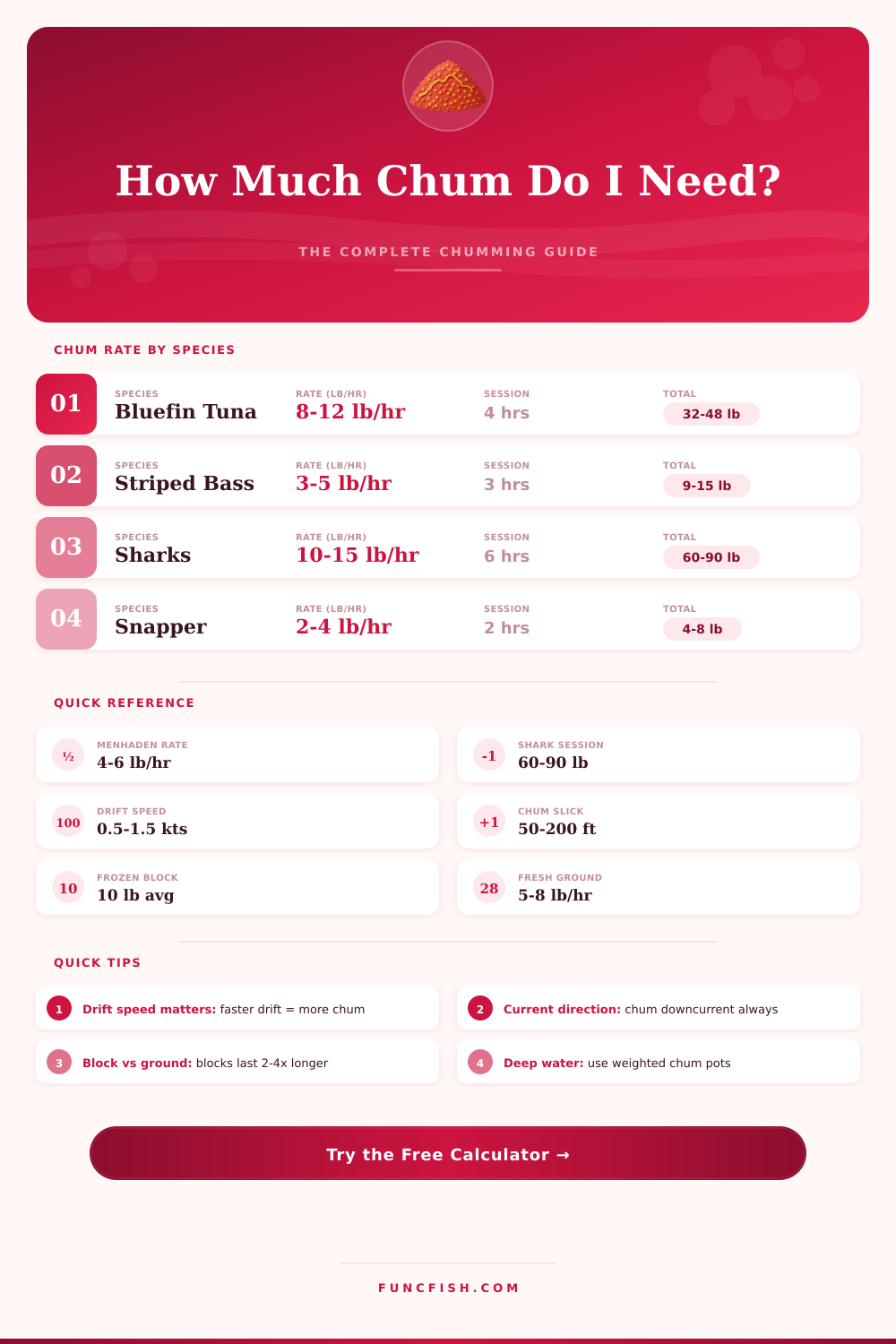
| Species | Chum Rate (lb/hr) | Chum Rate (kg/hr) | Best Chum Type | Typical Session |
|---|---|---|---|---|
| Bluefin Tuna | 8 – 12 | 3.6 – 5.4 | Ground Menhaden | 4 – 6 hrs |
| Yellowfin Tuna | 6 – 10 | 2.7 – 4.5 | Live Bait / Squid | 4 – 8 hrs |
| Striped Bass | 3 – 5 | 1.4 – 2.3 | Bunker Chunks | 2 – 4 hrs |
| Shark | 10 – 15 | 4.5 – 6.8 | Fish Oil Blend | 4 – 8 hrs |
| Red Snapper | 2 – 4 | 0.9 – 1.8 | Ground Shrimp | 2 – 3 hrs |
| Mahi-Mahi | 3 – 6 | 1.4 – 2.7 | Ground Squid | 2 – 4 hrs |
| Flounder | 1 – 2 | 0.45 – 0.9 | Ground Clam | 2 – 3 hrs |
| Cobia | 3 – 5 | 1.4 – 2.3 | Ground Menhaden | 2 – 4 hrs |
| Catfish | 1 – 3 | 0.45 – 1.4 | Chicken Liver | 2 – 5 hrs |
| Carp | 0.5 – 2 | 0.23 – 0.9 | Corn / Bread Mix | 3 – 6 hrs |
| Salmon | 2 – 4 | 0.9 – 1.8 | Ground Herring | 1 – 3 hrs |
| Chum Type | Base Rate (lb/hr) | Slick Effectiveness | Depth Range | Best For |
|---|---|---|---|---|
| Ground Menhaden | 4 – 6 | High | 0 – 200 ft | Tuna, Bass, Cobia |
| Bunker Chunks | 2 – 4 | Medium | 0 – 60 ft | Stripers, Bluefish |
| Ground Shrimp | 1 – 3 | Medium | 0 – 100 ft | Snapper, Flounder |
| Ground Squid | 2 – 4 | High | 0 – 300 ft | Mahi, Tuna |
| Fish Oil Blend | 0.5 – 1 | Very High | 0 – 500 ft | Sharks, Deep fish |
| Ground Clam | 1 – 2 | Low–Med | 0 – 40 ft | Flounder, Drum |
| Ground Herring | 2 – 4 | High | 0 – 150 ft | Salmon, Stripers |
| Chicken Liver | 0.5 – 1.5 | Medium | 0 – 30 ft | Catfish, Carp |
| Corn / Bread Mix | 0.25 – 0.75 | Low | 0 – 20 ft | Carp, Panfish |
| Commercial Block | 3 – 5 | High | 0 – 200 ft | All saltwater |
| Current Speed | Rate Multiplier | Slick Length | Notes |
|---|---|---|---|
| 0 – 0.3 knots | 0.8x (reduce) | 50 – 80 ft | Drift slowly, chum piles up |
| 0.4 – 0.8 knots | 1.0x (base) | 80 – 130 ft | Ideal range, steady slick |
| 0.9 – 1.5 knots | 1.2x (increase) | 130 – 200 ft | Good spread, add 20% |
| 1.6 – 2.5 knots | 1.5x (increase) | 200 – 350 ft | Fast dilution, add 50% |
| Over 2.5 knots | 2.0x (double) | 350+ ft | Very fast dilution, anchor up |
Chumming are the process of attracting fish to a fishing area by using fishs sense of smell. When you chum, you release oily particle into the water, and those oily particles will travel downstream until the fish discovers the bait. If you use to much chum, the fish may swim past your hook; however, if you use too little chum, the chum may dissolve before the fish can find your bait.
Thus, you must find a balance in the amount of chum you use when you are fishing. One of the factor to consider before chumming your area is the speed of the water current. Because the water current will dictate how fast the chum travels away from your boat, slow water current allow chum to be released into a designated lane in the water.
How to Chum When Fishing
However, if the water current is faster, such as at a rate of one or two knots, then you must use firm pieces of chum so that the chum does not travel past the fishing spot. For instance, you can use a ladle to release burst of chum into the water or you can use a mesh bag to slowly release the chum into the area. Each of these methods will impact the way the chum spread in the water.
Another of the factors to consider when chumming the water is the depth of the water. For example, if the water is shallower than forty feet, then you can use fine blend of chum. However, if the depth of the water is ninety feet or deeper, use chunky chum mixes to allow the chum to remain near the wreck on the sea floor where fish such as snapper and grouper lives.
In addition to the depth of the water, another consideration for anglers is the water temperature and the activity level of the fish in the water. If the water temperature is warm and above twenty-two degrees, the fish are more likely to become aggressive in there attempts to eat the chum, so you should use more oily chum. However, if the temperature of the water is cold and below sixteen degrees, the metabolism of the fish will be slow, so lighter amount of chum should be added to the water.
You can gain chumming control by blending your own chum mixtures. For instance, by blending your own chum, you can control how dense the chum mixture is, as well as the ratio of chunk in that chum. Chunks are the solid piece of food in the chum mixture, and they naturaly attract fish due to their tendency to mimic injured baitfish.
If there are too many chunk in the chum mixture, the chum may become too thick to spread effective; however, if there are too few chunks in the mixture, the chum may not be strong enough to attract the fish. For instance, if you have a five-gallon bucket containing thirty pound of chum, and you want thirty percent of that chum to be chunks, you will have ten pound of chunks and twenty pound of fine slurry in the chum mixture. The total amount of chum that you need can be calculated based off the length of your trip and the number of fishing rod you will be using.
For instance, if you will be on the trip for six hour and will be using three fishing rod in water with a one-knot current and eighty feet of depth, you will need forty pound of chum. If forty pound of chum is to be spread out over six hour, seven pound of chum can be released per hour. This amount of chum can be broken into eight bucket fills of five gallon each.
Additionally, the number of fishing rod you will use will impact the amount of chum needed; the more fishing rod you have in the water, the more hook will be in the water, and thus the more chum you will need. Finally, the last factor to consider before chumming the area is the behavior of the fish. If the fish are biting on the line, then the current chumming rate can be maintained.
However, if the fish are continually splashing but not biting on your hook, you should decrease the rate at which you chum the area to encourage the fish to become curious about the chum. Furthermore, it is also essential to have extra chum prepared before you enter the fishing area. Due to the tides changing the current in the water, the fish may require different amount of chum added to the area depending on the change in the water current.