⛵ Boat Fuel Tank Size Calculator
Calculate the ideal fuel tank capacity for your boat based on engine size, range, and trip type
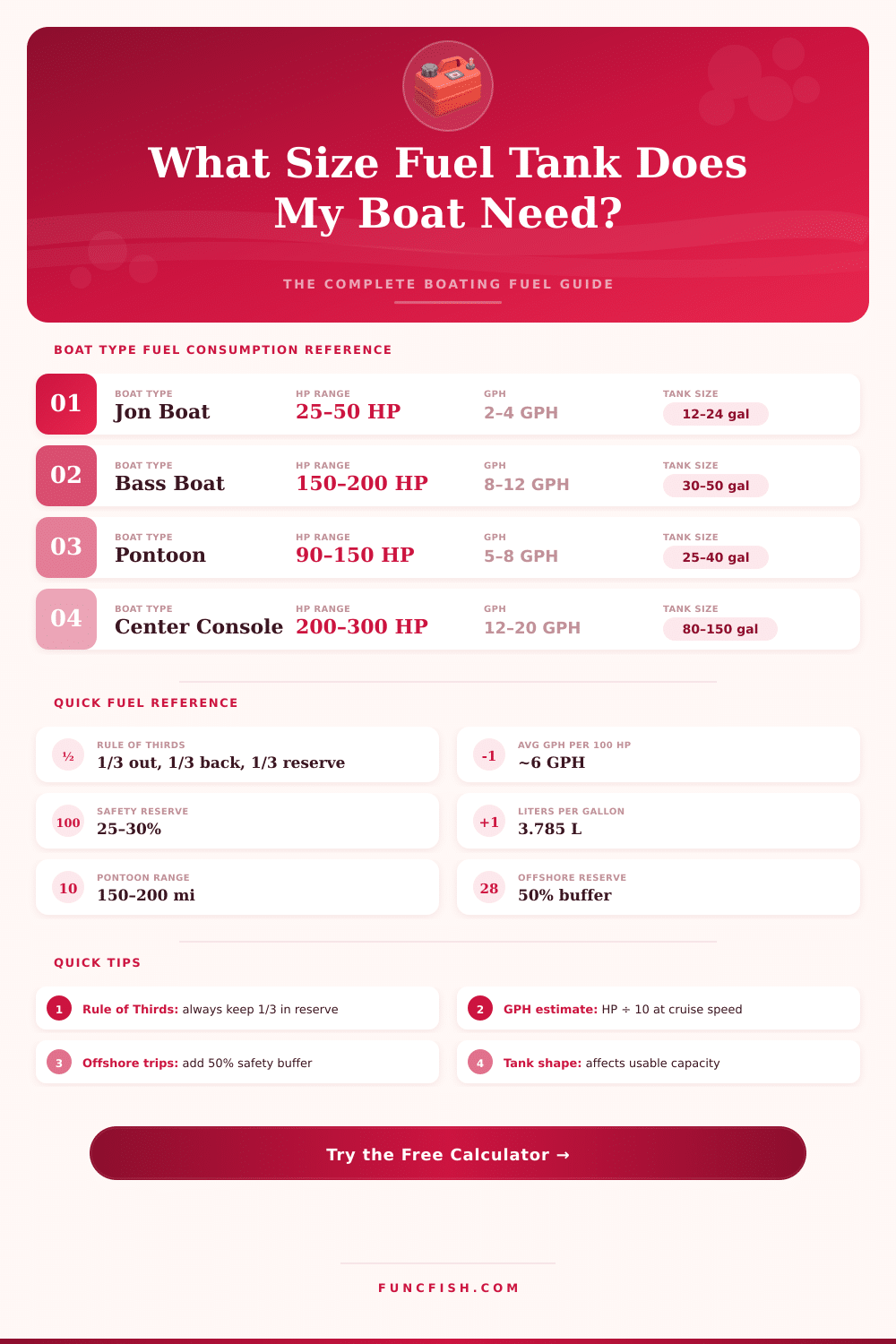
| Boat Type | Typical HP | Cruise GPH | Typical Tank (gal) | Typical Tank (L) | Avg Range (mi) |
|---|---|---|---|---|---|
| Jon Boat (small) | 25–50 HP | 2–4 | 6–15 | 23–57 | 50–100 |
| Bass Boat | 150–250 HP | 8–14 | 25–40 | 95–151 | 150–300 |
| Pontoon | 90–150 HP | 5–9 | 25–40 | 95–151 | 150–250 |
| Center Console (small) | 115–200 HP | 7–12 | 40–80 | 151–303 | 200–350 |
| Center Console (large) | 200–400 HP | 14–25 | 80–150 | 303–568 | 200–400 |
| Bay Boat | 115–200 HP | 7–12 | 35–60 | 132–227 | 180–300 |
| Ski / Wake Boat | 300–450 HP | 12–20 | 40–55 | 151–208 | 100–200 |
| Cabin Cruiser | 250–500 HP | 18–30 | 80–200 | 303–757 | 200–500 |
| Sport Fisherman | 400–1200 HP | 30–80 | 200–600 | 757–2271 | 300–800 |
| Motorized Kayak | 2–6 HP | 0.2–0.6 | 1–3 | 4–11 | 40–80 |
| Engine Type | Efficiency (GPH per HP) | Best Use | Notes |
|---|---|---|---|
| 2-Stroke Outboard (old) | 0.12–0.15 | Small / light boats | Higher consumption, simpler |
| 4-Stroke Outboard | 0.08–0.10 | All-purpose | Industry standard estimate |
| Direct Injection 2-Stroke | 0.09–0.11 | Performance boats | Better than old 2-stroke |
| Sterndrive (gas) | 0.10–0.12 | Ski / cruise | Similar to 4-stroke outboard |
| Inboard Gas | 0.10–0.13 | Wake / ski boats | High displacement engines |
| Inboard Diesel | 0.05–0.07 | Long-range cruising | 40–50% more efficient |
| Diesel Outboard | 0.05–0.07 | Commercial / offshore | Best range per gallon |
| Electric (kWh equivalent) | N/A (kWh/mi) | Lakes / short trips | ~1–3 kWh per mile |
| Trip Type | Safety Factor | Reserve % | Recommended Tank Extra | Rationale |
|---|---|---|---|---|
| Calm Lake / Pond | 1.20x | 17% | +20% over trip fuel | Rescue nearby, calm water |
| Mixed Conditions | 1.25x | 20% | +25% standard rec. | General purpose boating |
| Recommended Minimum | 1.30x | 23% | +30% for most trips | Headwinds, currents, delays |
| Inshore / Bay | 1.35x | 26% | +35% tidal waters | Tidal flow, wind, shallows |
| Coastal | 1.40x | 29% | +40% open water | Weather changes, chop |
| Offshore (Rule of Thirds) | 1.50x | 33% | +50% offshore minimum | No rescue / weather risk |
| US Gallons (gal) | Liters (L) | Imperial Gal (UK) | At 10 GPH — Hours | At 20 GPH — Hours |
|---|---|---|---|---|
| 10 gal | 37.9 L | 8.3 UK gal | 1.0 hr | 0.5 hr |
| 20 gal | 75.7 L | 16.7 UK gal | 2.0 hr | 1.0 hr |
| 30 gal | 113.6 L | 25.0 UK gal | 3.0 hr | 1.5 hr |
| 50 gal | 189.3 L | 41.6 UK gal | 5.0 hr | 2.5 hr |
| 80 gal | 302.8 L | 66.6 UK gal | 8.0 hr | 4.0 hr |
| 100 gal | 378.5 L | 83.3 UK gal | 10.0 hr | 5.0 hr |
| 150 gal | 567.8 L | 124.9 UK gal | 15.0 hr | 7.5 hr |
| 200 gal | 757.1 L | 166.5 UK gal | 20.0 hr | 10.0 hr |
For tinier boats, people commonly use one portable tank. They come in sizes of three, six, or twelve gallons. Plastic tanks, designed for gasoline up on the deck, offer from twelve to twenty-four gallons.
A tank of three gallons fits more well in a little boat, when the space is tight. Pots of six gallons also suit, because one can move them around the deck or even remove them for short trips freeing up space.
How to Choose a Boat Fuel Tank
Boats between eighteen and twenty feet usually have tanks of twenty-five to thirty gallons. The most common twenty-foot fishing boats carry between forty and eighty gallons, so a Boat Fuel Tank of nineteen gallons would seem small compared to the standard for that size. One owner of a boat uses a Boat Fuel Tank of thirty-two gallons as reserve, together with an aftermarket one of nineteen gallons, for entirely fifty-one gallons.
A boat of seventeen feet could get by with a tank of twenty-two gllons, while before a tank of ten gallons already worked for full use with water skiing.
Pontoon boats normally supply capacity of twenty to thirty-five gallons for fuel. Many owners of such boats change or upgrade the tanks for longer trips. For pontoon boats one suggests to add a Boat Fuel Tank of twelve to twenty gallons.
Bigger boats require far more fuel. A small fun boat for water sports maybe only needs a tank of fifty gallons. A boat for a weekend trip in sea for some days could want a hundred fifty gallons or more.
One must balance that, because extra fuel adds wait, what slows steering and takes up space. A boat with a tank of a hundred thirty-five gallons easily can reach from two hundred fifty to three hundred miles on the ocean, following the thirds rule.
A key cause to know is that the listed tank sizes do not always match to what one indeed can use. One boat with a tank of eighty-two gallons only accepted seventy gallons, when one filled it at a near station. Some tanks carry internal tubes, so taking away two or three gallons from the printed size one gets a more exact number for the used fuel.
In a cruise boat with two tanks of eighteen gallons for diesel, the whole amount cannot enter, because the fuel shakes with the move of the boat.
The use of fuel also matters for choosing the tank size. An engine of fifteen horses with two-stroke burns uses one and half gallons in an hour at full gas. If one turns to seventy-five percent of the gas, that drops to roughly eight gallons in an hour.
The state of the propeller very much affects howmany gallons burn. Filling a big tank up adds weight, what deserves to mind always.
Choosing the right size for the Boat Fuel Tank of a boat depends on several factors. Here the kind of the boat, the distance that it needs to cover, and the model of engine that it uses. Everything matters.
The capacity of tanks ranges from only some gallons to even more than a hundred.