🎣 Fishing Rod Handle Length Calculator
Find the ideal handle length for your rod based on technique, body size, and fishing style
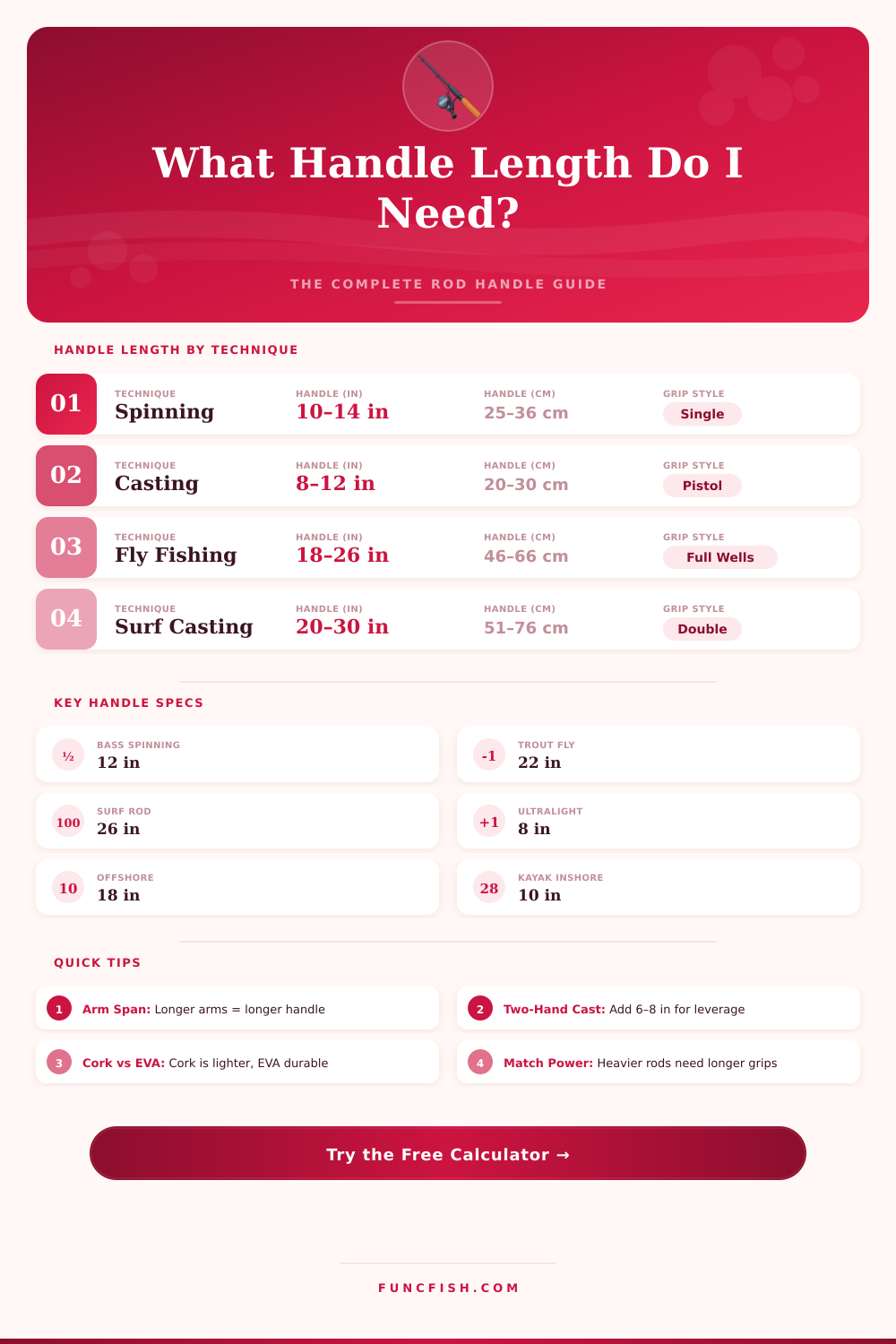
| Technique | Typical Handle (in) | Typical Handle (cm) | Grip Style | Notes |
|---|---|---|---|---|
| Spinning | 10–14 in | 25–36 cm | Single / Split | One-hand default |
| Baitcasting | 8–12 in | 20–30 cm | Pistol / Split | Compact for control |
| Fly Fishing | 18–26 in | 46–66 cm | Full Wells / Half Wells | Longer for line loop |
| Surf Casting | 20–30 in | 51–76 cm | Double Grip | Two-hand leverage |
| Offshore / Trolling | 14–22 in | 36–56 cm | Double / Roller | Fore-grip + rear-grip |
| Ultralight / Panfish | 6–10 in | 15–25 cm | Single / Pistol | Short, sensitive |
| Jigging | 10–16 in | 25–41 cm | Split / Single | Wrist action emphasis |
| Species | Avg. Weight | Rod Power | Handle Length (in) | Handle Length (cm) |
|---|---|---|---|---|
| Largemouth Bass | 2–8 lb (0.9–3.6 kg) | Medium–Med-Heavy | 10–14 in | 25–36 cm |
| Smallmouth Bass | 1–5 lb (0.5–2.3 kg) | Med-Light–Medium | 10–12 in | 25–30 cm |
| Rainbow Trout | 0.5–4 lb (0.2–1.8 kg) | Ultralight–Light | 8–12 in | 20–30 cm |
| Walleye | 1–8 lb (0.5–3.6 kg) | Med-Light–Med-Heavy | 10–14 in | 25–36 cm |
| Striped Bass | 5–30 lb (2.3–14 kg) | Med-Heavy–Heavy | 18–26 in | 46–66 cm |
| Salmon | 5–30 lb (2.3–14 kg) | Medium–Heavy | 20–26 in | 51–66 cm |
| Northern Pike | 3–20 lb (1.4–9 kg) | Med-Heavy–Heavy | 12–16 in | 30–41 cm |
| Bluefin Tuna | 50–300 lb (23–136 kg) | Extra-Heavy | 18–24 in | 46–61 cm |
| Panfish / Crappie | 0.25–1.5 lb (0.1–0.7 kg) | Ultralight | 6–10 in | 15–25 cm |
| Rod Power | Lure Weight Range | Min Handle (in/cm) | Max Handle (in/cm) | Best For |
|---|---|---|---|---|
| Ultralight | 1/64–1/8 oz (0.4–3.5 g) | 6 in / 15 cm | 10 in / 25 cm | Panfish, trout streams |
| Light | 1/16–1/4 oz (1.8–7 g) | 8 in / 20 cm | 12 in / 30 cm | Trout, small bass |
| Medium-Light | 1/8–3/8 oz (3.5–10.6 g) | 10 in / 25 cm | 13 in / 33 cm | Walleye, trout |
| Medium | 1/4–5/8 oz (7–17.7 g) | 10 in / 25 cm | 14 in / 36 cm | Bass, walleye |
| Medium-Heavy | 3/8–1 oz (10.6–28 g) | 12 in / 30 cm | 18 in / 46 cm | Bass, pike, redfish |
| Heavy | 1/2–2 oz (14–57 g) | 14 in / 36 cm | 24 in / 61 cm | Catfish, surf, salmon |
| Extra-Heavy | 1–4+ oz (28–113+ g) | 18 in / 46 cm | 30 in / 76 cm | Offshore, muskie, surf |
Handle length are one of the critical component of fishing rod building because handle length affect how a fishing rod feels and cause fatigue in the muscle of a persons arms. A fishing rod could have all the appropriate feature for a rod, but if the handle length is incorrect, fishing with this rod will be difficult. A fishing rod with the incorrect handle length will cause an individuals elbow to bump against the butt of the fishing rod when perform a backcast.
In addition, the incorrect handle length will cause the balance point of the fishing rod to be too far forward for the individual to effectively cast the line. A person must consider several factor when determining the correct handle length for a fishing rod. One of these factors is the reach of an individuals forearm.
How to Pick the Right Handle Length for Your Fishing Rod
An individual with a longer reach for there arm will require a longer rear grip on their fishing rod. An individual with a shorter arm can take up a rod with a shorter rear grip. Another of these factors are the weight of the individuals fishing reel.
An individual with heavy fishing reel will have a balance point that tilt towards the rear of the fishing rod. Therefore, such an individual will need a longer handle on the rear of their fishing rod. Finally, another of these factors is the fishing technique that an individual utilize when fishing.
Finesse fishing will require the individual to use rods with compact handles. Surf casting will require long handles on the fishing rod to provide the power needed for these casts. The environment where an individual fishes will dictate the length of the handle that is require for the fishing rod.
For instance, when fishing from a kayak, an individual may require a short grip on the rear of the fishing rod so that the handle does not hit the kayak or the personal flotation device on which the individual will be sitting. When fishing from a bank, an individual may require a medium-to-long handle on the fishing rod so that the handle does not get in the way of clothing or bush. When fishing from a pier, an individual will require an extra-long handle on their fishing rod so that they have the leverage needed to cast the line against the railing of the piers pier.
However, an extra-long handle may make it difficult for the individual to handle a fishing net when they are fishing from a pier. The grip that an individual use when holding the fishing rod will also change how the rod feels to that individual. For instance, if an individual uses a full cork grip on the fishing rod, the load on the individuals hands will be steady.
Full cork grips are best for beginners. Split grips allow for the rear of the fishing rod to be lighter. Using split grips can make a fishing rod feel more lively in the individuals hands.
However, many individuals may make the mistake of choosing a fishing rod with a maximum handle length to increase the power with which they can cast the fishing line. However, this will eventually decrease the ability of an individual to perform finesse movement with their fishing line. The weight of the lures that will be used when fishing and the power of the blank of the fishing rod are also factor in determining the length of the handle of the fishing rod.
When using light lures, there will be minimal requirement for the foregrips on a fishing rod. However, if the lures that will be used when fishing are heavy, an individual will require a firm foregrip and an extended rear grip on the fishing rod to fight the fish with there muscles. When using ultra-light lures, the length of the handle of the fishing rod will be minimal to allow for wrist snap to set the lures.
However, for extra-heavy blanks, an individual will require an extended length for the handle of the fishing rod to fight the fish effectively. An individual must also consider the tuck clearance of the fishing rod during the building of the fishing rod. Tuck clearance is the space between the butt of the fishing rod and an individuals ribs while casting the fishing line.
If an individual has low tuck clearance, the butt of the fishing rod may hit an individuals ribs while casting. An individual with a taller frame may need a longer handle on the fishing rod so that the individual does not have to use there pinky finger to hold onto the fishing rod when casting. Before completing the construction of the fishing rod, an individual should of create a mockup of the fishing rod.
To do this, an individual can wrap masking tape around the fishing rod blank to indicate the length of the rear grip that will be required. Once the individual places the masking tape on the fishing rod, the individual should attach the fishing rods reel to the fishing rod. Then the individual can perform ten normal casts while wearing there fishing gear.
If the handle of the fishing rod causes the individual to experience fatigue in their wrists, the individual should adjust the length of the handle of the fishing rod. If the fishing rod feels like it have too much weight in the nose of the fishing rod, the individual should extend the fishing rods butt. However, an individual should remember that a long handle is good for casting power but bad for finesse fishing.
A short handle is good for finesse fishing but bad for power when fishing casts.