🎣 Fishing Rod Balance Point Calculator
Find the ideal balance point for any rod & reel combo — imperial & metric supported
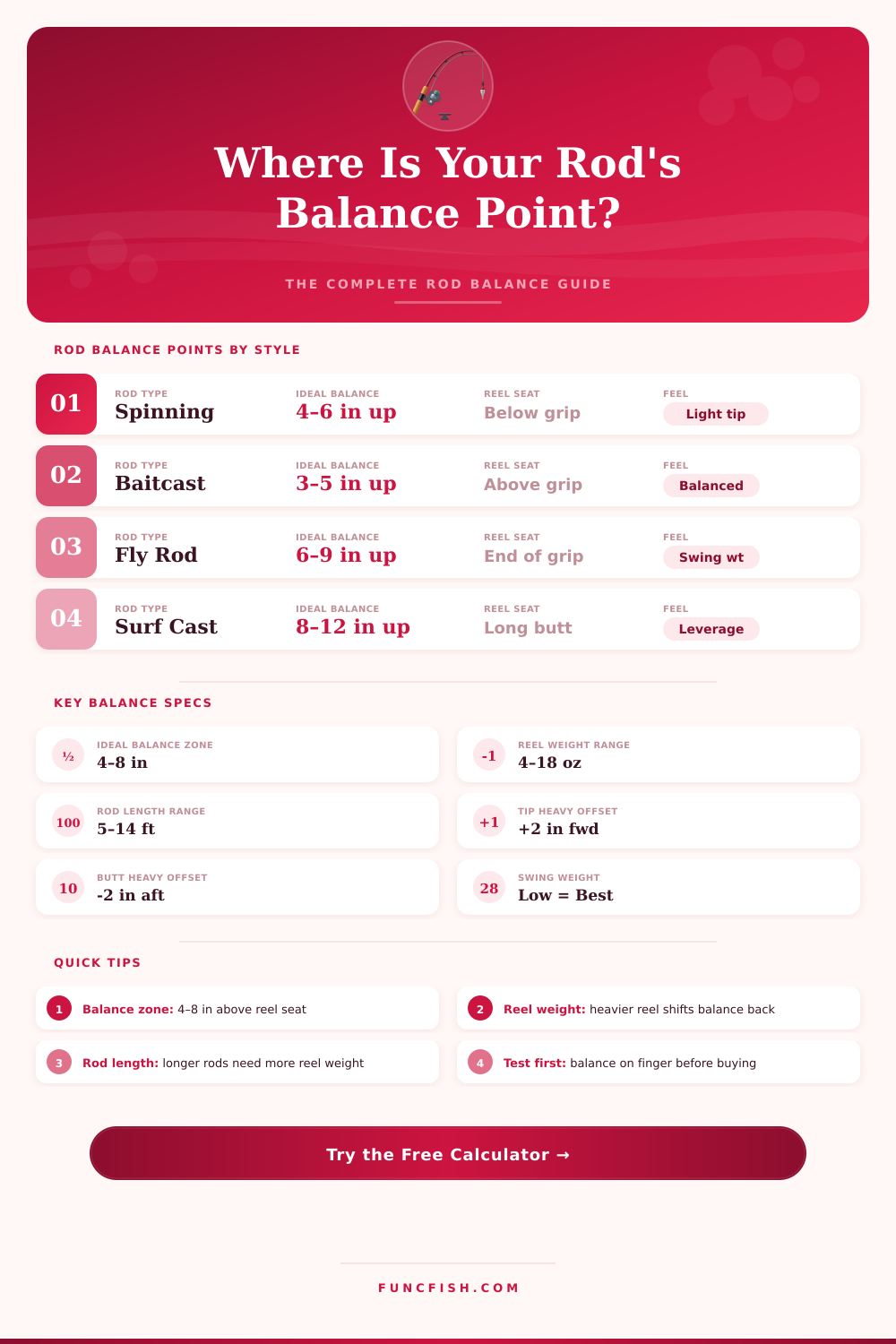
| Rod Type | Ideal Balance Point (from reel seat) | Typical Reel Weight | Balance Feel |
|---|---|---|---|
| Spinning (light) | 4–6 in (10–15 cm) | 4–7 oz (113–198 g) | Tip-balanced |
| Spinning (medium) | 5–7 in (13–18 cm) | 7–10 oz (198–283 g) | Neutral |
| Baitcasting | 3–5 in (8–13 cm) | 8–14 oz (227–397 g) | Reel-forward |
| Fly Rod (4–6 wt) | 6–9 in (15–23 cm) | 3–5 oz (85–142 g) | Extended grip |
| Surf Casting | 8–14 in (20–36 cm) | 12–20 oz (340–567 g) | Leverage butt |
| Trolling | 5–9 in (13–23 cm) | 14–30 oz (397–850 g) | Heavy reel |
| Species | Typical Weight | Rod Length | Reel Weight | Ideal Balance |
|---|---|---|---|---|
| Largemouth Bass | 1–8 lb (0.5–3.6 kg) | 6.5–7.5 ft | 6–9 oz | 5–7 in from reel |
| Rainbow Trout | 0.5–4 lb (0.2–1.8 kg) | 5–7 ft | 3–5 oz | 4–6 in from reel |
| Walleye | 1–10 lb (0.5–4.5 kg) | 6–7.5 ft | 5–8 oz | 5–7 in from reel |
| Northern Pike | 2–20 lb (0.9–9 kg) | 7–8 ft | 9–14 oz | 4–6 in from reel |
| Panfish / Bluegill | 0.1–1 lb (45–450 g) | 4.5–6 ft | 2–4 oz | 4–5 in from reel |
| Channel Catfish | 1–30 lb (0.5–13.6 kg) | 7–9 ft | 10–16 oz | 6–9 in from reel |
| Striped Bass (surf) | 2–50 lb (0.9–22.7 kg) | 10–14 ft | 14–22 oz | 10–14 in from reel |
| Yellowfin Tuna | 10–200 lb (4.5–90 kg) | 7–8 ft | 20–40 oz | 5–8 in from reel |
| Balance Rating | Balance Point Location | Swing Weight Feel | Best Use |
|---|---|---|---|
| Tip-Heavy (>>) | >3 in past ideal | Fatiguing, slow | Pitching, heavy lures |
| Slightly Tip-Heavy (>) | 1–3 in past ideal | Sensitive tip | Bottom fishing, jigging |
| Perfectly Balanced (✔) | Within ideal zone | Effortless all-day | All techniques |
| Slightly Butt-Heavy (<) | 1–3 in behind ideal | Reel-forward, stable | Baitcasting, trolling |
| Butt-Heavy (<<) | >3 in behind ideal | Wrist strain, slow cast | Heavy offshore |
Fishing rods balance is the measurement of how the weight of a fishing rod is distributed across the fishing rods itself. Fishing rods has different components, including a rod blank, the reel, the lure, and the handle. Because fishing rods have different weight for each of their components, the fishing rod will pivot around a specific point.
That point is referred to as the balance point. If the balance point is located too far towards the tip of the rod, then the tip of the fishing rod will feel heaviness. Alternatively, if the balance point is located too far towards the handle of the fishing rod, the handle will feel heavy.
How to Find and Adjust the Balance of a Fishing Rod
The angler can find the balance point by resting the fishing rod on an finger. The fishing rod will rest on the rod at the point where it feels even, without either the tip or the handle of the rod feeling heavy. The balance point is important to the fishing rod because a balanced fishing rod will reduce fatigue in the fisher’s arm.
If the fishing rod isnt balance, the fisher will experience fatigue in there arm. The fishing rod’s components contributes to the location of the balance point. For instance, a fishing rod with a heavy reel will have a balance point that is located towards the handle of the fishing rod.
Similarly, a fishing rod with a heavy lure will have a balance point that is located towards the tip of the fishing rod. Thus, if either the fisher change the reel or the lure that is attached to the fishing rod, the balance point will change. Consequently, the fisher must consider the weight of each of these components in the creation of a balanced fishing rod.
A common mistake with fishing rods is to test the balance of the fishing rod without attaching the lure to the fishing rod. Balance should not be tested with the fishing rod and its reel alone. To test the balance of a fishing rod, the lure and the fishing line must be attached to the fishing rod.
This is because the weight of the lure and the weight of the fishing line change where the balance point is located. Using the fishing rod without the lure will balance the fishing rod. However, when the lure is added, the fishing rod will no longer be balanced.
The angler can adjust the balance point of a fishing rod by adding weight to the handle of the fishing rod. Adding counterweights to the butt cap of the fishing rod will move the balance point of the fishing rod towards the handle. Adding weight to the butt cap of the fishing rod is helpful because it allows the fishing rod to feel light in the hand of the angler.
However, if too much weight is added to the butt cap of the fishing rod, the fishing rod will become too heavy to hold when fishing. Therefore, only small increment of weight should of been added to the butt cap. The balance point of the fishing rod will differ according to the type of fishing that is being performed.
For example, finesse fishing will require a balance point of two to three and a half inches in front of the reel seat. This type of fishing will require a balance point of the fishing rod forward so that the angler has more clarity when the bait is dragged along the fish. In contrast, surf fishing may require a balance point of four to six and a half inches in front of the reel seat.
This fishing technique will require more power in the casting of the line. Therefore, the balance point of the fishing rod must match the fishing technique that will be use. When measuring the fishing rod, anglers must be precise in the measurement that are taken.
The measurements should start from the center of the butt cap of the fishing rod. Furthermore, the measurement from where the reel seat will be measured is from the midpoint of the hood of the reel seat. If the measurements are incorrect, the balance point will be incorrect.
An incorrect balance point will make the fishing rod unbalanced. To ensure that the fishing rod is balanced to the needs of the angler, accurate measurement must be used when measuring the fishing rod.