🎣 Nymphing Leader Length Calculator
Calculate the perfect leader length for euro, indicator, and high-stick nymphing rigs
| Tippet Size | Diameter (in) | Diameter (mm) | Breaking Strength | Best For |
|---|---|---|---|---|
| 0X | 0.011 in | 0.28 mm | 15.5 lb / 7.0 kg | Large streamers, steelhead |
| 1X | 0.010 in | 0.25 mm | 13.5 lb / 6.1 kg | Large nymphs, bass |
| 2X | 0.009 in | 0.23 mm | 11.5 lb / 5.2 kg | Salmon, steelhead nymphs |
| 3X | 0.008 in | 0.20 mm | 8.5 lb / 3.9 kg | Large trout, #8–12 nymphs |
| 4X | 0.007 in | 0.18 mm | 6.0 lb / 2.7 kg | Standard trout, #12–16 |
| 5X | 0.006 in | 0.15 mm | 4.75 lb / 2.2 kg | Trout, #16–20 nymphs |
| 6X | 0.005 in | 0.13 mm | 3.5 lb / 1.6 kg | Selective trout, grayling |
| 7X | 0.004 in | 0.10 mm | 2.5 lb / 1.1 kg | Tiny nymphs, #22+ |
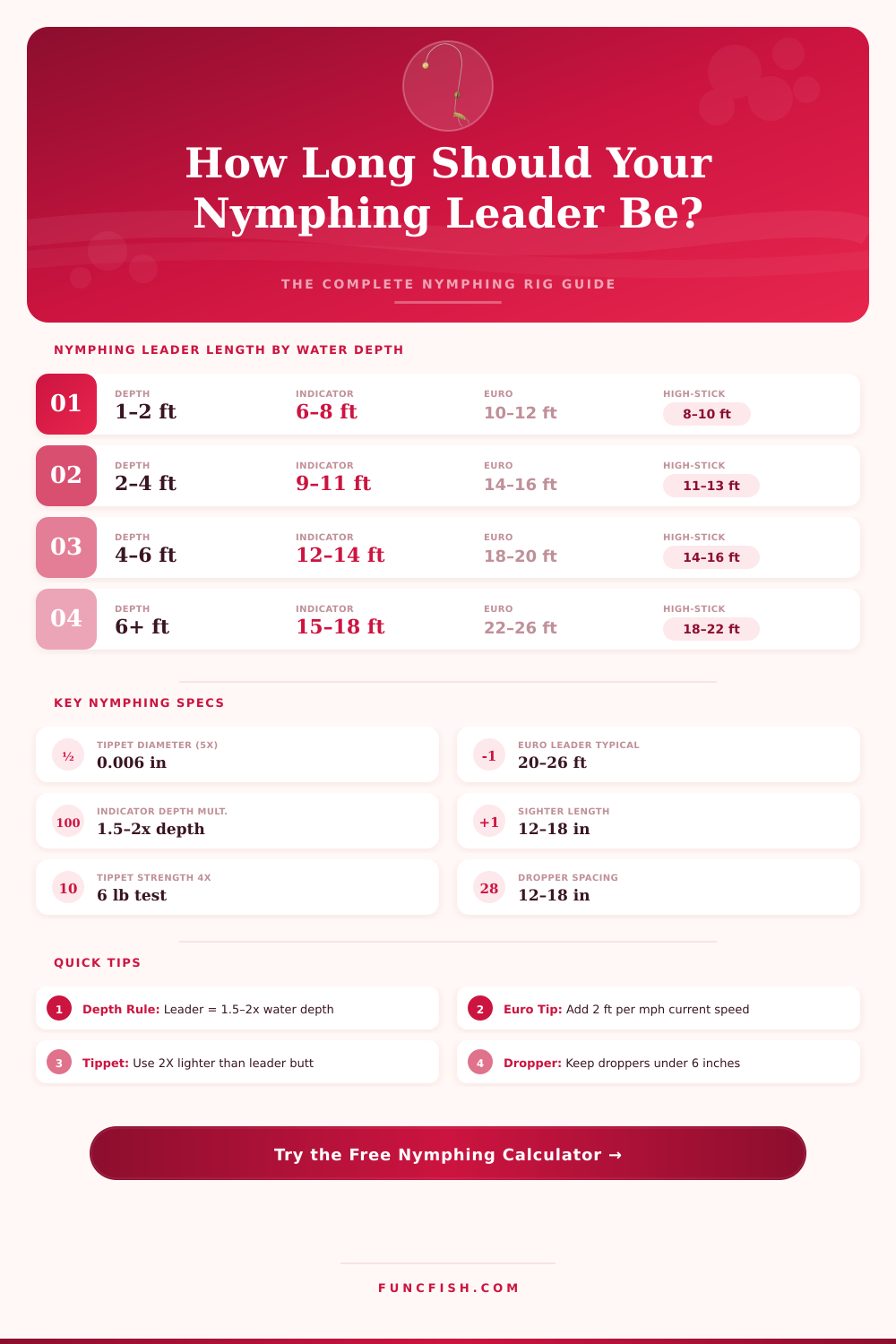
| Depth | Euro Leader | Indicator | High-Stick | Tippet Section |
|---|---|---|---|---|
| 1–2 ft (0.3–0.6 m) | 10–12 ft (3–3.7 m) | 6–8 ft (1.8–2.4 m) | 8–10 ft (2.4–3 m) | 18–24 in (46–61 cm) |
| 2–4 ft (0.6–1.2 m) | 14–18 ft (4.3–5.5 m) | 9–11 ft (2.7–3.4 m) | 10–14 ft (3–4.3 m) | 18–30 in (46–76 cm) |
| 4–6 ft (1.2–1.8 m) | 18–22 ft (5.5–6.7 m) | 12–14 ft (3.7–4.3 m) | 13–17 ft (4–5.2 m) | 24–36 in (61–91 cm) |
| 6–8 ft (1.8–2.4 m) | 22–26 ft (6.7–7.9 m) | 14–18 ft (4.3–5.5 m) | 16–20 ft (4.9–6.1 m) | 30–48 in (76–122 cm) |
| 8+ ft (2.4+ m) | 26–30 ft (7.9–9.1 m) | 18–22 ft (5.5–6.7 m) | 20–24 ft (6.1–7.3 m) | 36–60 in (91–152 cm) |
| Species | Typical Weight | Rec. Tippet | Technique | Nymph Size |
|---|---|---|---|---|
| Brown Trout | 1–5 lb (0.5–2.3 kg) | 4X–5X | Euro / Indicator | #12–18 |
| Rainbow Trout | 1–4 lb (0.5–1.8 kg) | 4X–6X | Euro / High-Stick | #14–20 |
| Brook Trout | 0.5–2 lb (0.2–0.9 kg) | 5X–6X | High-Stick | #14–20 |
| Grayling | 0.5–2 lb (0.2–0.9 kg) | 5X–7X | Euro | #16–22 |
| Whitefish | 1–3 lb (0.5–1.4 kg) | 3X–4X | Euro / Indicator | #10–16 |
| Steelhead | 5–15 lb (2.3–6.8 kg) | 1X–3X | Indicator | #4–10 |
| Atlantic Salmon | 8–20 lb (3.6–9 kg) | 1X–2X | Indicator | #4–8 |
| Smallmouth Bass | 1–4 lb (0.5–1.8 kg) | 2X–3X | High-Stick | #8–12 |
A nymphing leader is the piece of fishing line that connects a fishing rod to a fly. The length and composition of this leader will ultimately determine the way in which the artificial fly perform in the water. Should the nymphing leader be too short, the fly may not reach the bottom of the river’s depth.
However, if the nymphing leader are too long, then the nymphing leader may become difficultly to manage when fishing. The angler must select the nymphing leader based off the depth of the water, the speed of the current within the river, and the weight of the flies that is being used. The speed of the current in the river will impact both the way in which the nymphing leader function and the drag that the fishing flies will experience.
How to Choose a Nymphing Leader
In rivers with fast currents, a shorter nymphing leader are required to avoid the line bowing in the water. However, in slow moving currents, a fisherman can use a longer nymphing leader. The clarity of the water will also impact the nymphing leader requirement.
In clear water, a thinner, nearly invisible tippet are required for the nymphing leader. In murky water, a thicker, more durable tippet is required for the nymphing leader. The weight of the flies will impact both the length of the nymphing leader required and the tension of the line.
With heavy tungsten flies, the flies will quickly sink to the riverbed, allowing for the use of a shorter nymphing leader. With lighter flies, the nymphing leader must be longer to ensure the flies reach the desired depth. Additionally, the fishing technique will impact the requirement of the nymphing leader.
For euro nymphing, a longer tippet is required to maintain the tension in the line. For indicator nymphing, the nymphing leader will need to allow the flies to suspend at a certain depth in the water. A nymphing leader is comprised of three separate section: the butt section, the mid-section, and the tippet.
The butt section of the nymphing leader is the thickest portion of the line and is used to provide stability for the flies while fishing. The mid-section is used to provide control to the drift of the nymphing leader, and it connect the butt section to the tippet. The tippet is the thinnest portion of the nymphing leader and the portion that connects to the fly.
Each of these sections must be of the appropriate size to the nymphing leader requirements. If the weight of the flies change, then the nymphing leader must also be evaluated. If larger beads are used instead of smaller beads, for instance, the larger beads will sink at a more fast rate.
In this instance, the nymphing leader may need to be adjust. If the flies are floating too high in the water, the angler can lengthen the contact section of the nymphing leader, or the weight of the flies can be increased. Should the flies be moving too slow, the tippet can be thinned, or the nymphing leader itself may need to be changed.
Because stillwater features no current, the settings for the nymphing leader will be different than those required for moving rivers. In still water, the nymphing leader can be of a fixed length of between eleven and fifteen feet. In moving rivers, the angler will need to adjust the nymphing leader according to the movement in the water.
Regardless of the type of water in which the flies are being cast, the angler should always test the drift of they’re fishing flies to ensure they have the apropiate nymphing leader for the water conditions.