🎣 Streamer Leader Length Calculator
Calculate the ideal leader length, tippet size, and section breakdown for streamer fly fishing
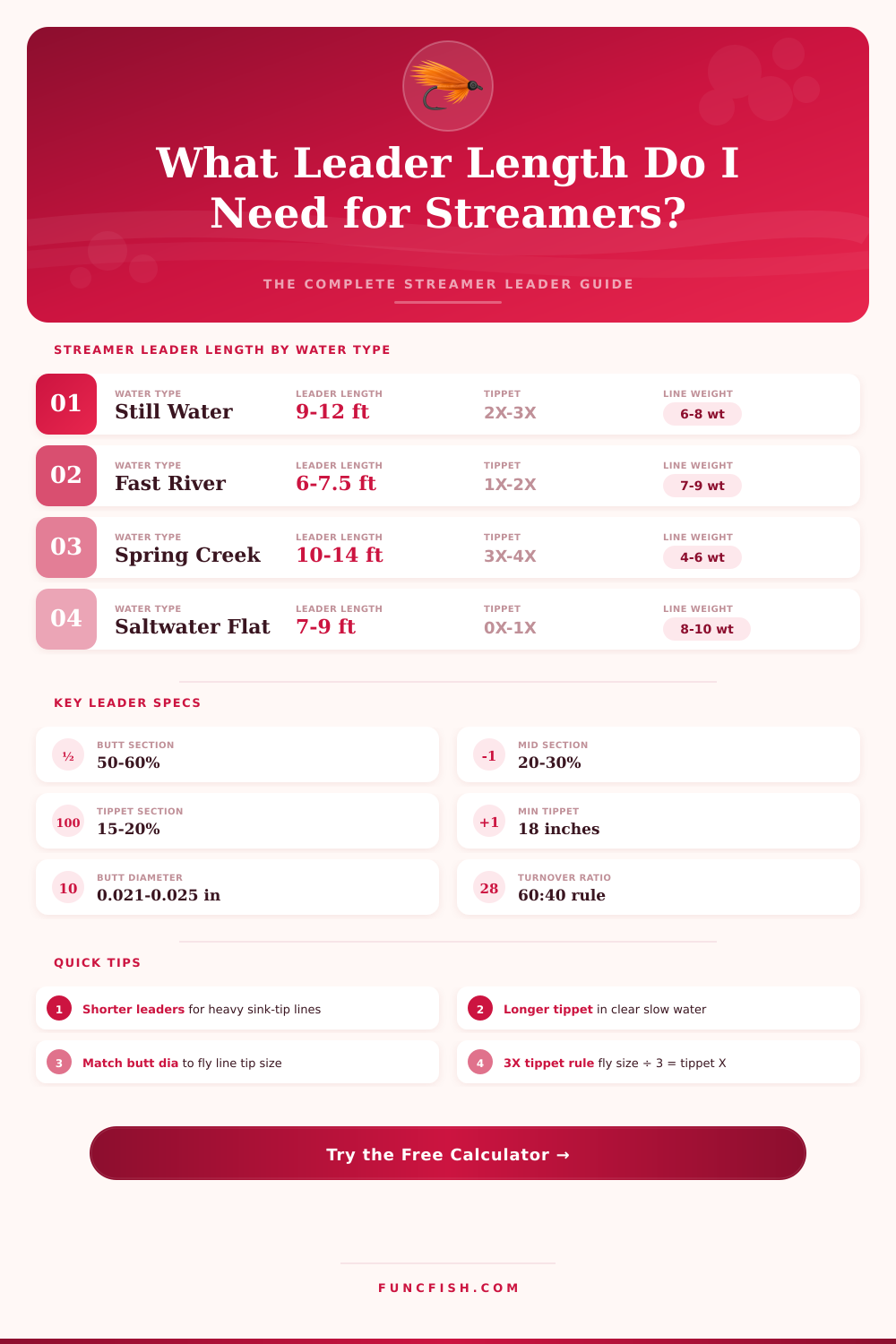
| Water Type | Current Speed | Recommended Leader (ft) | Recommended Leader (m) | Notes |
|---|---|---|---|---|
| Fast Mountain Stream | Fast | 6 – 7.5 | 1.8 – 2.3 | Short for control, quick turnover |
| Freestone River | Moderate | 7.5 – 9 | 2.3 – 2.7 | Standard streamer presentation |
| Tailwater / Spring Creek | Slow | 10 – 14 | 3.0 – 4.3 | Clear water, stealthy approach |
| Lake / Reservoir | Still | 9 – 12 | 2.7 – 3.7 | Match depth to sink rate |
| Saltwater Flat | Tidal / Slow | 7 – 9 | 2.1 – 2.7 | Wind-resistant, hard turnover |
| Estuary / Tidal River | Moderate | 6 – 8 | 1.8 – 2.4 | Allow for fast current strips |
| Pocket Water | Very Fast | 5 – 6 | 1.5 – 1.8 | Shortest practical leader |
| Target Species | Typical Weight | Leader Length (ft) | Tippet Size | Min Breaking Strength |
|---|---|---|---|---|
| Brown Trout | 1 – 8 lb | 9 – 12 | 2X – 4X | 6 – 12 lb |
| Rainbow Trout | 1 – 10 lb | 7.5 – 10 | 2X – 3X | 8 – 12 lb |
| Atlantic Salmon | 8 – 30 lb | 9 – 12 | 0X – 1X | 15 – 20 lb |
| Largemouth Bass | 2 – 12 lb | 6 – 9 | 0X – 2X | 12 – 20 lb |
| Pike / Muskie | 5 – 30 lb | 6 – 8 | Wire / 40+ lb mono | 40+ lb |
| Bonefish | 2 – 10 lb | 9 – 12 | 1X – 3X | 10 – 16 lb |
| Tarpon | 50 – 150 lb | 7 – 9 | Class tippet 16-20 lb | 80 lb shock |
| Striped Bass | 5 – 50 lb | 7 – 9 | 0X – 1X | 16 – 25 lb |
| Tippet Size | Diameter (in) | Diameter (mm) | Approx Break Strength (lb) | Typical Streamer Hook Size |
|---|---|---|---|---|
| 4X | 0.007 | 0.178 | 6 | #8 – #12 |
| 3X | 0.008 | 0.203 | 8 | #6 – #10 |
| 2X | 0.009 | 0.229 | 11 | #4 – #8 |
| 1X | 0.010 | 0.254 | 13.5 | #2 – #6 |
| 0X | 0.011 | 0.279 | 15.5 | #1/0 – #2 |
| -1X (12 lb mono) | 0.012 | 0.305 | 18 | #2/0 – #1 |
| -2X (16 lb mono) | 0.013 | 0.330 | 22 | #3/0 and up |
| Line Type | Base Leader Multiplier | Typical Leader Range (ft) | Metric Range (m) | Reason |
|---|---|---|---|---|
| Floating | 1.0x (baseline) | 7.5 – 12 | 2.3 – 3.7 | Standard presentation, full leader works |
| Intermediate | 0.75x | 5 – 8 | 1.5 – 2.4 | Shorter allows sink control |
| Sink-Tip | 0.55x | 3 – 6 | 0.9 – 1.8 | Tip sinks, leader stays near bottom |
| Full Sinking | 0.35x | 2 – 4 | 0.6 – 1.2 | Short leader keeps fly deep |
| Poly Leader / VersiLeader | 0.5x | 3 – 5 | 0.9 – 1.5 | Leader includes poly section |
| Shooting Head | 0.5x | 3 – 6 | 0.9 – 1.8 | Long head turnover limits leader length |
A streamer leader is the length of line between the fly fishing line and the streamer fly. The length of this leader has to be the correct length for the streamer fly to perform as it should in the water. If the leader is too long for heavy waters, the sink tip will hover above the bottom of the water.
If the leader is too short for a floating line, the flies will splash loud on the surface of the water. Because this loud splash can spook the fish, the streamer leader must find a balance between stealth and power. The length of the streamer leader is dependent upon a few different variables.
Choose the Right Streamer Leader Length
For instance, the length of the fishing rods and the type of fly line that is used will play a role in the length of the streamer leader. For instance, a nine foot rod with a type 6 sink tip will require a different length of streamer leader then a nine foot rod with a floating line. The length of the rod will impact the length of the streamer leader because the length of the rod will dictate the amount of energy that is deposited into the cast, which will impact the way the streamer leader unrolls.
Additionally, the species of the fish that is targeted will play a role in the length of the streamer leader. Water conditions will play a role in the length of streamer leader that is used. For instance, if the water is clear, a longer streamer leader will help to keep the splash of the fly line away from the streamer fly.
The splash can spook the fish in clear water. If the water is murky and dirty, the splash cannot be seen so a shorter streamer leader can be used. Current speed will play a role in the length of the streamer leader.
Fast moving currents will drag long streamer leaders into bowlines which can prevent the leader from turning over proper. If water is shallow, longer streamer leaders can be used but in deep water shorter streamer leaders will be required. Finally, the size of the fly will play a role in the length of the streamer leader.
This is due to the idea that a large fly will behave differently than a small fly. The style in which the streamer will be cast will play a role in the length of the streamer leader that is used. Bank crawls and hangs will require a streamer leader with a midsection that has some give.
This allows the streamer to stall against the wood or rocks in the bank. Sink-tip pulse strips will require a short streamer leader to allow for the dense head of the streamer to move honest during the retrieve. The material for the streamer leader will play a role in the length of the streamer leader.
Fluorocarbon will allow the streamer to slice through the water which will allow for the use of a shorter streamer leader. Nylon will allow for the streamer to float higher in the water which will require a longer streamer leader. Poly leaders will bridge the gap between fluorocarbon and nylon because the front taper of the poly leader will sink which will allow for the mono tippet to not fight against the line.
There are a few common mistakes that can be made with the length of the streamer leader. One common mistake is using a long streamer leader to increase the sink rate of the streamer. Instead, the length of the streamer leader will increase the drag on the leader.
Another common mistake is to ignore the cover in which the fish are residing. For instance, if there are many weeds and roots in the area in which the fish are located, the streamer leader has to turn over quickly so as to not present an obstacle for the fish to snag on. A streamer leader has three different parts to it.
These parts include the butt section, the midsection, and the tippet. Each of these parts must be considered when creating the streamer leader. For instance, the total length of the streamer leader must be considered, the sink window of the leader must be considered, as well as the strength of the tippet.
The sink window is the amount of time it takes for the streamer fly to settle to the bottom. This is important to know to understand when to start stripping the line. Finally, the strength of the tippet should be considered in respect to the bulk of the fly that is attached to the leader as well as the type of cover in which the fish live.
There are a few different presets for the length of the streamer leader. For instance, if a streamer is used to target smallmouth bass on the bank, a length of five to seven feet of hard mono can be used. However, if a streamer is used to target lake leeches, intermediate length with poly leaders can be used to bridge the gap between fluorocarbon and nylon.
Blood knots can be used to connect the components of the streamer leader. Blood knots will allow for the leader to turn over properly. Prior to beginning to fish with the newly created streamer leader, you should of tested it with a few casts.
Testing the streamer leader will allow the streamer leader to be adjusted if necessary so that water movement will not cause the leader to hinge or pile up on itself. Finally, using the correct length of streamer leader will cause the streamer fly to sink in a true fashion in the water, as well as cause the fly to pause correct in the water. A streamer leader is the length of line between the fly fishing line and the streamer fly.
The length of this leader has to be the correct length for the streamer fly to perform as it should in the water. If the leader is too long for heavy waters, the sink tip will hover above the bottom of the water. If the leader is too short for a floating line, the flies will splash loud on the surface of the water.
Because this loud splash can spook the fish, the streamer leader must find a balance between stealth and power. The length of the streamer leader is dependent upon a few different variables. For instance, the length of the fishing rods and the type of fly line that is used will play a role in the length of the streamer leader.
For instance, a nine foot rod with a type 6 sink tip will require a different length of streamer leader then a nine foot rod with a floating line. The length of the rod will impact the length of the streamer leader because the length of the rod will dictate the amount of energy that is deposited into the cast, which will impact the way the streamer leader unrolls. Additionally, the species of the fish that is targeted will play a role in the length of the streamer leader.
Water conditions will play a role in the length of streamer leader that is used. For instance, if the water is clear, a longer streamer leader will help to keep the splash of the fly line away from the streamer fly. The splash can spook the fish in clear water.
If the water is murky and dirty, the splash cannot be seen so a shorter streamer leader can be used. Current speed will play a role in the length of the streamer leader. Fast moving currents will drag long streamer leaders into bowlines which can prevent the leader from turning over proper.
If water is shallow, longer streamer leaders can be used but in deep water shorter streamer leaders will be required. Finally, the size of the fly will play a role in the length of the streamer leader. This is due to the idea that a large fly will behave differently than a small fly.
The style in which the streamer will be cast will play a role in the length of the streamer leader that is used. Bank crawls and hangs will require a streamer leader with a midsection that has some give. This allows the streamer to stall against the wood or rocks in the bank.
Sink-tip pulse strips will require a short streamer leader to allow for the dense head of the streamer to move honest during the retrieve. The material for the streamer leader will play a role in the length of the streamer leader. Fluorocarbon will allow the streamer to slice through the water which will allow for the use of a shorter streamer leader.
Nylon will allow for the streamer to float higher in the water which will require a longer streamer leader. Poly leaders will bridge the gap between fluorocarbon and nylon because the front taper of the poly leader will sink which will allow for the mono tippet to not fight against the line. There are a few common mistakes that can be made with the length of the streamer leader.
One common mistake is using a long streamer leader to increase the sink rate of the streamer. Instead, the length of the streamer leader will increase the drag on the leader. Another common mistake is to ignore the cover in which the fish are residing.
For instance, if there are many weeds and roots in the area in which the fish are located, the streamer leader has to turn over quickly so as to not present an obstacle for the fish to snag on. A streamer leader has three different parts to it. These parts include the butt section, the midsection, and the tippet.
Each of these parts must be considered when creating the streamer leader. For instance, the total length of the streamer leader must be considered, the sink window of the leader must be considered, as well as the strength of the tippet. The sink window is the amount of time it takes for the streamer fly to settle to the bottom.
This is important to know to understand when to start stripping the line. Finally, the strength of the tippet should be considered in respect to the bulk of the fly that is attached to the leader as well as the type of cover in which the fish live. There are a few different presets for the length of the streamer leader.
For instance, if a streamer is used to target smallmouth bass on the bank, a length of five to seven feet of hard mono can be used. However, if a streamer is used to target lake leeches, intermediate length with poly leaders can be used to bridge the gap between fluorocarbon and nylon. Blood knots can be used to connect the components of the streamer leader.
Blood knots will allow for the leader to turn over properly. Prior to beginning to fish with the newly created streamer leader, it should be tested with a few casts. Testing the streamer leader will allow the streamer leader to be adjusted if necessary so that water movement will not cause the leader to hinge or pile up on itself.
Finally, using the correct length of streamer leader will cause the streamer fly to sink in a true fashion in the water, as well as cause the fly to pause correct in the water. A streamer leader is the length of line between the fly fishing line and the streamer fly. The length of this leader has to be the correct length for the streamer fly to perform as it should in the water.
If the leader is too long for heavy waters, the sink tip will hover above the bottom of the water. If the leader is too short for a floating line, the flies will splash loud on the surface of the water. Because this loud splash can spook the fish, the streamer leader must find a balance between stealth and power.
The length of the streamer leader is dependent upon a few different variables. For instance, the length of the fishing rods and the type of fly line that is used will play a role in the length of the streamer leader. For instance, a nine foot rod with a type 6 sink tip will require a different length of streamer leader then a nine foot rod with a floating line.
The length of the rod will impact the length of the streamer leader because the length of the rod will dictate the amount of energy that is deposited into the cast, which will impact the way the streamer leader unrolls. Additionally, the species of the fish that is targeted will play a role in the length of the streamer leader. Water conditions will play a role in the length of streamer leader that is used.
For instance, if the water is clear, a longer streamer leader will help to keep the splash of the fly line away from the streamer fly. The splash can spook the fish in clear water. If the water is murky and dirty, the splash cannot be seen so a shorter streamer leader can be used.
Current speed will play a role in the length of the streamer leader. Fast moving currents will drag long streamer leaders into bowlines which can prevent the leader from turning over proper. If water is shallow, longer streamer leaders can be used but in deep water shorter streamer leaders will be required.
Finally, the size of the fly will play a role in the length of the streamer leader. This is due to the idea that a large fly will behave differently than a small fly. The style in which the streamer will be cast will play a role in the length of the streamer leader that is used.
Bank crawls and hangs will require a streamer leader with a midsection that has some give. This allows the streamer to stall against the wood or rocks in the bank. Sink-tip pulse strips will require a short streamer leader to allow for the dense head of the streamer to move honest during the retrieve.
The material for the streamer leader will play a role in the length of the streamer leader. Fluorocarbon will allow the streamer to slice through the water which will allow for the use of a shorter streamer leader. Nylon will allow for the streamer to float higher in the water which will require a longer streamer leader.
Poly leaders will bridge the gap between fluorocarbon and nylon because the front taper of the poly leader will sink which will allow for the mono tippet to not fight against the line. There are a few common mistakes that can be made with the length of the streamer leader. One common mistake is using a long streamer leader to increase the sink rate of the streamer.
Instead, the length of the streamer leader will increase the drag on the leader. Another common mistake is to ignore the cover in which the fish are residing. For instance, if there are many weeds and roots in the area in which the fish are located, the streamer leader has to turn over quickly so as to not present an obstacle for the fish to snag on.
A streamer leader has three different parts to it. These parts include the butt section, the midsection, and the tippet. Each of these parts must be considered when creating the streamer leader.
For instance, the total length of the streamer leader must be considered, the sink window of the leader must be considered, as well as the strength of the tippet. The sink window is the amount of time it takes for the streamer fly to settle to the bottom. This is important to know to understand when to start stripping the line.
Finally, the strength of the tippet should be considered in respect to the bulk of the fly that is attached to the leader as well as the type of cover in which the fish live. There are a few different presets for the length of the streamer leader. For instance, if a streamer is used to target smallmouth bass on the bank, a length of five to seven feet of hard mono can be used.
However, if a streamer is used to target lake leeches, intermediate length with poly leaders can be used to bridge the gap between fluorocarbon and nylon. Blood knots can be used to connect the components of the streamer leader. Blood knots will allow for the leader to turn over properly.
Prior to beginning to fish with the newly created streamer leader, it should be tested with a few casts. Testing the streamer leader will allow the streamer leader to be adjusted if necessary so that water movement will not cause the leader to hinge or pile up on itself. Finally, using the correct length of streamer leader will cause the streamer fly to sink in a true fashion in the water, as well as cause the fly to pause correct in the water.
A streamer leader is the length of line between the fly fishing line and the streamer fly. The length of this leader has to be the correct length for the streamer fly to perform as it should in the water. If the leader is too long for heavy waters, the sink tip will hover above the bottom of the water.
If the leader is too short for a floating line, the flies will splash loud on the surface of the water. Because this loud splash can spook the fish, the streamer leader must find a balance between stealth and power. The length of the streamer leader is dependent upon a few different variables.
For instance, the length of the fishing rods and the type of fly line that is used will play a role in the length of the streamer leader. For instance, a nine foot rod with a type 6 sink tip will require a different length of streamer leader then a nine foot rod with a floating line. The length of the rod will impact the length of the streamer leader because the length of the rod will dictate the amount of energy that is deposited into the cast, which will impact the way the streamer leader unrolls.
Additionally, the species of the fish that is targeted will play a role in the length of the streamer leader. Water conditions will play a role in the length of streamer leader that is used. For instance, if the water is clear, a longer streamer leader will help to keep the splash of the fly line away from the streamer fly.
The splash can spook the fish in clear water. If the water is murky and dirty, the splash cannot be seen so a shorter streamer leader can be used. Current speed will play a role in the length of the streamer leader.
Fast moving currents will drag long streamer leaders into bowlines which can prevent the leader from turning over proper. If water is shallow, longer streamer leaders can be used but in deep water shorter streamer leaders will be required. Finally, the size of the fly will play a role in the length of the streamer leader.
This is due to the idea that a large fly will behave differently than a small fly. The style in which the streamer will be cast will play a role in the length of the streamer leader that is used. Bank crawls and hangs will require a streamer leader with a midsection that has some give.
This allows the streamer to stall against the wood or rocks in the bank. Sink-tip pulse strips will require a short streamer leader to allow for the dense head of the streamer to move honest during the retrieve. The material for the streamer leader will play a role in the length of the streamer leader.
Fluorocarbon will allow the streamer to slice through the water which will allow for the use of a shorter streamer leader. Nylon will allow for the streamer to float higher in the water which will require a longer streamer leader. Poly leaders will bridge the gap between fluorocarbon and nylon because the front taper of the poly leader will sink which will allow for the mono tippet to not fight against the line.
There are a few common mistakes that can be made with the length of the streamer leader. One common mistake is using a long streamer leader to increase the sink rate of the streamer. Instead, the length of the streamer leader will increase the drag on the leader.
Another common mistake is to ignore the cover in which the fish are residing. For instance, if there are many weeds and roots in the area in which the fish are located, the streamer leader has to turn over quickly so as to not present an obstacle for the fish to snag on. A streamer leader has three different parts to it.
These parts include the butt section, the midsection, and the tippet. Each of these parts must be considered when creating the streamer leader. For instance, the total length of the streamer leader must be considered, the sink window of the leader must be considered, as well as the strength of the tippet.
The sink window is the amount of time it takes for the streamer fly to settle to the bottom. This is important to know to understand when to start stripping the line. Finally, the strength of the tippet should be considered in respect to the bulk of the fly that is attached to the leader as well as the type of cover in which the fish live.
There are a few different presets for the length of the streamer leader. For instance, if a streamer is used to target smallmouth bass on the bank, a length of five to seven feet of hard mono can be used. However, if a streamer is used to target lake leeches, intermediate length with poly leaders can be used to bridge the gap between fluorocarbon and nylon.
Blood knots can be used to connect the components of the streamer leader. Blood knots will allow for the leader to turn over properly. Prior to beginning to fish with the newly created streamer leader, it should be tested with a few casts.
Testing the streamer leader will allow the streamer leader to be adjusted if necessary so that water movement will not cause the leader to hinge or pile up on itself. Finally, using the correct length of streamer leader will cause the streamer fly to sink in a true fashion in the water, as well as cause the fly to pause correct in the water. A streamer leader is the length of line between the fly fishing line and the streamer fly.
The length of this leader has to be the correct length for the streamer fly to perform as it should in the water. If the leader is too long for heavy waters, the sink tip will hover above the bottom of the water. If the leader is too short for a floating line, the flies will splash loud on the surface of the water.
Because this loud splash can spook the fish, the streamer leader must find a balance between stealth and power. The length of the streamer leader is dependent upon a few different variables. For instance, the length of the fishing rods and the type of fly line that is used will play a role in the length of the streamer leader.
For instance, a nine foot rod with a type 6 sink tip will require a different length of streamer leader then a nine foot rod with a floating line. The length of the rod will impact the length of the streamer leader because the length of the rod will dictate the amount of energy that is deposited into the cast, which will impact the way the streamer leader unrolls. Additionally, the species of the fish that is targeted will play a role in the length of the streamer leader.
Water conditions will play a role in the length of streamer leader that is used. For instance, if the water is clear, a longer streamer leader will help to keep the splash of the fly line away from the streamer fly. The splash can spook the fish in clear water.
If the water is murky and dirty, the splash cannot be seen so a shorter streamer leader can be used. Current speed will play a role in the length of the streamer leader. Fast moving currents will drag long streamer leaders into bowlines which can prevent the leader from turning over proper.
If water is shallow, longer streamer leaders can be used but in deep water shorter streamer leaders will be required. Finally, the size of the fly will play a role in the length of the streamer leader. This is due to the idea that a large fly will behave differently than a small fly.
The style in which the streamer will be cast will play a role in the length of the streamer leader that is used. Bank crawls and hangs will require a streamer leader with a midsection that has some give. This allows the streamer to stall against the wood or rocks in the bank.
Sink-tip pulse strips will require a short streamer leader to allow for the dense head of the streamer to move honest during the retrieve. The material for the streamer leader will play a role in the length of the streamer leader. Fluorocarbon will allow the streamer to slice through the water which will allow for the use of a shorter streamer leader.
Nylon will allow for the streamer to float higher in the water which will require a longer streamer leader. Poly leaders will bridge the gap between fluorocarbon and nylon because the front taper of the poly leader will sink which will allow for the mono tippet to not fight against the line. There are a few common mistakes that can be made with the length of the streamer leader.
One common mistake is using a long streamer leader to increase the sink rate of the streamer. Instead, the length of the streamer leader will increase the drag on the leader. Another common mistake is to ignore the cover in which the fish are residing.
For instance, if there are many weeds and roots in the area in which the fish are located, the streamer leader has to turn over quickly so as to not present an obstacle for the fish to snag on. A streamer leader has three different parts to it. These parts include the butt section, the midsection, and the tippet.
Each of these parts must be considered when creating the streamer leader. For instance, the total length of the streamer leader must be considered, the sink window of the leader must be considered, as well as the strength of the tippet. The sink window is the amount of time it takes for the streamer fly to settle to the bottom.
This is important to know to understand when to start stripping the line. Finally, the strength of the tippet should be considered in respect to the bulk of the fly that is attached to the leader as well as the type of cover in which the fish live. There are a few different presets for the length of the streamer leader.
For instance, if a streamer is used to target smallmouth bass on the bank, a length of five to seven feet of hard mono can be used. However, if a streamer is used to target lake leeches, intermediate length with poly leaders can be used to bridge the gap between fluorocarbon and nylon. Blood knots can be used to connect the components of the streamer leader.
Blood knots will allow for the leader to turn over properly. Prior to beginning to fish with the newly created streamer leader, it should be tested with a few casts. Testing the streamer leader will allow the streamer leader to be adjusted if necessary so that water movement will not cause the leader to hinge or pile up on itself.
Finally, using the correct length of streamer leader will cause the streamer fly to sink in a true fashion in the water, as well as cause the fly to pause correct in the water. A streamer leader is the length of line between the fly fishing line and the streamer fly. The length of this leader has to be the correct length for the streamer fly to perform as it should in the water.
If the leader is too long for heavy waters, the sink tip will hover above the bottom of the water. If the leader is too short for a floating line, the flies will splash loud on the surface of the water. Because this loud splash can spook the fish, the streamer leader must find a balance between stealth and power.
The length of the streamer leader is dependent upon a few different variables. For instance, the length of the fishing rods and the type of fly line that is used will play a role in the length of the streamer leader. For instance, a nine foot rod with a type 6 sink tip will require a different length of streamer leader then a nine foot rod with a floating line.
The length of the rod will impact the length of the streamer leader because the length of the rod will dictate the amount of energy that is deposited into the cast, which will impact the way the streamer leader unrolls. Additionally, the species of the fish that is targeted will play a role in the length of the streamer leader. Water conditions will play a role in the length of streamer leader that is used.
For instance, if the water is clear, a longer streamer leader will help to keep the splash of the fly line away from the streamer fly. The splash can spook the fish in clear water. If the water is murky and dirty, the splash cannot be seen so a shorter streamer leader can be used.
Current speed will play a role in the length of the streamer leader. Fast moving currents will drag long streamer leaders into bowlines which can prevent the leader from turning over proper. If water is shallow, longer streamer leaders can be used but in deep water shorter streamer leaders will be required.
Finally, the size of the fly will play a role in the length of the streamer leader. This is due to the idea that a large fly will behave differently than a small fly. The style in which the streamer will be cast will play a role in the length of the streamer leader that is used.
Bank crawls and hangs will require a streamer leader with a midsection that has some give. This allows the streamer to stall against the wood or rocks in the bank. Sink-tip pulse strips will require a short streamer leader to allow for the dense head of the streamer to move honest during the retrieve.
The material for the streamer leader will play a role in the length of the streamer leader. Fluorocarbon will allow the streamer to slice through the water which will allow for the use of a shorter streamer leader. Nylon will allow for the streamer to float higher in the water which will require a longer streamer leader.
Poly leaders will bridge the gap between fluorocarbon and nylon because the front taper of the poly leader will sink which will allow for the mono tippet to not fight against the line. There are a few common mistakes that can be made with the length of the streamer leader. One common mistake is using a long streamer leader to increase the sink rate of the streamer.
Instead, the length of the streamer leader will increase the drag on the leader. Another common mistake is to ignore the cover in which the fish are residing. For instance, if there are many weeds and roots in the area in which the fish are located, the streamer leader has to turn over quickly so as to not present an obstacle for the fish to snag on.
A streamer leader has three different parts to it. These parts include the butt section, the midsection, and the tippet. Each of these parts must be considered when creating the streamer leader.
For instance, the total length of the streamer leader must be considered, the sink window of the leader must be considered, as well as the strength of the tippet. The sink window is the amount of time it takes for the streamer fly to settle to the bottom. This is important to know to understand when to start stripping the line.
Finally, the strength of the tippet should be considered in respect to the bulk of the fly that is attached to the leader as well as the type of cover in which the fish live. There are a few different presets for the length of the streamer leader. For instance, if a streamer is used to target smallmouth bass on the bank, a length of five to seven feet of hard mono can be used.
However, if a streamer is used to target lake leeches, intermediate length with poly leaders can be used to bridge the gap between fluorocarbon and nylon. Blood knots can be used to connect the components of the streamer leader. Blood knots will allow for the leader to turn over properly.
Prior to beginning to fish with the newly created streamer leader, it should be tested with a few casts. Testing the streamer leader will allow the streamer leader to be adjusted if necessary so that water movement will not cause the leader to hinge or pile up on itself. Finally, using the correct length of streamer leader will cause the streamer fly to sink in a true fashion in the water, as well as cause the fly to pause correct in the water.
A streamer leader is the length of line between the fly fishing line and the streamer fly. The length of this leader has to be the correct length for the streamer fly to perform as it should in the water. If the leader is too long for heavy waters, the sink tip will hover above the bottom of the water.
If the leader is too short for a floating line, the flies will splash loud on the surface of the water. Because this loud splash can spook the fish, the streamer leader must find a balance between stealth and power. The length of the streamer leader is dependent upon a few different variables.
For instance, the length of the fishing rods and the type of fly line that is used will play a role in the length of the streamer leader. For instance, a nine foot rod with a type 6 sink tip will require a different length of streamer leader then a nine foot rod with a floating line. The length of the rod will impact the length of the streamer leader because the length of the rod will dictate the amount of energy that is deposited into the cast, which will impact the way the streamer leader unrolls.
Additionally, the species of the fish that is targeted will play a role in the length of the streamer leader. Water conditions will play a role in the length of streamer leader that is used. For instance, if the water is clear, a longer streamer leader will help to keep the splash of the fly line away from the streamer fly.
The splash can spook the fish in clear water. If the water is murky and dirty, the splash cannot be seen so a shorter streamer leader can be used. Current speed will play a role in the length of the streamer leader.
Fast moving currents will drag long streamer leaders into bowlines which can prevent the leader from turning over proper. If water is shallow, longer streamer leaders can be used but in deep water shorter streamer leaders will be required. Finally, the size of the fly will play a role in the length of the streamer leader.
This is due to the idea that a large fly will behave differently than a small fly. The style in which the streamer will be cast will play a role in the length of the streamer leader that is used. Bank crawls and hangs will require a streamer leader with a midsection that has some give.
This allows the streamer to stall against the wood or rocks in the bank. Sink-tip pulse strips will require a short streamer leader to allow for the dense head of the streamer to move honest during the retrieve. The material for the streamer leader will play a role in the length of the streamer leader.
Fluorocarbon will allow the streamer to slice through the water which will allow for the use of a shorter streamer leader. Nylon will allow for the streamer to float higher in the water which will require a longer streamer leader. Poly leaders will bridge the gap between fluorocarbon and nylon because the front taper of the poly leader will sink which will allow for the mono tippet to not fight against the line.
There are a few common mistakes that can be made with the length of the streamer leader. One common mistake is using a long streamer leader to increase the sink rate of the streamer. Instead, the length of the streamer leader will increase the drag on the leader.
Another common mistake is to ignore the cover in which the fish are residing. For instance, if there are many weeds and roots in the area in which the fish are located, the streamer leader has to turn over quickly so as to not present an obstacle for the fish to snag on. A streamer leader has three different parts to it.
These parts include the butt section, the midsection, and the tippet. Each of these parts must be considered when creating the streamer leader. For instance, the total length of the streamer leader must be considered, the sink window of the leader must be considered, as well as the strength of the tippet.
The sink window is the amount of time it takes for the streamer fly to settle to the bottom. This is important to know to understand when to start stripping the line. Finally, the strength of the tippet should be considered in respect to the bulk of the fly that is attached to the leader as well as the type of cover in which the fish live.
There are a few different presets for the length of the streamer leader. For instance, if a streamer is used to target smallmouth bass on the bank, a length of five to seven feet of hard mono can be used. However, if a streamer is used to target lake leeches, intermediate length with poly leaders can be used to bridge the gap between fluorocarbon and nylon.
Blood knots can be used to connect the components of the streamer leader. Blood knots will allow for the leader to turn over properly. Prior to beginning to fish with the newly created streamer leader, it should be tested with a few casts.
Testing the streamer leader will allow the streamer leader to be adjusted if necessary so that water movement will not cause the leader to hinge or pile up on itself. Finally, using the correct length of streamer leader will cause the streamer fly to sink in a true fashion in the water, as well as cause the fly to pause correct in the water. A streamer leader is the length of line between the fly fishing line and the streamer fly.
The length of this leader has to be the correct length for the streamer fly to perform as it should in the water. If the leader is too long for heavy waters, the sink tip will hover above the bottom of the water. If the leader is too short for a floating line, the flies will splash loud on the surface of the water.
Because this loud splash can spook the fish, the streamer leader must find a balance between stealth and power. The length of the streamer leader is dependent upon a few different variables. For instance, the length of the fishing rods and the type of fly line that is used will play a role in the length of the streamer leader.
For instance, a nine foot rod with a type 6 sink tip will require a different length of streamer leader then a nine foot rod with a floating line. The length of the rod will impact the length of the streamer leader because the length of the rod will dictate the amount of energy that is deposited into the cast, which will impact the way the streamer leader unrolls. Additionally, the species of the fish that is targeted will play a role in the length of the streamer leader.
Water conditions will play a role in the length of streamer leader that is used. For instance, if the water is clear, a longer streamer leader will help to keep the splash of the fly line away from the streamer fly. The splash can spook the fish in clear water.
If the water is murky and dirty, the splash cannot be seen so a shorter streamer leader can be used. Current speed will play a role in the length of the streamer leader. Fast moving currents will drag long streamer leaders into bowlines which can prevent the leader from turning over proper.
If water is shallow, longer streamer leaders can be used but in deep water shorter streamer leaders will be required. Finally, the size of the fly will play a role in the length of the streamer leader. This is due to the idea that a large fly will behave differently than a small fly.
The style in which the streamer will be cast will play a role in the length of the streamer leader that is used. Bank crawls and hangs will require a streamer leader with a midsection that has some give. This allows the streamer to stall against the wood or rocks in the bank.
Sink-tip pulse strips will require a short streamer leader to allow for the dense head of the streamer to move honest during the retrieve. The material for the streamer leader will play a role in the length of the streamer leader. Fluorocarbon will allow the streamer to slice through the water which will allow for the use of a shorter streamer leader.
Nylon will allow for the streamer to float higher in the water which will require a longer streamer leader. Poly leaders will bridge the gap between fluorocarbon and nylon because the front taper of the poly leader will sink which will allow for the mono tippet to not fight against the line. There are a few common mistakes that can be made with the length of the streamer leader.
One common mistake is using a long streamer leader to increase the sink rate of the streamer. Instead, the length of the streamer leader will increase the drag on the leader. Another common mistake is to ignore the cover in which the fish are residing.
For instance, if there are many weeds and roots in the area in which the fish are located, the streamer leader has to turn over quickly so as to not present an obstacle for the fish to snag on. A streamer leader has three different parts to it. These parts include the butt section, the midsection, and the tippet.
Each of these parts must be considered when creating the streamer leader. For instance, the total length of the streamer leader must be considered, the sink window of the leader must be considered, as well as the strength of the tippet. The sink window is the amount of time it takes for the streamer fly to settle to the bottom.
This is important to know to understand when to start stripping the line. Finally, the strength of the tippet should be considered in respect to the bulk of the fly that is attached to the leader as well as the type of cover in which the fish live. There are a few different presets for the length of the streamer leader.
For instance, if a streamer is used to target smallmouth bass on the bank, a length of five to seven feet of hard mono can be used. However, if a streamer is used to target lake leeches, intermediate length with poly leaders can be used to bridge the gap between fluorocarbon and nylon. Blood knots can be used to connect the components of the streamer leader.
Blood knots will allow for the leader to turn over properly. Prior to beginning to fish with the newly created streamer leader, it should be tested with a few casts. Testing the streamer leader will allow the streamer leader to be adjusted if necessary so that water movement will not cause the leader to hinge or pile up on itself.
Finally, using the correct length of streamer leader will cause the streamer fly to sink in a true fashion in the water, as well as cause the fly to pause correct in the water. A streamer leader is the length of line between the fly fishing line and the streamer fly. The length of this leader has to be the correct length for the streamer fly to perform as it should in the water.
If the leader is too long for heavy waters, the sink tip will hover above the bottom of the water. If the leader is too short for a floating line, the flies will splash loud on the surface of the water. Because this loud splash can spook the fish, the streamer leader must find a balance between stealth and power.
The length of the streamer leader is dependent upon a few different variables. For instance, the length of the fishing rods and the type of fly line that is used will play a role in the length of the streamer leader. For instance, a nine foot rod with a type 6 sink tip will require a different length of streamer leader then a nine foot rod with a floating line.
The length of the rod will impact the length of the streamer leader because the length of the rod will dictate the amount of energy that is deposited into the cast, which will impact the way the streamer leader unrolls. Additionally, the species of the fish that is targeted will play a role in the length of the streamer leader. Water conditions will play a role in the length of streamer leader that is used.
For instance, if the water is clear, a longer streamer leader will help to keep the splash of the fly line away from the streamer fly. The splash can spook the fish in clear water. If the water is murky and dirty, the splash cannot be seen so a shorter streamer leader can be used.
Current speed will play a role in the length of the streamer leader. Fast moving currents will drag long streamer leaders into bowlines which can prevent the leader from turning over proper. If water is shallow, longer streamer leaders can be used but in deep water shorter streamer leaders will be required.
Finally, the size of the fly will play a role in the length of the streamer leader. This is due to the idea that a large fly will behave differently than a small fly. The style in which the streamer will be cast will play a role in the length of the streamer leader that is used.
Bank crawls and hangs will require a streamer leader with a midsection that has some give. This allows the streamer to stall against the wood or rocks in the bank. Sink-tip pulse strips will require a short streamer leader to allow for the dense head of the streamer to move honest during the retrieve.
The material for the streamer leader will play a role in the length of the streamer leader. Fluorocarbon will allow the streamer to slice through the water which will allow for the use of a shorter streamer leader. Nylon will allow for the streamer to float higher in the water which will require a longer streamer leader.
Poly leaders will bridge the gap between fluorocarbon and nylon because the front taper of the poly leader will sink which will allow for the mono tippet to not fight against the line. There are a few common mistakes that can be made with the length of the streamer leader. One common mistake is using a long streamer leader to increase the sink rate of the streamer.
Instead, the length of the streamer leader will increase the drag on the leader. Another common mistake is to ignore the cover in which the fish are residing. For instance, if there are many weeds and roots in the area in which the fish are located, the streamer leader has to turn over quickly so as to not present an obstacle for the fish to snag on.
A streamer leader has three different parts to it. These parts include the butt section, the midsection, and the tippet. Each of these parts must be considered when creating the streamer leader.
For instance, the total length of the streamer leader must be considered, the sink window of the leader must be considered, as well as the strength of the tippet. The sink window is the amount of time it takes for the streamer fly to settle to the bottom. This is important to know to understand when to start stripping the line.
Finally, the strength of the tippet should be considered in respect to the bulk of the fly that is attached to the leader as well as the type of cover in which the fish live. There are a few different presets for the length of the streamer leader. For instance, if a streamer is used to target smallmouth bass on the bank, a length of five to seven feet of hard mono can be used.
However, if a streamer is used to target lake leeches, intermediate length with poly leaders can be used to bridge the gap between fluorocarbon and nylon. Blood knots can be used to connect the components of the streamer leader. Blood knots will allow for the leader to turn over properly.
Prior to beginning to fish with the newly created streamer leader, it should be tested with a few casts. Testing the streamer leader will allow the streamer leader to be adjusted if necessary so that water movement will not cause the leader to hinge or pile up on itself. Finally, using the correct length of streamer leader will cause the streamer fly to sink in a true fashion in the water, as well as cause the fly to pause correct in the water.
A streamer leader is the length of line between the fly fishing line and the streamer fly. The length of this leader has to be the correct length for the streamer fly to perform as it should in the water. If the leader is too long for heavy waters, the sink tip will hover above the bottom of the water.
If the leader is too short for a floating line, the flies will splash loud on the surface of the water. Because this loud splash can spook the fish, the streamer leader must find a balance between stealth and power. The length of the streamer leader is dependent upon a few different variables.
For instance, the length of the fishing rods and the type of fly line that is used will play a role in the length of the streamer leader. For instance, a nine foot rod with a type 6 sink tip will require a different length of streamer leader then a nine foot rod with a floating line. The length of the rod will impact the length of the streamer leader because the length of the rod will dictate the amount of energy that is deposited into the cast, which will impact the way the streamer leader unrolls.
Additionally, the species of the fish that is targeted will play a role in the length of the streamer leader. Water conditions will play a role in the length of streamer leader that is used. For instance, if the water is clear, a longer streamer leader will help to keep the splash of the fly line away from the streamer fly.
The splash can spook the fish in clear water. If the water is murky and dirty, the splash cannot be seen so a shorter streamer leader can be used. Current speed will play a role in the length of the streamer leader.
Fast moving currents will drag long streamer leaders into bowlines which can prevent the leader from turning over proper. If water is shallow, longer streamer leaders can be used but in deep water shorter streamer leaders will be required. Finally, the size of the fly will play a role in the length of the streamer leader.
This is due to the idea that a large fly will behave differently than a small fly. The style in which the streamer will be cast will play a role in the length of the streamer leader that is used. Bank crawls and hangs will require a streamer leader with a midsection that has some give.
This allows the streamer to stall against the wood or rocks in the bank. Sink-tip pulse strips will require a short streamer leader to allow for the dense head of the streamer to move honest during the retrieve. The material for the streamer leader will play a role in the length of the streamer leader.
Fluorocarbon will allow the streamer to slice through the water which will allow for the use of a shorter streamer leader. Nylon will allow for the streamer to float higher in the water which will require a longer streamer leader. Poly leaders will bridge the gap between fluorocarbon and nylon because the front taper of the poly leader will sink which will allow for the mono tippet to not fight against the line.
There are a few common mistakes that can be made with the length of the streamer leader. One common mistake is using a long streamer leader to increase the sink rate of the streamer. Instead, the length of the streamer leader will increase the drag on the leader.
Another common mistake is to ignore the cover in which the fish are residing. For instance, if there are many weeds and roots in the area in which the fish are located, the streamer leader has to turn over quickly so as to not present an obstacle for the fish to snag on. A streamer leader has three different parts to it.
These parts include the butt section, the midsection, and the tippet. Each of these parts must be considered when creating the streamer leader. For instance, the total length of the streamer leader must be considered, the sink window of the leader must be considered, as well as the strength of the tippet.
The sink window is the amount of time it takes for the streamer fly to settle to the bottom. This is important to know to understand when to start stripping the line. Finally, the strength of the tippet should be considered in respect to the bulk of the fly that is attached to the leader as well as the type of cover in which the fish live.
There are a few different presets for the length of the streamer leader. For instance, if a streamer is used to target smallmouth bass on the bank, a length of five to seven feet of hard mono can be used. However, if a streamer is used to target lake leeches, intermediate length with poly leaders can be used to bridge the gap between fluorocarbon and nylon.
Blood knots can be used to connect the components of the streamer leader. Blood knots will allow for the leader to turn over properly. Prior to beginning to fish with the newly created streamer leader, it should be tested with a few casts.
Testing the streamer leader will allow the streamer leader to be adjusted if necessary so that water movement will not cause the leader to hinge or pile up on itself. Finally, using the correct length of streamer leader will cause the streamer fly to sink in a true fashion in the water, as well as cause the fly to pause correct in the water. A streamer leader is the length of line between the fly fishing line and the streamer fly.
The length of this leader has to be the correct length for the streamer fly to perform as it should in the water. If the leader is too long for heavy waters, the sink tip will hover above the bottom of the water. If the leader is too short for a floating line, the flies will splash loud on the surface of the water.
Because this loud splash can spook the fish, the streamer leader must find a balance between stealth and power. The length of the streamer leader is dependent upon a few different variables. For instance, the length of the fishing rods and the type of fly line that is used will play a role in the length of the streamer leader.
For instance, a nine foot rod with a type 6 sink tip will require a different length of streamer leader then a nine foot rod with a floating line. The length of the rod will impact the length of the streamer leader because the length of the rod will dictate the amount of energy that is deposited into the cast, which will impact the way the streamer leader unrolls. Additionally, the species of the fish that is targeted will play a role in the length of the streamer leader.
Water conditions will play a role in the length of streamer leader that is used. For instance, if the water is clear, a longer streamer leader will help to keep the splash of the fly line away from the streamer fly. The splash can spook the fish in clear water.
If the water is murky and dirty, the splash cannot be seen so a shorter streamer leader can be used. Current speed will play a role in the length of the streamer leader. Fast moving currents will drag long streamer leaders into bowlines which can prevent the leader from turning over proper.
If water is shallow, longer streamer leaders can be used but in deep water shorter streamer leaders will be required. Finally, the size of the fly will play a role in the length of the streamer leader. This is due to the idea that a large fly will behave differently than a small fly.
The style in which the streamer will be cast will play a role in the length of the streamer leader that is used. Bank crawls and hangs will require a streamer leader with a midsection that has some give. This allows the streamer to stall against the wood or rocks in the bank.
Sink-tip pulse strips will require a short streamer leader to allow for the dense head of the streamer to move honest during the retrieve. The material for the streamer leader will play a role in the length of the streamer leader. Fluorocarbon will allow the streamer to slice through the water which will allow for the use of a shorter streamer leader.
Nylon will allow for the streamer to float higher in the water which will require a longer streamer leader. Poly leaders will bridge the gap between fluorocarbon and nylon because the front taper of the poly leader will sink which will allow for the mono tippet to not fight against the line. There are a few common mistakes that can be made with the length of the streamer leader.
One common mistake is using a long streamer leader to increase the sink rate of the streamer. Instead, the length of the streamer leader will increase the drag on the leader. Another common mistake is to ignore the cover in which the fish are residing.
For instance, if there are many weeds and roots in the area in which the fish are located, the streamer leader has to turn over quickly so as to not present an obstacle for the fish to snag on. A streamer leader has three different parts to it. These parts include the butt section, the midsection, and the tippet.
Each of these parts must be considered when creating the streamer leader. For instance, the total length of the streamer leader must be considered, the sink window of the leader must be considered, as well as the strength of the tippet. The sink window is the amount of time it takes for the streamer fly to settle to the bottom.
This is important to know to understand when to start stripping the line. Finally, the strength of the tippet should be considered in respect to the bulk of the fly that is attached to the leader as well as the type of cover in which the fish live. There are a few different presets for the length of the streamer leader.
For instance, if a streamer is used to target smallmouth bass on the bank, a length of five to seven feet of hard mono can be used. However, if a streamer is used to target lake leeches, intermediate length with poly leaders can be used to bridge the gap between fluorocarbon and nylon. Blood knots can be used to connect the components of the streamer leader.
Blood knots will allow for the leader to turn over properly. Prior to beginning to fish with the newly created streamer leader, it should be tested with a few casts. Testing the streamer leader will allow the streamer leader to be adjusted if necessary so that water movement will not cause the leader to hinge or pile up on itself.
Finally, using the correct length of streamer leader will cause the streamer fly to sink in a true fashion in the water, as well as cause the fly to pause correct in the water. A streamer leader is the length of line between the fly fishing line and the streamer fly. The length of this leader has to be the correct length for the streamer fly to perform as it should in the water.
If the leader is too long for heavy waters, the sink tip will hover above the bottom of the water. If the leader is too short for a floating line, the flies will splash loud on the surface of the water. Because this loud splash can spook the fish, the streamer leader must find a balance between stealth and power.
The length of the streamer leader is dependent upon a few different variables. For instance, the length of the fishing rods and the type of fly line that is used will play a role in the length of the streamer leader. For instance, a nine foot rod with a type 6 sink tip will require a different length of streamer leader then a nine foot rod with a floating line.
The length of the rod will impact the length of the streamer leader because the length of the rod will dictate the amount of energy that is deposited into the cast, which will impact the way the streamer leader unrolls. Additionally, the species of the fish that is targeted will play a role in the length of the streamer leader. Water conditions will play a role in the length of streamer leader that is used.
For instance, if the water is clear, a longer streamer leader will help to keep the splash of the fly line away from the streamer fly. The splash can spook the fish in clear water. If the water is murky and dirty, the splash cannot be seen so a shorter streamer leader can be used.
Current speed will play a role in the length of the streamer leader. Fast moving currents will drag long streamer leaders into bowlines which can prevent the leader from turning over proper. If water is shallow, longer streamer leaders can be used but in deep water shorter streamer leaders will be required.
Finally, the size of the fly will play a role in the length of the streamer leader. This is due to the idea that a large fly will behave differently than a small fly. The style in which the streamer will be cast will play a role in the length of the streamer leader that is used.
Bank crawls and hangs will require a streamer leader with a midsection that has some give. This allows the streamer to stall against the wood or rocks in the bank. Sink-tip pulse strips will require a short streamer leader to allow for the dense head of the streamer to move honest during the retrieve.
The material for the streamer leader will play a role in the length of the streamer leader. Fluorocarbon will allow the streamer to slice through the water which will allow for the use of a shorter streamer leader. Nylon will allow for the streamer to float higher in the water which will require a longer streamer leader.
Poly leaders will bridge the gap between fluorocarbon and nylon because the front taper of the poly leader will sink which will allow for the mono tippet to not fight against the line. There are a few common mistakes that can be made with the length of the streamer leader. One common mistake is using a long streamer leader to increase the sink rate of the streamer.
Instead, the length of the streamer leader will increase the drag on the leader. Another common mistake is to ignore the cover in which the fish are residing. For instance, if there are many weeds and roots in the area in which the fish are located, the streamer leader has to turn over quickly so as to not present an obstacle for the fish to snag on.
A streamer leader has three different parts to it. These parts include the butt section, the midsection, and the tippet. Each of these parts must be considered when creating the streamer leader.
For instance, the total length of the streamer leader must be considered, the sink window of the leader must be considered, as well as the strength of the tippet. The sink window is the amount of time it takes for the streamer fly to settle to the bottom. This is important to know to understand when to start stripping the line.
Finally, the strength of the tippet should be considered in respect to the bulk of the fly that is attached to the leader as well as the type of cover in which the fish live. There are a few different presets for the length of the streamer leader. For instance, if a streamer is used to target smallmouth bass on the bank, a length of five to seven feet of hard mono can be used.
However, if a streamer is used to target lake leeches, intermediate length with poly leaders can be used to bridge the gap between fluorocarbon and nylon. Blood knots can be used to connect the components of the streamer leader. Blood knots will allow for the leader to turn over properly.
Prior to beginning to fish with the newly created streamer leader, it should be tested with a few casts. Testing the streamer leader will allow the streamer leader to be adjusted if necessary so that water movement will not cause the leader to hinge or pile up on itself. Finally, using the correct length of streamer leader will cause the streamer fly to sink in a true fashion in the water, as well as cause the fly to pause correct in the water.
A streamer leader is the length of line between the fly fishing line and the streamer fly. The length of this leader has to be the correct length for the streamer fly to perform as it should in the water. If the leader is too long for heavy waters, the sink tip will hover above the bottom of the water.
If the leader is too short for a floating line, the flies will splash loud on the surface of the water. Because this loud splash can spook the fish, the streamer leader must find a balance between stealth and power. The length of the streamer leader is dependent upon a few different variables.
For instance, the length of the fishing rods and the type of fly line that is used will play a role in the length of the streamer leader. For instance, a nine foot rod with a type 6 sink tip will require a different length of streamer leader then a nine foot rod with a floating line. The length of the rod will impact the length of the streamer leader because the length of the rod will dictate the amount of energy that is deposited into the cast, which will impact the way the streamer leader unrolls.
Additionally, the species of the fish that is targeted will play a role in the length of the streamer leader. Water conditions will play a role in the length of streamer leader that is used. For instance, if the water is clear, a longer streamer leader will help to keep the splash of the fly line away from the streamer fly.
The splash can spook the fish in clear water. If the water is murky and dirty, the splash cannot be seen so a shorter streamer leader can be used. Current speed will play a role in the length of the streamer leader.
Fast moving currents will drag long streamer leaders into bowlines which can prevent the leader from turning over proper. If water is shallow, longer streamer leaders can be used but in deep water shorter streamer leaders will be required. Finally, the size of the fly will play a role in the length of the streamer leader.
This is due to the idea that a large fly will behave differently than a small fly. The style in which the streamer will be cast will play a role in the length of the streamer leader that is used. Bank crawls and hangs will require a streamer leader with a midsection that has some give.
This allows the streamer to stall against the wood or rocks in the bank. Sink-tip pulse strips will require a short streamer leader to allow for the dense head of the streamer to move honest during the retrieve. The material for the streamer leader will play a role in the length of the streamer leader.
Fluorocarbon will allow the streamer to slice through the water which will allow for the use of a shorter streamer leader. Nylon will allow for the streamer to float higher in the water which will require a longer streamer leader. Poly leaders will bridge the gap between fluorocarbon and nylon because the front taper of the poly leader will sink which will allow for the mono tippet to not fight against the line.
There are a few common mistakes that can be made with the length of the streamer leader. One common mistake is using a long streamer leader to increase the sink rate of the streamer. Instead, the length of the streamer leader will increase the drag on the leader.
Another common mistake is to ignore the cover in which the fish are residing. For instance, if there are many weeds and roots in the area in which the fish are located, the streamer leader has to turn over quickly so as to not present an obstacle for the fish to snag on. A streamer leader has three different parts to it.
These parts include the butt section, the midsection, and the tippet. Each of these parts must be considered when creating the streamer leader. For instance, the total length of the streamer leader must be considered, the sink window of the leader must be considered, as well as the strength of the tippet.
The sink window is the amount of time it takes for the streamer fly to settle to the bottom. This is important to know to understand when to start stripping the line. Finally, the strength of the tippet should be considered in respect to the bulk of the fly that is attached to the leader as well as the type of cover in which the fish live.
There are a few different presets for the length of the streamer leader. For instance, if a streamer is used to target smallmouth bass on the bank, a length of five to seven feet of hard mono can be used. However, if a streamer is used to target lake leeches, intermediate length with poly leaders can be used to bridge the gap between fluorocarbon and nylon.
Blood knots can be used to connect the components of the streamer leader. Blood knots will allow for the leader to turn over properly. Prior to beginning to fish with the newly created streamer leader, it should be tested with a few casts.
Testing the streamer leader will allow the streamer leader to be adjusted if necessary so that water movement will not cause the leader to hinge or pile up on itself. Finally, using the correct length of streamer leader will cause the streamer fly to sink in a true fashion in the water, as well as cause the fly to pause correct in the water. A streamer leader is the length of line between the fly fishing line and the streamer fly.
The length of this leader has to be the correct length for the streamer fly to perform as it should in the water. If the leader is too long for heavy waters, the sink tip will hover above the bottom of the water. If the leader is too short for a floating line, the flies will splash loud on the surface of the water.
Because this loud splash can spook the fish, the streamer leader must find a balance between stealth and power. The length of the streamer leader is dependent upon a few different variables. For instance, the length of the fishing rods and the type of fly line that is used will play a role in the length of the streamer leader.
For instance, a nine foot rod with a type 6 sink tip will require a different length of streamer leader then a nine foot rod with a floating line. The length of the rod will impact the length of the streamer leader because the length of the rod will dictate the amount of energy that is deposited into the cast, which will impact the way the streamer leader unrolls. Additionally, the species of the fish that is targeted will play a role in the length of the streamer leader.
Water conditions will play a role in the length of streamer leader that is used. For instance, if the water is clear, a longer streamer leader will help to keep the splash of the fly line away from the streamer fly. The splash can spook the fish in clear water.
If the water is murky and dirty, the splash cannot be seen so a shorter streamer leader can be used. Current speed will play a role in the length of the streamer leader. Fast moving currents will drag long streamer leaders into bowlines which can prevent the leader from turning over proper.
If water is shallow, longer streamer leaders can be used but in deep water shorter streamer leaders will be required. Finally, the size of the fly will play a role in the length of the streamer leader. This is due to the idea that a large fly will behave differently than a small fly.
The style in which the streamer will be cast will play a role in the length of the streamer leader that is used. Bank crawls and hangs will require a streamer leader with a midsection that has some give. This allows the streamer to stall against the wood or rocks in the bank.
Sink-tip pulse strips will require a short streamer leader to allow for the dense head of the streamer to move honest during the retrieve. The material for the streamer leader will play a role in the length of the streamer leader. Fluorocarbon will allow the streamer to slice through the water which will allow for the use of a shorter streamer leader.
Nylon will allow for the streamer to float higher in the water which will require a longer streamer leader. Poly leaders will bridge the gap between fluorocarbon and nylon because the front taper of the poly leader will sink which will allow for the mono tippet to not fight against the line. There are a few common mistakes that can be made with the length of the streamer leader.
One common mistake is using a long streamer leader to increase the sink rate of the streamer. Instead, the length of the streamer leader will increase the drag on the leader. Another common mistake is to ignore the cover in which the fish are residing.
For instance, if there are many weeds and roots in the area in which the fish are located, the streamer leader has to turn over quickly so as to not present an obstacle for the fish to snag on. A streamer leader has three different parts to it. These parts include the butt section, the midsection, and the tippet.
Each of these parts must be considered when creating the streamer leader. For instance, the total length of the streamer leader must be considered, the sink window of the leader must be considered, as well as the strength of the tippet. The sink window is the amount of time it takes for the streamer fly to settle to the bottom.
This is important to know to understand when to start stripping the line. Finally, the strength of the tippet should be considered in respect to the bulk of the fly that is attached to the leader as well as the type of cover in which the fish live. There are a few different presets for the length of the streamer leader.
For instance, if a streamer is used to target smallmouth bass on the bank, a length of five to seven feet of hard mono can be used. However, if a streamer is used to target lake leeches, intermediate length with poly leaders can be used to bridge the gap between fluorocarbon and nylon. Blood knots can be used to connect the components of the streamer leader.
Blood knots will allow for the leader to turn over properly. Prior to beginning to fish with the newly created streamer leader, it should be tested with a few casts. Testing the streamer leader will allow the streamer leader to be adjusted if necessary so that water movement will not cause the leader to hinge or pile up on itself.
Finally, using the correct length of streamer leader will cause the streamer fly to sink in a true fashion in the water, as well as cause the fly to pause correct in the water. A streamer leader is the length of line between the fly fishing line and the streamer fly. The length of this leader has to be the correct length for the streamer fly to perform as it should in the water.
If the leader is too long for heavy waters, the sink tip will hover above the bottom of the water. If the leader is too short for a floating line, the flies will splash loud on the surface of the water. Because this loud splash can spook the fish, the streamer leader must find a balance between stealth and power.
The length of the streamer leader is dependent upon a few different variables. For instance, the length of the fishing rods and the type of fly line that is used will play a role in the length of the streamer leader. For instance, a nine foot rod with a type 6 sink tip will require a different length of streamer leader then a nine foot rod with a floating line.
The length of the rod will impact the length of the streamer leader because the length of the rod will dictate the amount of energy that is deposited into the cast, which will impact the way the streamer leader unrolls. Additionally, the species of the fish that is targeted will play a role in the length of the streamer leader. Water conditions will play a role in the length of streamer leader that is used.
For instance, if the water is clear, a longer streamer leader will help to keep the splash of the fly line away from the streamer fly. The splash can spook the fish in clear water. If the water is murky and dirty, the splash cannot be seen so a shorter streamer leader can be used.
Current speed will play a role in the length of the streamer leader. Fast moving currents will drag long streamer leaders into bowlines which can prevent the leader from turning over proper. If water is shallow, longer streamer leaders can be used but in deep water shorter streamer leaders will be required.
Finally, the size of the fly will play a role in the length of the streamer leader. This is due to the idea that a large fly will behave differently than a small fly. The style in which the streamer will be cast will play a role in the length of the streamer leader that is used.
Bank crawls and hangs will require a streamer leader with a midsection that has some give. This allows the streamer to stall against the wood or rocks in the bank. Sink-tip pulse strips will require a short streamer leader to allow for the dense head of the streamer to move honest during the retrieve.
The material for the streamer leader will play a role in the length of the streamer leader. Fluorocarbon will allow the streamer to slice through the water which will allow for the use of a shorter streamer leader. Nylon will allow for the streamer to float higher in the water which will require a longer streamer leader.
Poly leaders will bridge the gap between fluorocarbon and nylon because the front taper of the poly leader will sink which will allow for the mono tippet to not fight against the line. There are a few common mistakes that can be made with the length of the streamer leader. One common mistake is using a long streamer leader to increase the sink rate of the streamer.
Instead, the length of the streamer leader will increase the drag on the leader. Another common mistake is to ignore the cover in which the fish are residing. For instance, if there are many weeds and roots in the area in which the fish are located, the streamer leader has to turn over quickly so as to not present an obstacle for the fish to snag on.
A streamer leader has three different parts to it. These parts include the butt section, the midsection, and the tippet. Each of these parts must be considered when creating the streamer leader.
For instance, the total length of the streamer leader must be considered, the sink window of the leader must be considered, as well as the strength of the tippet. The sink window is the amount of time it takes for the streamer fly to settle to the bottom. This is important to know to understand when to start stripping the line.
Finally, the strength of the tippet should be considered in respect to the bulk of the fly that is attached to the leader as well as the type of cover in which the fish live. There are a few different presets for the length of the streamer leader. For instance, if a streamer is used to target smallmouth bass on the bank, a length of five to seven feet of hard mono can be used.
However, if a streamer is used to target lake leeches, intermediate length with poly leaders can be used to bridge the gap between fluorocarbon and nylon. Blood knots can be used to connect the components of the streamer leader. Blood knots will allow for the leader to turn over properly.
Prior to beginning to fish with the newly created streamer leader, it should be tested with a few casts. Testing the streamer leader will allow the streamer leader to be adjusted if necessary so that water movement will not cause the leader to hinge or pile up on itself. Finally, using the correct length of streamer leader will cause the streamer fly to sink in a true fashion in the water, as well as cause the fly to pause correct in the water.
A streamer leader is the length of line between the fly fishing line and the streamer fly. The length of this leader has to be the correct length for the streamer fly to perform as it should in the water. If the leader is too long for heavy waters, the sink tip will hover above the bottom of the water.
If the leader is too short for a floating line, the flies will splash loud on the surface of the water. Because this loud splash can spook the fish, the streamer leader must find a balance between stealth and power. The length of the streamer leader is dependent upon a few different variables.
For instance, the length of the fishing rods and the type of fly line that is used will play a role in the length of the streamer leader. For instance, a nine foot rod with a type 6 sink tip will require a different length of streamer leader then a nine foot rod with a floating line. The length of the rod will impact the length of the streamer leader because the length of the rod will dictate the amount of energy that is deposited into the cast, which will impact the way the streamer leader unrolls.
Additionally, the species of the fish that is targeted will play a role in the length of the streamer leader. Water conditions will play a role in the length of streamer leader that is used. For instance, if the water is clear, a longer streamer leader will help to keep the splash of the fly line away from the streamer fly.
The splash can spook the fish in clear water. If the water is murky and dirty, the splash cannot be seen so a shorter streamer leader can be used. Current speed will play a role in the length of the streamer leader.
Fast moving currents will drag long streamer leaders into bowlines which can prevent the leader from turning over proper. If water is shallow, longer streamer leaders can be used but in deep water shorter streamer leaders will be required. Finally, the size of the fly will play a role in the length of the streamer leader.
This is due to the idea that a large fly will behave differently than a small fly. The style in which the streamer will be cast will play a role in the length of the streamer leader that is used. Bank crawls and hangs will require a streamer leader with a midsection that has some give.
This allows the streamer to stall against the wood or rocks in the bank. Sink-tip pulse strips will require a short streamer leader to allow for the dense head of the streamer to move honest during the retrieve. The material for the streamer leader will play a role in the length of the streamer leader.
Fluorocarbon will allow the streamer to slice through the water which will allow for the use of a shorter streamer leader. Nylon will allow for the streamer to float higher