🐟 Fish Smoking Time by Weight Calculator
Calculate precise smoking time, temperature, and doneness for any fish species and weight
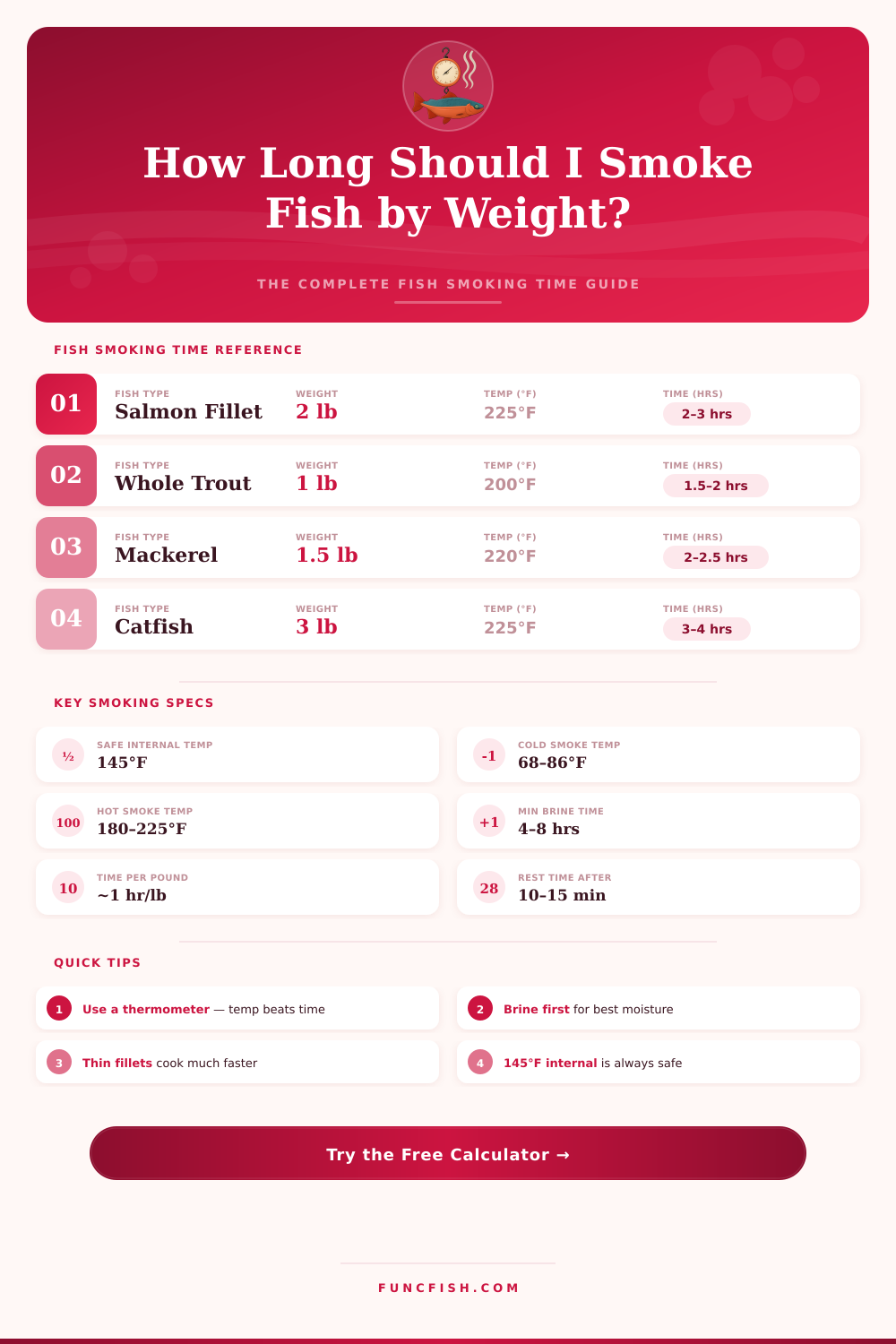
| Fish Type | Base Rate (hrs/lb) | Hot Smoke Temp °F | Target Internal °F | Fat Level | Cold Smoke Compatible |
|---|---|---|---|---|---|
| Salmon Fillet | 0.9–1.1 | 200–225 | 145 | High | Yes (6–24 hrs) |
| Whole Trout | 1.0–1.2 | 200–215 | 145 | Medium | Yes (8–12 hrs) |
| Mackerel | 0.8–1.0 | 215–230 | 145 | High | Yes |
| Catfish | 1.0–1.3 | 220–235 | 145 | Low-Med | No |
| Whitefish | 1.0–1.2 | 220–225 | 145 | Medium | Yes |
| Tuna Steak | 0.6–0.8 | 175–185 | 120–145 | Medium | No |
| Halibut | 1.0–1.2 | 215–225 | 145 | Low | No |
| Bass | 0.9–1.1 | 200–225 | 145 | Low-Med | No |
| Tilapia | 0.8–1.0 | 200–215 | 145 | Low | No |
| Herring | 0.7–0.9 | 200–220 | 145 | High | Yes (Kippers) |
| Doneness Level | Internal Temp (°F) | Internal Temp (°C) | Texture | Best For |
|---|---|---|---|---|
| Rare | 120°F | 49°C | Soft, translucent center | Tuna only |
| Mild / Lightly Smoked | 140°F | 60°C | Moist, flakes gently | Salmon, Trout |
| Moderate (USDA Safe) | 145°F | 63°C | Firm flake, moist | All species |
| Well Done | 150–160°F | 66–71°C | Firm, fully opaque | Catfish, dense fish |
| Thickness | Measurement (in / cm) | Time Multiplier | Notes |
|---|---|---|---|
| Thin | <1 in / <2.5 cm | 0.75x | Monitor closely, cooks fast |
| Medium | 1–2 in / 2.5–5 cm | 1.0x | Standard reference thickness |
| Thick | >2 in / >5 cm | 1.25x | May need to butterfly for even cook |
When smoking fish, there are several variable that must be considered in order to correctly cook the fish. Many people tend to make the mistake of only considering the weight of the fish that they are smoking. However, the weight of the fish alone dont allow for the determination of how long the fish will take to cook.
Other variables that must also be considered include the thickness of the fish, the oil content of the fish, and the smoker temperature. The cut of the fish to be smoked is one of the primary factor that will determine the cooking process of the fish. For instance, thin fish fillets will take longer to cook than thick trout fish.
What Affects Cooking Time When Smoking Fish
Should the fish that is being smoked be thick and located near the spine of the fish, it will take more longer to cook than fish that are thin like the tail of the fish. Additionally, fish that contain high amounts of oil, such as salmon, will retain moisture when smoke. In contrast, lean fish like whitefish will dry out at the edges while the center of the fish is still raw.
Fish that are thin strips will cook faster than fish that are a large side of fish due to the amount of surface area that the thin strips have to allow for the heat to reach the center of the fish. Another of the factor to consider is the type of brine that is used on the fish prior to smoking. Salting the fish will draw water out of the fishs flesh.
This allows for the smoke to penetrate the flesh of the fish. Should sugar be added to the brine, the sugar will create a glaze on the fish. This glaze will require the smoking process to last for a longer period of time.
Air drying the fish allows for the formation of a pellicle. This pellicle will allow smoke to adhere to the fish, ensuring the flavor of the smoke remains on the fishs flesh rather than the moisture of the fish. The smoker temperature will play a role in the rate at which the fish will cook.
The higher the temperature to which you set the smoker, the faster the fish will cook. For instance, setting the smoker temperature to 190 degrees will allow for the fish to cook at a faster rate than if the smoker is set to 150 degrees. Using a thermometer to measure the internal temperature of the fish is essential to ensure that the smoked fish is safe to eat.
Inserting the thermometer into the thickest part of the fish will provide the correct reading. Testing the temperature of thin parts of the fish will provide an inaccurate reading of the cooking of the fish. The thickest parts of the fish will take the longest time to cook, so testing this portion is crucial.
Due to the protein content of the fish, each type of fish will cook at a different rate and will require different heat levels to ensure that the fish remains moist and flavorful. For example, salmon contains a high level of oil that allows the salmon to retain moisture when smoked. Due to the oily nature of sablefish, using low heat when smoking sablefish will allow for the oil in the sablefish to not mask the texture of the sablefish.
Using gentle heat when smoking whitefish will prevent the edges of the whitefish from drying out. When smoked fish begins to overcook, albumin will begin to ooze from the flesh of the fish. Seeing albumin is a sign that the fish is being overcooked during the smoking process.
When the smoked fish reaches the correct internal temperature, the fish should be removed from the smoker. Smoked fish should reach an internal temperature of between 140 and 150 degrees. After the fish is removed from the smoker, the fish should be allowed to rest for eight to twenty minutes.
This resting period allows for the juices of the fish to settle within the flesh of the fish. Allowing the fish to rest ensures that the moisture of the fish remains inside the flesh rather than draining from the fish. Finally, the cook should quickly cool and wrap the smoked fish loosely to allow for the retention of the quality of the smoked fish.