🎣 Shock Leader Length & Lure Weight Calculator
Calculate the ideal shock leader length, breaking strain, and material for any lure weight and fishing technique
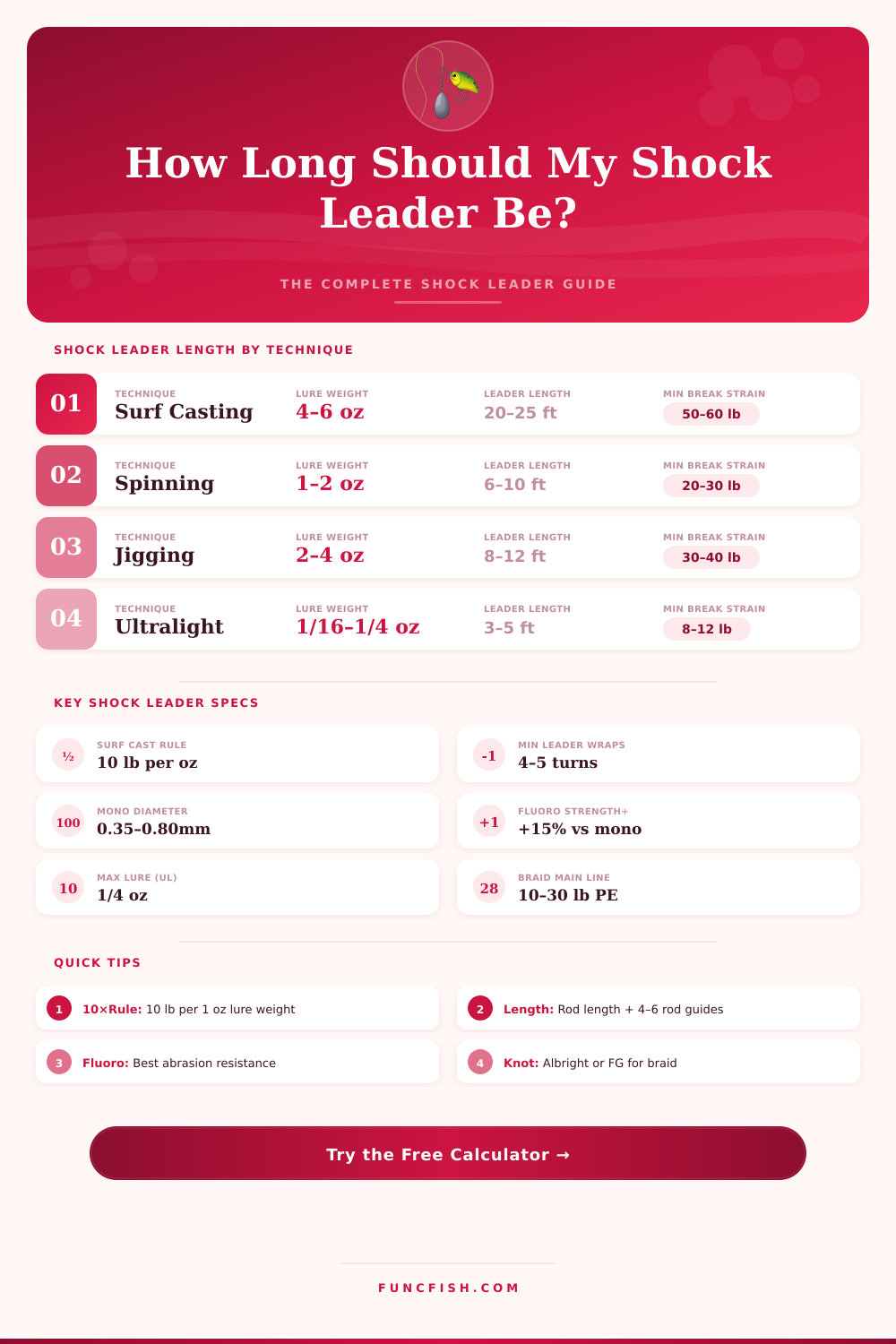
| Lure Weight (oz) | Lure Weight (g) | Min Break Strain (lb) | Min Break Strain (kg) | Suggested Length (ft) | Suggested Length (m) | Technique |
|---|---|---|---|---|---|---|
| 1/16 oz | 1.8 g | 8 lb | 3.6 kg | 3–5 ft | 0.9–1.5 m | Ultralight |
| 1/8 oz | 3.5 g | 10 lb | 4.5 kg | 4–6 ft | 1.2–1.8 m | Ultralight |
| 1/4 oz | 7 g | 12 lb | 5.4 kg | 5–7 ft | 1.5–2.1 m | Ultralight / Light |
| 1/2 oz | 14 g | 15 lb | 6.8 kg | 6–8 ft | 1.8–2.4 m | Light Spinning |
| 1 oz | 28 g | 20 lb | 9 kg | 7–9 ft | 2.1–2.7 m | Spinning |
| 2 oz | 56 g | 30 lb | 13.6 kg | 8–10 ft | 2.4–3.0 m | Spinning / Jigging |
| 3 oz | 85 g | 40 lb | 18 kg | 9–12 ft | 2.7–3.7 m | Surf / Jigging |
| 4 oz | 113 g | 50 lb | 22.7 kg | 12–18 ft | 3.7–5.5 m | Surf Casting |
| 5 oz | 142 g | 60 lb | 27.2 kg | 18–22 ft | 5.5–6.7 m | Surf Casting |
| 6 oz | 170 g | 70 lb | 31.8 kg | 20–25 ft | 6.1–7.6 m | Heavy Surf |
| Target Species | Typical Lure Weight | Recommended Leader lb | Recommended Leader kg | Material | Typical Technique |
|---|---|---|---|---|---|
| Largemouth Bass | 1/4–3/4 oz | 15–25 lb | 6.8–11.3 kg | Fluorocarbon | Spinning / Baitcast |
| Striped Bass | 2–5 oz | 30–60 lb | 13.6–27 kg | Mono / Fluoro | Surf / Shore |
| Rainbow Trout | 1/16–1/4 oz | 6–12 lb | 2.7–5.4 kg | Fluorocarbon | Ultralight Spinning |
| Northern Pike | 1–3 oz | 30–50 lb wire | 13.6–22.7 kg | Wire / Coated Wire | Casting / Trolling |
| Walleye | 1/8–1/2 oz | 12–20 lb | 5.4–9 kg | Fluorocarbon | Jigging / Spinning |
| Catfish | 2–4 oz | 30–50 lb | 13.6–22.7 kg | Heavy Mono | Bottom / Surf |
| Redfish / Red Drum | 1/2–2 oz | 20–40 lb | 9–18 kg | Fluorocarbon | Inshore Spinning |
| Snook | 1/2–1.5 oz | 20–40 lb | 9–18 kg | Fluorocarbon | Inshore Spinning |
| Technique | Leader Length (ft) | Leader Length (m) | Break Strain Rule | Best Material | Knot Connection |
|---|---|---|---|---|---|
| Surf Casting (Heavy) | 20–25 ft | 6–7.6 m | 10 lb per 1 oz | Heavy Mono / Nylon | Uni-to-Uni / Blood |
| Surf Casting (Light) | 12–18 ft | 3.7–5.5 m | 10 lb per 1 oz | Mono | Albright |
| Shore Jigging | 8–12 ft | 2.4–3.7 m | 3–4x lure weight lb | Fluorocarbon | FG Knot |
| Light Spinning | 5–9 ft | 1.5–2.7 m | 2–3x main line lb | Fluorocarbon | FG / Albright |
| Ultralight / Finesse | 3–6 ft | 0.9–1.8 m | 2x main line lb | Fluorocarbon | Double Uni |
| Inshore Braid | 6–10 ft | 1.8–3 m | 3–4x braid class | Fluorocarbon | FG Knot |
| Kayak Inshore | 6–8 ft | 1.8–2.4 m | 2–3x main line lb | Fluorocarbon | Double Uni |
A shock leaders is a piece of fishing line that is attached to a main fishing line to absorb the force that is created when a person cast their fishing lure. When a person casts their fishing lure, the lure creates force that travels through the fishing line, but the shock leader will absorb that force to prevent the main fishing line from break. If a shock leader is too short, it will not be able to absorb enough of the force that is created when a person casts there lure.
However, if a shock leader is too long, the knot on the shock leader may interfere with teh fishing reel. The weight of the lure that are being used will indicate the amount of shock leader that is needed. Because heavy lures create more inertial shock then light lures, heavy lures will require a longer shock leader to prevent the main fishing line from snapping.
How to choose the right shock leader
Additionally, the spool on the fishing reel will also affect the length of the shock leader that is needed. If a person use a shallow spool, the person will have to make sure that there are enough wrap of the fishing line on the spool to ensure that the knot does not come off of the spool during the cast. Finally, the material of the shock leader can impact the length of the shock leader that is needed.
For instance, because nylon shock leaders will stretch more than fluorocarbon shock leaders, a nylon shock leader will be able to absorb more force with fewer wrap than a fluorocarbon shock leader. In addition to the specifications of the fishing line and lure, there is other factors that will impact the length of the shock leader that is needed. For instance, the casting style can have an impact on the force that is placed on the shock leader.
Overhead cast will create less force on the shock leader than pendulum casts, meaning that pendulum casts will require longer shock leaders. Finally, the environment in which the fishing is occurring can also have an impact on the length of the shock leader that should be used. If a person encounter rocks or timber in the fishing area, their line may experience abrasion.
Abrasion of the fishing line will require the person to use a lon
The strength of the main fishing line is one of the factors that go into determining the strength of the shock leader. The shock leader need to be strong enough to handle the force that the main fishing line cannot handle. Most people use a ratio that determine the strength of the shock leader based off the weight of the lure that is to be used; typically, ten pounds of leader strength is recommended for every one ounce of the weight of the lure.
However, the strength of the shock leader may also need to be increase if the fishing rod experiences strong winds, or if the main fishing line is a low-stretch line, like braided fishing line. Braided fishing lines have very little stretch, so they require a beefier shock leader to absorb the shock that is created when the line is cast. There are a few mistake that a person may make when choosing the length of the shock leader.
For instance, if the shock leader is too short, it will exhaust its strength to absorb the force of the cast before the fishing rod has flexed to that force, reducing the distance that the person can cast their line. If the shock leader is too long, however, there will be too much slack in the line during the fish retrieve, making it difficult for the person to control the fish on the main fishing line. Additionally, the strength of the wind may have an impact on the effectiveness of the shock leader; stronger winds will place more force upon the fish lure, and lures with a large surface area for the fish to swim through (like poppers) will experience more force from the wind than metal fish lures.
Finally, a person must find a balance between the various requirement of the shock leader in order to be successful with fishing. For instance, a shorter shock leader allow for a smoother cast, but increases the chance that the main fishing line will break. A longer shock leader will provide more protection and abrasion reserve for the main fishing line, but can make the casting of the fishing line more difficult.
Each of these factor must be balanced according to the weight of the lure, the strength of the main fishing line, the style of cast that will be used, and the environment in which the fishing will occur.