🐟 Buffalo Fish Weight Calculator
Estimate your buffalo fish weight from length & girth — supports bigmouth, smallmouth & black buffalo
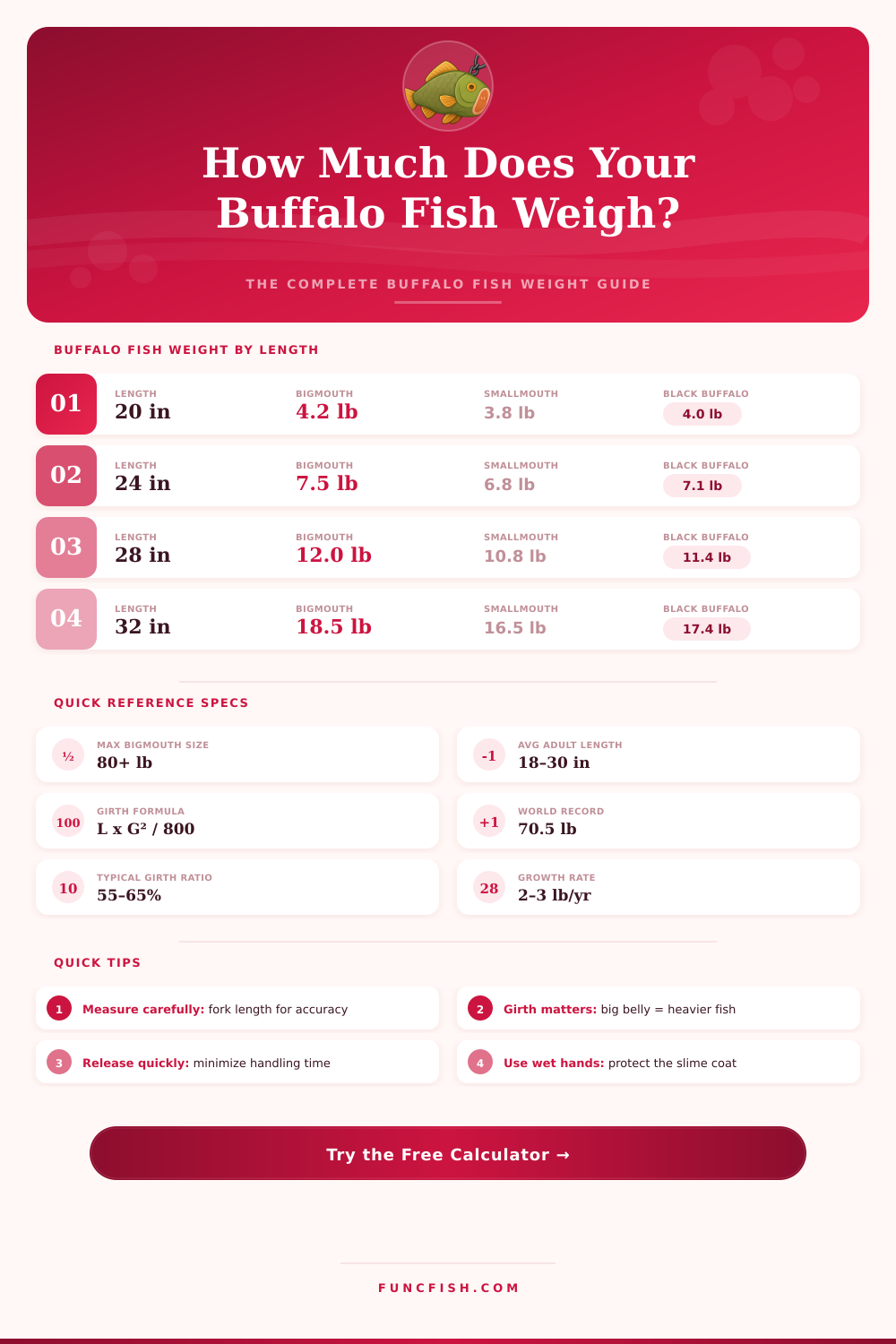
| Length (in) | Length (cm) | Bigmouth (lb / kg) | Smallmouth (lb / kg) | Black Buffalo (lb / kg) |
|---|---|---|---|---|
| 16" | 40.6 | 2.4 / 1.1 | 2.1 / 1.0 | 2.2 / 1.0 |
| 18" | 45.7 | 3.4 / 1.5 | 3.0 / 1.4 | 3.2 / 1.4 |
| 20" | 50.8 | 4.7 / 2.1 | 4.2 / 1.9 | 4.4 / 2.0 |
| 22" | 55.9 | 6.3 / 2.9 | 5.6 / 2.5 | 5.9 / 2.7 |
| 24" | 60.9 | 8.2 / 3.7 | 7.3 / 3.3 | 7.7 / 3.5 |
| 26" | 66.0 | 10.5 / 4.8 | 9.3 / 4.2 | 9.8 / 4.4 |
| 28" | 71.1 | 13.1 / 5.9 | 11.6 / 5.3 | 12.3 / 5.6 |
| 30" | 76.2 | 16.1 / 7.3 | 14.3 / 6.5 | 15.1 / 6.9 |
| 32" | 81.3 | 19.6 / 8.9 | 17.4 / 7.9 | 18.4 / 8.3 |
| 34" | 86.4 | 23.5 / 10.7 | 20.8 / 9.4 | 22.0 / 10.0 |
| 36" | 91.4 | 27.9 / 12.7 | 24.7 / 11.2 | 26.1 / 11.8 |
| 40" | 101.6 | 38.5 / 17.5 | 34.1 / 15.5 | 36.0 / 16.3 |
| 44" | 111.8 | 51.5 / 23.4 | 45.6 / 20.7 | 48.2 / 21.9 |
| Est. Weight | Rod Power | Line (lb test) | Hook Size | Leader |
|---|---|---|---|---|
| Under 5 lb | Medium | 10–15 lb | #2 – #1/0 | 12–20 lb mono |
| 5–10 lb | Medium-Heavy | 15–20 lb | #1/0 – #2/0 | 20–30 lb mono |
| 10–20 lb | Heavy | 20–30 lb | #2/0 – #4/0 | 30–40 lb mono |
| 20–35 lb | Heavy | 30–50 lb | #4/0 – #6/0 | 50 lb mono/fluoro |
| 35+ lb | Extra Heavy | 50–80 lb | #6/0 – #8/0 | 60–80 lb fluoro |
| K-Factor | Condition | Weight Multiplier | Notes |
|---|---|---|---|
| 0.80–0.89 | Lean / Poor | x0.85 | Post-spawn or low food availability |
| 0.90–1.05 | Average | x1.00 | Typical wild population baseline |
| 1.06–1.15 | Good | x1.10 | Good habitat, adequate forage |
| 1.16–1.25 | Excellent | x1.20 | Optimal environment, well-fed |
| 1.26+ | Trophy | x1.35 | Exceptional specimen, top habitat |
To estimate the weight of an buffalo fish, you will needing to take specific measurement of the fish. Even if two buffalo fish has the same length, the weight of the buffalo fish can vary. A buffalo fish can have a long and lean body, or it might have a short and barrel shaped body.
In order to calculate the weight of a buffalo fish, a calculator are used. The calculator’s equation incorporates several variable in calculating the weight of the buffalo fish. One of the variables is the girth of the buffalo fish.
How to Estimate the Weight of a Buffalo Fish
The girth of the buffalo fish is the measurement of the widest part of the belly of the buffalo fish. This measurement is crucial in calculating the weight of the buffalo fish because the girth is squared in the equation for calculating the weight. Furthermore, it is essential that you correctly apply the measuring tape to the buffalo fish in order to measure the girth of the buffalo fish correctly.
Another of the variables in calculating the weight of a buffalo fish is the species of buffalo fish. For instance, a bigmouth buffalo fish may have a different weight then a black buffalo fish. Bigmouth buffalo fish tend to be more heavier than black buffalo fish.
This can be partly due to the fact that bigmouth buffalo fish can be found in reservoirs that contains food for the buffalo fish, whereas black buffalo fish may live in rivers that fight against the river current. A bigmouth buffalo fish may have a different divisor in the calculating equation to account for the fact that the species is different from a black buffalo fish. Using the species of buffalo fish allow the equation to more accurately calculate the weight of the buffalo fish as it will not over or under-estimate the expected weight of the buffalo fish.
Another of the variables to consider in calculating the weight of a buffalo fish is the body class of the buffalo fish. A buffalo fish in the pre-spawn condition may have more mass than a buffalo fish in the post-spawn condition due to the presence of egg or milt on the buffalo fish while it is pre-spawning. Additionally, a buffalo fish in the pre-spawn condition may have more mass than a buffalo fish of the same length due to the additional bulk that the eggs adds to the fish.
A buffalo fish in the post-spawn condition may look lean and haggard. In this condition, the buffalo fish will weigh less than an adult buffalo fish of the same length. The body class of the buffalo fish is another crucial element in calculating the weight of the buffalo fish.
Furthermore, the habitat in which the buffalo fish live can have an impact on the weight of the buffalo fish. Buffalo fish in a reservoir will have more mass than buffalo fish in a river because the river buffalo fish have to fight against the current in the river. An additional measurement to consider when estimating the weight of a buffalo fish is the body depth of the buffalo fish.
By measuring the body depth, you can verify the girth measurement. If the girth measurement of the buffalo fish is large but the body depth is shallow, it is possible that the girth measurement was not correctly measure. Another of the variables to consider is the buffalo fish’s measurement confidence.
If you measured the buffalo fish on a bank it may be less accurate than if you measured it on a board using a tight measuring tape. The best way to account for this is to use a range of number for the weight of the buffalo fish instead of a specific number. The weight of a buffalo fish is important in that the weight will determine the gear that should be used to handle the buffalo fish.
The gear that is used for a fifteen pound buffalo fish should not be the same as the gear used for a fifty pound buffalo fish. Reference tables that include the different weight of buffalo fish and the gear that should be used for each weight can determine the correct gear. Smaller buffalo fish may require only a rubber fishing net in order to catch the buffalo fish.
However, giant buffalo fish require a cradle and sling to catch the buffalo fish. A sling should be used to catch large buffalo fish to avoid injuring the buffalo fish; lifting the fish by the jaw or thin net may damage the buffalo fish’s delicate internal organ. By estimating the weight of a buffalo fish, it is possible to go from feeling to a data backed estimate of the weight of the buffalo fish.
The information described in these measurement can help to learn more about the health and the age of the buffalo fish populations.