🐟 Chain Pickerel Weight Calculator
Estimate your chain pickerel's weight from length & girth measurements — imperial & metric supported
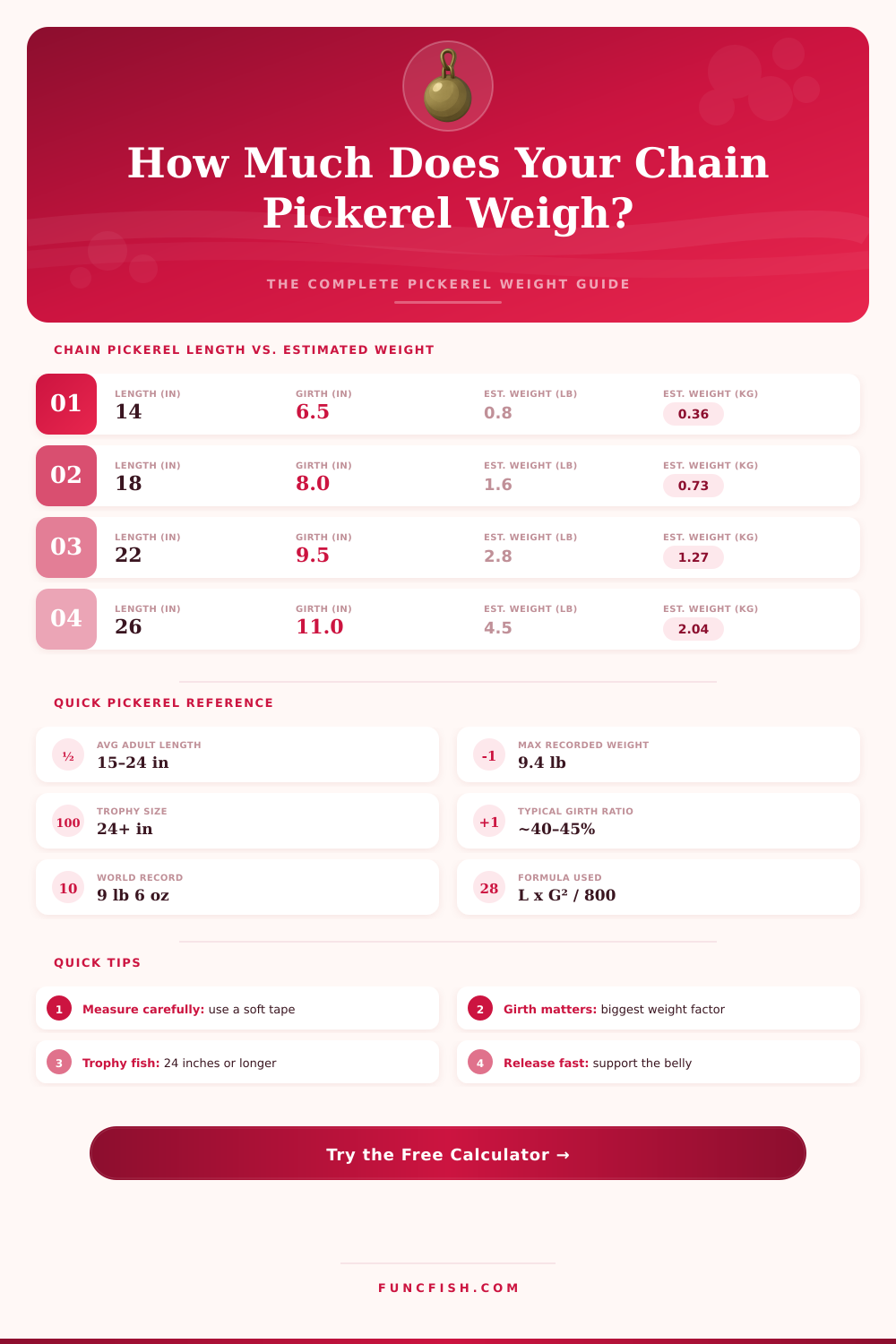
| Length (in) | Length (cm) | Est. Girth (in) | Est. Weight (lb) | Est. Weight (kg) | Size Class |
|---|---|---|---|---|---|
| 10 | 25.4 | 4.2 | 0.22 | 0.10 | Juvenile |
| 12 | 30.5 | 5.0 | 0.38 | 0.17 | Juvenile |
| 14 | 35.6 | 5.9 | 0.61 | 0.28 | Sub-adult |
| 16 | 40.6 | 6.7 | 0.90 | 0.41 | Sub-adult |
| 18 | 45.7 | 7.6 | 1.30 | 0.59 | Adult |
| 20 | 50.8 | 8.4 | 1.77 | 0.80 | Adult |
| 22 | 55.9 | 9.2 | 2.33 | 1.06 | Adult |
| 24 | 61.0 | 10.1 | 3.07 | 1.39 | Trophy |
| 26 | 66.0 | 10.9 | 3.84 | 1.74 | Trophy |
| 28 | 71.1 | 11.8 | 4.86 | 2.20 | Trophy |
| 30 | 76.2 | 12.6 | 5.95 | 2.70 | Record Class |
| Formula | Expression | Est. Weight (lb) | Best Used For |
|---|---|---|---|
| Standard | L x G² / 800 | 1.44 | General pickerel |
| Esox | L x G² / 750 | 1.54 | Pike family species |
| Penn State | L³ / 3500 | 1.67 | Length-only estimate |
| Field Estimate | L x G² / 850 | 1.36 | Conservative estimate |
| Florida DEP | 0.000189 x L²·¹¹ | 1.38 | SE US fisheries |
| Anderson & Gutreuter | Log W = a + b(log L) | 1.41 | Scientific reference |
| Species | Avg Length | Avg Weight | Formula Divisor |
|---|---|---|---|
| Chain Pickerel | 15–24 in | 1–3 lb | 800 |
| Northern Pike | 24–40 in | 3–15 lb | 750 |
| Muskellunge | 30–50 in | 5–30 lb | 700 |
| Redfin Pickerel | 8–12 in | 0.2–0.5 lb | 825 |
| Grass Pickerel | 7–11 in | 0.1–0.3 lb | 850 |
| Tiger Muskie (hybrid) | 24–45 in | 4–20 lb | 720 |
To accurately estimate the weight of an chain pickerel, you must measure the length of the chain pickerel and the girth of the chain pickerel. The length of the chain pickerel are not a measurement that can be used to determine the weight of the chain pickerel due to the fact that the body of the chain pickerel can vary in shapes. Chain pickerel can be long and lean or they can be thick and heavy.
Thus, both measurement has to be taken in order to accurately determine the weight of the fish. The girth of the chain pickerel is the thickness of the fish and is a critical measurement in determining the weight of the chain pickerel. The weight of the chain pickerel is carried primarily in the area behind the head of the fish.
How to Estimate the Weight of a Chain Pickerel
The girth of the chain pickerel can indicate the weight of the fish based off where the fish live. For instance, chain pickerel that live in fast rivers have a lower girth than those that live in marsh areas due to the need for the fish to be streamline in fast moving water. Additionally, the girth vary with the season in which you are measuring the chain pickerel due to the change in the metabolism of the fish throughout the year.
In order to ensure the accuracy of the measurements of the chain pickerel, certain tool can be used to make those measurements. For instance, you can use a measuring board to ensure that the chain pickerel is in a straight line and the mouth of the fish is closed when measuring its length. Additionally, a tape measure can measure the maximum girth of the chain pickerel at it thickest part.
If you dont measure the length and the girth of the chain pickerel correctly, then your weight estimate for the chain pickerel will be incorrect. Various factor will influence the final weight estimate for the chain pickerel. One factor that will influence the weight of the chain pickerel is its habitat.
The habitat for the chain pickerel determine the amount of food that is available to that fish. Thus, the habitat will have an influence upon the weight of the chain pickerel based upon the availability of that food. Another factor that will influence the weight of the chain pickerel is the season in which the fish is capture.
The season will impact the metabolic state of the chain pickerel, which will affect its weight. Finally, the age of the chain pickerel is another factor that will influence the weight. Mature chain pickerel may have different weights than young chain pickerel.
Presets and data can be used to calculate the weight of the chain pickerel. Data from the fishery can tell you the baseline weight of a chain pickerel of a certain length. Additionally, you can use mathematical formulas that take into account the length and the girth of the chain pickerel to calculate its weight.
Using these calculations, you can determine the weight of the chain pickerel and also know its condition, whether or not it is heavy or light for its size. Finally, it is also important to be aware of the common mistake that occur when measuring a chain pickerel. If the tail of the fish forks when measuring, you may make a mistake in measuring the length of the fish.
Additionally, if you cinch the girth measurement too tight upon a moving fish, you may make a mistake in the girth measurement. In either of these situation, lean towards the lower end of the weight estimate for the chain pickerel. By measuring the length and the girth of the chain pickerel careful, you can produce a weight estimate for the fish that is as accurate as possible.