🐟 Sauger Weight Calculator
Estimate sauger weight from length & girth — imperial & metric results instantly
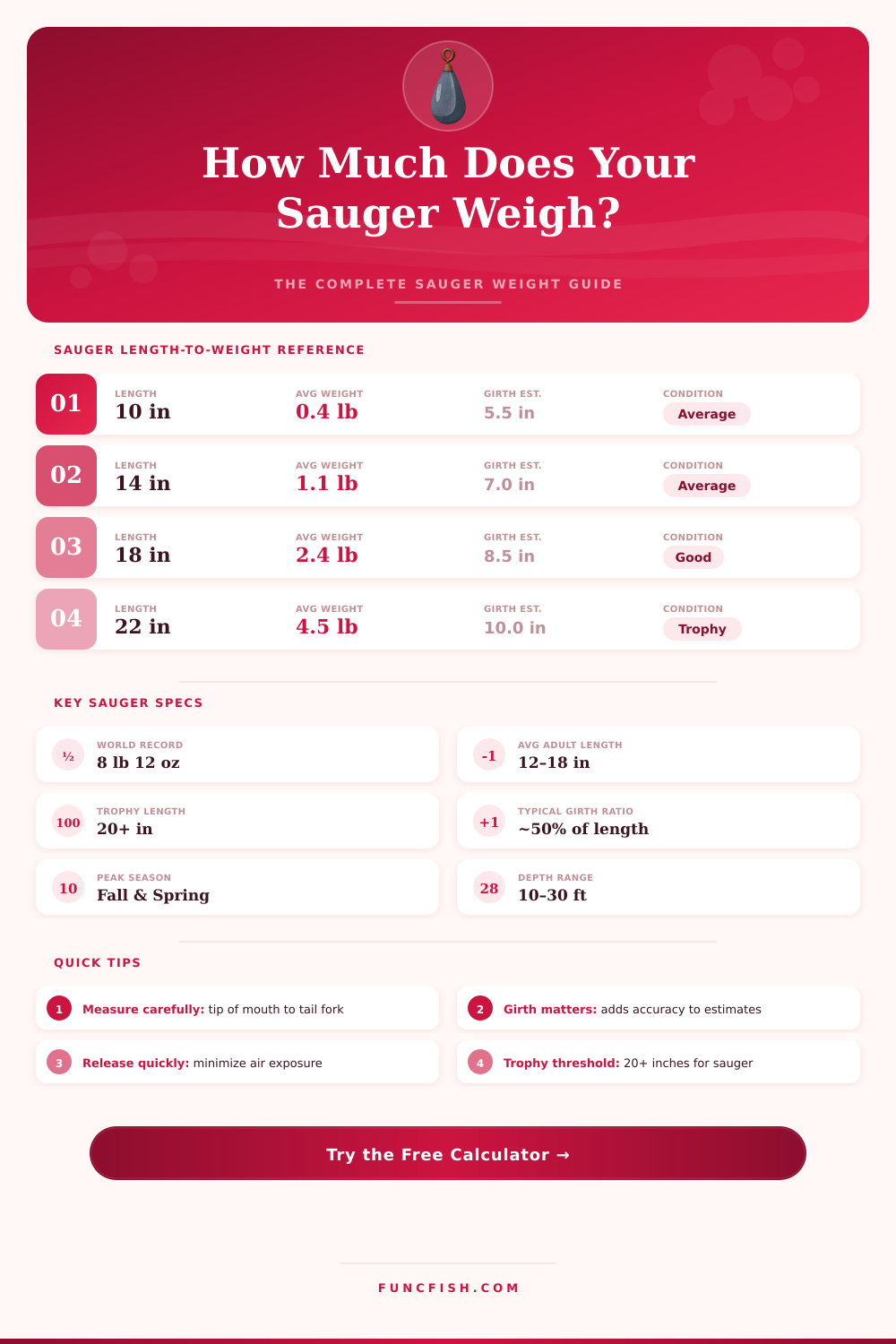
| Length (in) | Length (cm) | Est. Weight (lb) | Est. Weight (kg) | Est. Girth (in) | Classification |
|---|---|---|---|---|---|
| 8 | 20.3 | 0.18 | 0.08 | 4.0 | Juvenile |
| 10 | 25.4 | 0.38 | 0.17 | 5.0 | Juvenile |
| 12 | 30.5 | 0.66 | 0.30 | 6.0 | Sub-Legal |
| 14 | 35.6 | 1.06 | 0.48 | 7.0 | Keeper |
| 15 | 38.1 | 1.30 | 0.59 | 7.5 | Keeper |
| 16 | 40.6 | 1.59 | 0.72 | 8.0 | Keeper |
| 17 | 43.2 | 1.90 | 0.86 | 8.5 | Good |
| 18 | 45.7 | 2.26 | 1.03 | 9.0 | Good |
| 19 | 48.3 | 2.66 | 1.21 | 9.5 | Quality |
| 20 | 50.8 | 3.10 | 1.41 | 10.0 | Trophy |
| 22 | 55.9 | 4.15 | 1.88 | 11.0 | Trophy |
| 24 | 61.0 | 5.40 | 2.45 | 12.0 | Master Angler |
| Attribute | Sauger | Walleye | Saugeye (Hybrid) |
|---|---|---|---|
| Typical Adult Length | 12–18 in | 15–25 in | 14–22 in |
| Typical Adult Weight | 0.5–3 lb | 1–8 lb | 1–6 lb |
| World Record Weight | 8 lb 12 oz | 25 lb 0 oz | 13 lb 2 oz |
| Condition Factor (K) | 0.9–1.2 | 0.9–1.3 | 0.95–1.25 |
| Girth/Length Ratio | ~50% | ~52% | ~51% |
| Preferred Depth | 10–30 ft | 8–25 ft | 10–28 ft |
| Formula | Inputs Needed | Best For | Accuracy |
|---|---|---|---|
| Length² × Girth / 800 | Length + Girth (in) | Field estimate | ±10–15% |
| Length³ / Divisor | Length only (in) | Quick estimate | ±15–25% |
| Condition Factor (K) | Length (in) | Population studies | ±20% |
| Regression Formula | Length + species data | Scientific accuracy | ±5–8% |
When you catch a sauger, you may be able to find the lengths of the sauger. However, the length of the sauger dont necessarily inform you of the weight of the sauger. A bump board may allow you to find the length of the sauger, but it wont allow you to find the weights of the sauger.
Saugers of the same length can have different weight. For example, two sauger may both have the same length of 18 inches. However, one sauger can have more mass than the other due to the location in which they lives.
How to Find a Sauger’s Weight
Saugers that live in reservoirs can have more mass than those that lives in rivers. The opposite can be true, though. Saugers that live in rivers may have less mass due to the exercises that the fish must performing to swim against the river current.
The weight of the sauger can be calculated using the sauger weight calculator. This calculator employ several different variables to calculate the weight of the sauger. One of the variables is the standard weight of a sauger of a certain length.
This is the average weight of saugers of that length. Other variables that can be added to the calculator are the sauger’s girth and body depth measurement. The girth of a sauger indicate the mass of the sauger; the heavier the girth of the sauger in comparison to it length, the more massive the sauger is likely to be.
A high relative weight for the sauger means that the sauger has alot of mass throughout its body (it is a plump sauger). A low relative weight for the sauger mean that it has little mass throughout its body, it is a thin sauger. Finally, the season of the year can have an impact on the weight of the sauger.
During the pre-spawn season for saugers, female saugers are carrying egg mass, which increase the weight of the female sauger without increasing its length. During the post-spawn season, sauger fish may weigh less due to the fact that the sauger fish have used there energy reserves to build nests. The calculator is designed to account for these difference in weight due to the fact that a sauger in May is different than the sauger in November.
Additionally, the type of water in which the sauger lives can also impact the weight of that sauger. For instance, sauger lives in certain area of the river that contain more food, such as the tailrace below the dam. Due to the abundance of food in these area, the sauger can consume more food and thus weigh more.
Information regarding the water scenario in which the sauger is captured, and the class of sauger that is currently being consider, provides information regarding the food availability for the fish, as well as the energy that the sauger utilize during its life span. The confidence in the measurement of the weight of the sauger is also another factor to consider in determining the weight of the sauger. For example, you can determine the weight of the sauger through the taking of a precise measurement of the fish with a soft tape, or through the estimation of the weight of the sauger from a photograph.
The weight of the sauger from the photograph, however, may not be accurate to the actual weight of the sauger. By adjusting the confidence level for the measurement of the sauger, the calculator will provide an estimate band for the weight of the sauger. An estimate band for the weight of the sauger is a range of weights for the fish, and is more accurately than providing the calculated number for the weight of the sauger.
A trophy-class sauger is defined as a sauger that has a length of twenty-two inches, and a relative weight of the fish that indicates that the body of the sauger are deep and has a thick girth. Thus, while the length of the sauger may be twenty-two inches, the relative weight of the fish must be high to indicate a trophy-class sauger. By considering the length and the shape of the sauger, it is possible to determine the weight of the sauger.
Thus, by considering the length and the shape of the sauger, you can turn a guess as to the weight of the sauger into a calculated estimate. Thus, a calculated estimate is more accurate than a guess as to the weight of the fish.