Bluefish Weight Calculator
Estimate bluefish weight from fork length or total length, maximum girth, body depth, seasonal fatness, surf, inlet, bay, or offshore zone, fight class, gear class, and measurement confidence.
📌Bluefish presets
⚙Bluefish measurements
Snout to the end of a pinched tail. Bluefish fork length is commonly a little shorter.
Snout to the fork of the tail. Use this when a fork board or tournament fork length was recorded.
Wrap the deepest shoulder and belly area without compressing the fish.
Back-to-belly depth near the pectoral area; useful for lean racer versus bunker-fed shape.
Use a positive value if the tail was not fully pinched; use a negative value if the photo likely overstates length.
Bluefish estimate
Calculation breakdown
📊Bluefish shape data
Fork ratio
Girth signal
Depth cue
Confidence band
📘Bluefish reference tables
| Bluefish class | Total length | Common weight | Typical girth cue | Common setting |
|---|---|---|---|---|
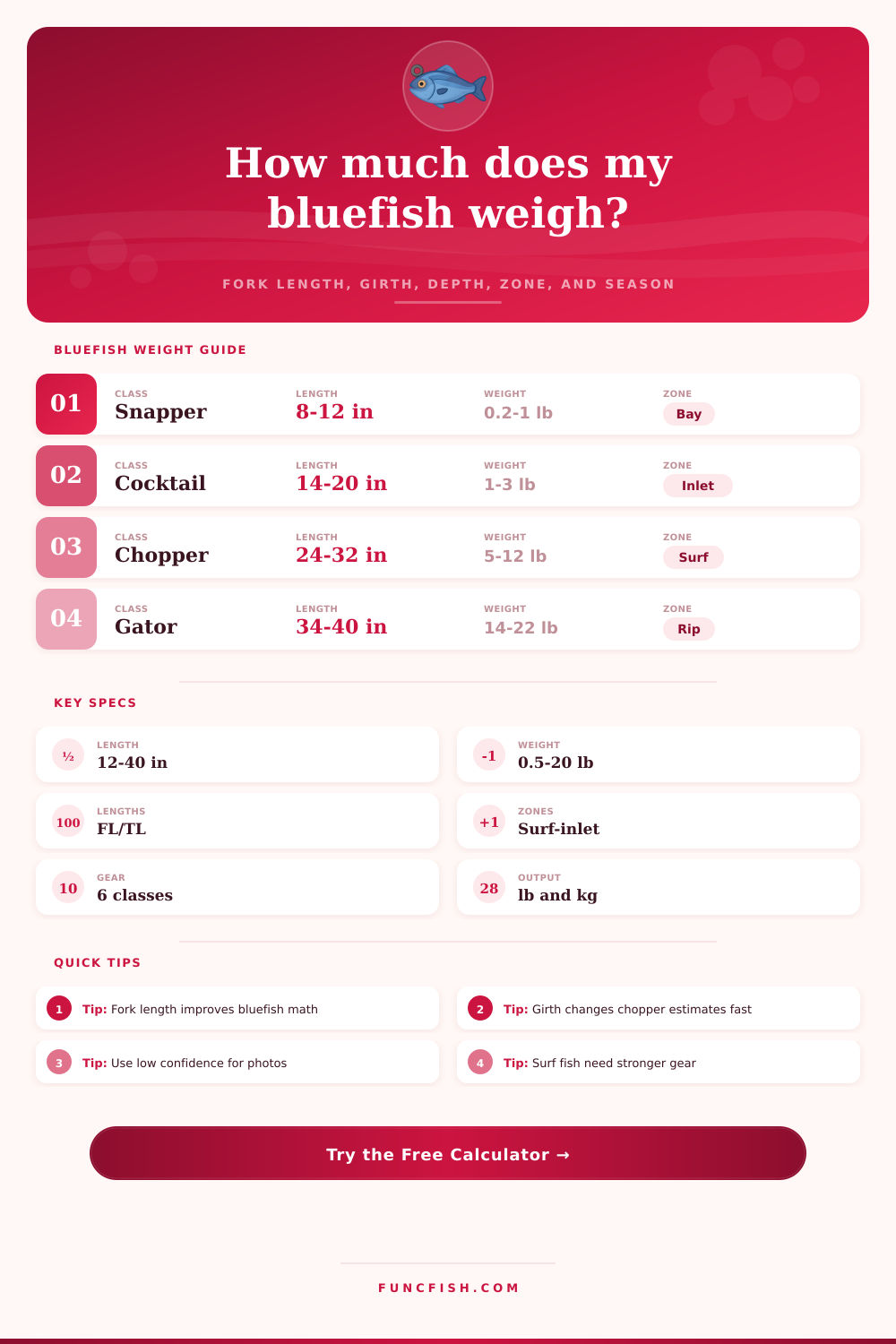
| Snapper blue | 6-12 in / 15-30 cm | 0.1-0.8 lb / 45-360 g | slim, small belly | Back bay, creeks, docks |
| Cocktail blue | 13-20 in / 33-51 cm | 1-3 lb / 0.5-1.4 kg | fast, narrow shoulders | Harbors, inlets, jetties |
| Schoolie bluefish | 20-25 in / 51-64 cm | 3-6 lb / 1.4-2.7 kg | average 50% girth ratio | Surf wash, bay channels |
| Chopper bluefish | 25-33 in / 64-84 cm | 6-13 lb / 2.7-5.9 kg | deep shoulder, thick wrist | Beach blitzes, inlet rips |
| Gator bluefish | 34-40+ in / 86-102+ cm | 14-22+ lb / 6.4-10+ kg | heavy belly and tall back | Outer bars, tide rips, bunker schools |
| Measurement | Best use | Bluefish conversion | Calculator role | Watchout |
|---|---|---|---|---|
| Total length | Most angler reports | TL = FL / 0.935 | Main input for L x G x G formula | Tail pinch changes longer fish |
| Fork length | Tournament or board records | FL = TL x 0.935 | Length-weight benchmark curve | Do not add tail length twice |
| Maximum girth | Weight-sensitive field estimate | G/TL often 0.46-0.58 | Dominates heavy chopper estimates | Soft tape should not compress belly |
| Body depth | Lean racer versus bunker fish | D/TL often 0.21-0.28 | Shape check and condition index | Exclude dorsal fin and bent posture |
| Season or feed | Fatness factor | Typical profile | Where it matters | Estimate effect |
|---|---|---|---|---|
| Spring lean migrant | 0.94 | Long, bright, narrow belly | Ocean beaches and inlets | Pulls estimate slightly lower |
| Summer average | 1.00 | Normal shoulders and belly | Most bay and surf catches | Neutral baseline |
| Late-summer mullet feed | 1.05 | Thicker belly after bait feed | Jetties and wash edges | Adds modest condition weight |
| Fall bunker-heavy fish | 1.10 | Deep shoulders, blunt belly | Bunker schools and outer bars | Raises heavy-fish estimate |
| Roe-heavy female | 1.08 | Full belly without huge girth spread | Late spring and early summer | Small upward adjustment |
| Zone | Drag factor | Common bluefish size | Fight behavior | Gear note |
|---|---|---|---|---|
| Back bay creeks | 1.00 | Snapper to cocktail | Short bursts around docks | Light wire or bite tippet |
| Rock jetty | 1.10 | Cocktail to chopper | Side pressure near stones | Leader abrasion matters |
| Open beach surf | 1.14 | Schoolie to gator | Wave pull plus head shakes | Long rod helps control line angle |
| Fast inlet rip | 1.24 | Chopper and gator fish | Current multiplies load quickly | Use heavier leader and drag margin |
| Offshore shoal | 1.08 | School fish to choppers | Boat-side circles and dives | Shorter rods can manage lift |
🎣Gear and species comparison grid
Bluefish
Wire Teeth, head shakes, and short burst speed make bite protection more important than with most similar-weight fish.Striped bass
Mono Often heavier at the same length, but tooth abrasion is much lower and fight load is steadier.Spanish mackerel
Light Slimmer body and faster slash, usually lower girth for the same fork length.False albacore
Drag Similar pelagic speed, deeper sustained runs, and no cutting teeth like a bluefish.💡Measurement tips
Fork and total length: If only one length was recorded, the calculator converts with a bluefish fork-to-total ratio before blending the formulas. Enter both when you have a good board reading.
Girth and depth: For choppers and gators, one extra inch of girth can change the estimate more than one extra inch of length. Use a relaxed soft tape at the deepest shoulder.
To estimate the weight of a bluefish, several measurement are required. Taking several measurements of the fish determine the weight of a bluefish. Besides measuring the length of the fish, you must also measure the girth of the fish to obtain an accurat weight estimate.
The girth is the measurement of the bluefish around it’s widest part. You should take this measurement at the deepest part of the bluefish near the pectoral fin. Do not squeeze teh tape measure too tight around the body of the fish.
How to Measure a Bluefish and Find Its Weight
Squeezing the tape measure too tight will give an underestimation of the girth of the fish, which will ultimately result in the underestimation of the weight of the fish. The length of the bluefish must also be measured. You can measure the length of the bluefish in two different ways: total length and fork length.
Fork length is the measurement from the snout of the fish to the fork in the tail of the fish. Total length is measured from the snout of the fish to the tip of the tail. Fork length is the standard measurement for many bluefish fishing tournament.
However, the tail of a bluefish forks at 94 percent of its total length. Therefore, you must convert the total length of the fish to the fork length of the fish for the weight calculation to be perform correctly. The total length and fork length of a bluefish can be used to calculate its weight.
The condition of a bluefish can impact the weight of the fish. The food intake of the fish will vary according to the time of year the bluefish is caught and the location where they are caught. Bluefish that are caught in the spring will often be leaner then bluefish that are caught in other months of the year.
This is due to the fact that spring bluefish have not yet consumed as many bait as bluefish that are caught in other parts of the year. Additionally, bluefish that are caught in the fall will weigh more than bluefish that are caught in other month. This is due to the fact that fall bluefish have consumed more bait.
Additionally, bluefish that are caught in inlet rips will have more body mass than bluefish that are caught in back bay areas. Therefore, you can examine the belly of the fish. If the belly is distended, this indicate that the bluefish has consumed more bait, which will result in a higher weight for the bluefish.
In order to calculate the weight of the fish, a specific mathematical formula is utilized. The formula require that you measure the girth of the bluefish and square it, and that you divide the length of the fish by 800. The result of this division can then be adjusted according to the fork length of the fish and the condition of the fish.
The result of the calculation will provide the whole weight of the fish, the relative index of the fish, and the effective load that the fish place on your fishing gear. Using this measurement, you can determine if your fishing gear was appropriate for the size of the bluefish that you caught. For instance, if you caught a large bluefish with light fishing gear, the calculation will show that the load of the bluefish test the limits of your gear.
Depending on the weight of a bluefish, there are different class of bluefish. Bluefish that weigh less than one pound is considered snappers. Bluefish that weigh between one and three pounds are considered cocktails.
Bluefish that weigh between six and thirteen pound are considered choppers. Finally, bluefish that weigh more than 20 pounds are considered gators. The girth and depth of a fish can help to determine the class of bluefish that was caught.
For instance, if the girth of the fish is more than 55 percent of its length, the bluefish is considered to be heavy. Additionally, if the depth of the fish is 26 percent of its length, then the fish are a chopper. By understanding these different measurement, people can avoid making mistake when estimating the weight of a bluefish.