Fish Feeding Rate Calculator
Estimate daily ration, meal size, percent biomass, and projected gain from species group, standing biomass, average fish weight, water temperature, life stage, FCR target, feeding frequency, and appetite condition.
🐟 Pond And Hatchery Presets
⚙ Feeding Inputs
The calculator estimates a starting ration from biomass, fish size, life stage, species feeding curve, temperature comfort zone, feed conversion target, and observed appetite. Confirm with feed trays, dissolved oxygen, and recent sample weights.
Feeding Rate Results
Calculation Breakdown
📊 Feeding Curve Data Grid
Fry
Fingerling
Juvenile
Growout
📋 Reference Tables
| Species group | Comfort temperature | Base feeding style | Ration note |
|---|---|---|---|
| Tilapia and warmwater omnivore | 77 to 86°F / 25 to 30°C | Frequent surface or tray feeding | Strong appetite in warm water |
| Catfish and bullhead | 75 to 86°F / 24 to 30°C | Floating or sinking ration | Reduce during oxygen dips |
| Carp and pond polyculture | 72 to 82°F / 22 to 28°C | Broadcast pond feeding | Natural food can support part of intake |
| Trout and salmonid | 50 to 60°F / 10 to 16°C | Small repeated rations | Falls quickly above comfort range |
| Marine finfish | 70 to 80°F / 21 to 27°C | Demand, hand, or timed feeding | Watch salinity and oxygen together |
| Life stage | Starting ration | Meal frequency | Sampling interval |
|---|---|---|---|
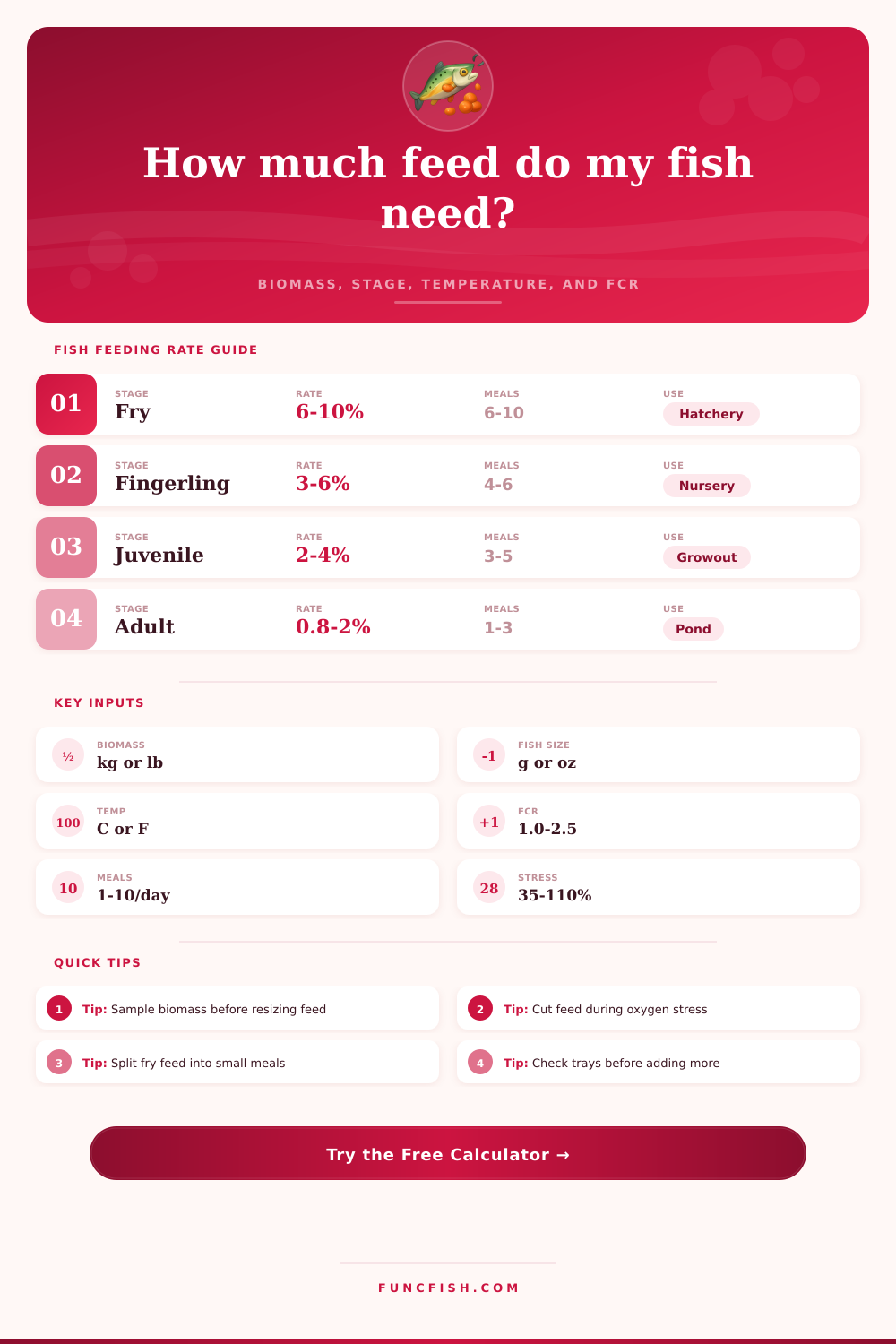
| Fry / larval nursery | 6% to 10% of biomass | 6 to 10 meals per day | Daily or every 2 days |
| Fingerling | 3% to 6% of biomass | 4 to 6 meals per day | Every 5 to 7 days |
| Juvenile | 2% to 4% of biomass | 3 to 5 meals per day | Every 1 to 2 weeks |
| Growout | 0.8% to 2.5% of biomass | 1 to 3 meals per day | Every 2 to 4 weeks |
| Broodstock / maintenance | 0.5% to 1.5% of biomass | 1 to 2 meals per day | Condition based |
| Appetite condition | Calculator factor | Use when | Feeding action |
|---|---|---|---|
| Aggressive feeding | 110% | Feed is cleared quickly and water is stable | Increase carefully after sampling |
| Normal appetite | 100% | Fish feed evenly without leftovers | Keep ration steady |
| Slightly reduced | 85% | Cool fronts, minor turbidity, or uneven feeding | Trim ration and recheck trays |
| Recent handling | 70% | Grading, transfer, vaccination, or crowding | Resume gradually after recovery |
| Low oxygen stress | 35% | Morning piping or weak feeding response | Hold feed until water stabilizes |
| Feeding frequency | Best fit | Meal size behavior | Watch point |
|---|---|---|---|
| 1 meal per day | Large growout fish in ponds | Largest single ration | Uneaten feed is easier to spot |
| 2 to 3 meals per day | Most growout and broodstock systems | Moderate ration per feeding | Good balance for labor and intake |
| 4 to 6 meals per day | Fingerlings and juveniles | Smaller gut-friendly meals | Keep feed fresh and evenly spread |
| 7 to 10 meals per day | Fry rooms and intensive nurseries | Very small repeated meals | Clean screens, trays, and drains often |
⚖ Species And Life Stage Comparison Grid
Tilapia Juvenile
3.2% Fast warmwater growth around 82°FCatfish Growout
1.8% Pond ration often limited by oxygenTrout Fingerling
3.6% Coolwater fish prefer many small mealsMarine Nursery
4.8% High protein demand and close tray checksCarp Polyculture
2.4% Natural pond food can lower prepared feedBass Juvenile
2.7% Predator fingerlings need size gradingOrnamental Fry
7.5% Tiny meals protect water qualityBroodstock
1.0% Condition and spawning cycle matter most💡 Feeding Checks
Biomass check: Recalculate after grading, mortality, transfers, or sample weights. A small weight error across thousands of fish can move the daily ration sharply.
Water check: Temperature and dissolved oxygen can override the ration. When feeding response drops, reduce feed first and rebuild only after water quality and trays look stable.
Effective fish feeding management require constant observation and adjustment of the amount of feed required by the fish based on several different variable. If the amount of feed provided to the fish are too great, the operation will waste money and the water will become polluted. If the amount of feed provided to the fish is too little, the growth of the fish will slow down and there growth cycle will become more longer.
Therefore, the amount of feed that should be provided to the fish each day is not a fixed amount, but vary based off the size of the fish, the temperature of the water, and the appetite of the fish. The temperature of the water is one of the main factor that will impact the amount of feed that the fish require. When the water temperature is within an ideal range for the species of fish that are being managed, the metabolism of the fish will increase, leading to an increased requirement for feed.
How to Feed Fish Properly
If the water is too hot or too cold for the fish, however, the appetite of the fish will decrease. Therefore, measurement of the water temperature will help to determine the amount of feed that is required by the fish. The body weight of the fish will also impact the amount of feed that the species of fish that are being managed require.
Small fish requires a high percentage of their body weight in feed compared to larger fish. For instance, fry, which are young and small fish, require 6-10% of their body weight in feed each day. Because fry have small stomachs, it is important that they are fed small amount of feed frequently each day.
Growout fish, in contrast, require only about 1 or 2% of their body weight in feed. As the size of the fish increases, the amount of feed required by their body mass decrease. Different species of fish require different amounts of feed.
For instance, warmwater omnivorous fish species, such as tilapia or catfish, will eat the broadcast pellets that is deposited into ponds that contain natural plankton. Predatory fish, such as bass, will require specific size of feed provided to the pond to avoid any fighting between the fish, and the amount of feed provided must be conservative for these species. Additionally, salmonid species will stop eating if the water temperature increase to 16 degrees Celsius or above.
Finally, fish species like carp will eat the natural plankton and detritus that are naturaly contained in the pond, so they require less prepared feed than species like tilapia. However, if the water is stressed in any way, whether from handling of the fish or a low dissolved oxygen level in the water, the appetite of the fish will decrease. The Feed Conversion Ratio, or FCR, is another measurement that can be used to determine how effective the feeding process will be for the fish farm.
FCR is a measurement of how many pounds of feed is required to gain one pound of fish weight gain. For most fish farming operation, the FCR should be between 1.2 and 1.8. If too much feed is added to the fish, though, the FCR will increase, as will the decreased profit margin for the farms profit.
To provide an estimate of the future biomass of the farms fish, the daily ration of feed may be divided by the FCR. However, because these estimations are often not accurate, sampling the fish will ensure that the estimated biomass of the farms fish is accurate. If the biomass is estimated incorrect by 10%, for example, then the calculation of the amount of feed that should be provided to the fish each day will also be incorrect.
Fish feeding tray can be used to monitor the appetite of the fish. If the fish consume the feed provided in the feeding tray within two minute, the amount of feed should be increased. If there is any remaining feed after five minute, though, the amount of feed should be decreased.
The frequency with which the fish are fed should also be managed. For instance, fry should be fed many times each day with small portions of feed, while larger fish may be fed fewer times each day. Dissolved oxygen level in the water must be accounted for prior to determining the amount of feed that should be provided to the fish.
If the dissolved oxygen level in the pond is below 4 mg/L in the morning, feeding the fish should be avoided altogether. Additionally, static amount of feed should not be provided to the fish each day, as they grow in size every few weeks. The amount of feed should be recalculated each time that the fish are sampled.
By monitoring the water, the different species of fish in the farm, the weight of the fish, and the feeding trays, the fish farming operation will be able to effectively manage the feeding of its fish.