🚛 Trailer Dovetail Angle Calculator
Calculate the precise dovetail ramp angle, rise, run, and ground clearance for any trailer configuration
| Deck Height (in / cm) | Dovetail Length (in / cm) | Angle (°) | Angle Rating | Effective Rise/Run |
|---|---|---|---|---|
| 12 in / 30.5 cm | 30 in / 76.2 cm | 23.6° | Moderate | 1:2.5 |
| 16 in / 40.6 cm | 36 in / 91.4 cm | 26.4° | Moderate | 1:2.25 |
| 18 in / 45.7 cm | 48 in / 121.9 cm | 22.0° | Good | 1:2.67 |
| 20 in / 50.8 cm | 48 in / 121.9 cm | 24.6° | Good | 1:2.4 |
| 20 in / 50.8 cm | 60 in / 152.4 cm | 19.5° | Excellent | 1:3 |
| 24 in / 61.0 cm | 54 in / 137.2 cm | 26.6° | Moderate | 1:2.25 |
| 24 in / 61.0 cm | 72 in / 182.9 cm | 19.4° | Excellent | 1:3 |
| 28 in / 71.1 cm | 60 in / 152.4 cm | 25.0° | Good | 1:2.14 |
| 30 in / 76.2 cm | 72 in / 182.9 cm | 22.6° | Good | 1:2.4 |
| 36 in / 91.4 cm | 96 in / 243.8 cm | 20.6° | Good | 1:2.67 |
| Trailer Type | Typical Deck Ht. | Recommended Dovetail | Ideal Angle | Notes |
|---|---|---|---|---|
| Car Hauler | 18–22 in | 48–60 in | 18–22° | Low-profile needed |
| Equipment / Tag | 22–28 in | 54–72 in | 18–24° | Heavy loads |
| Gooseneck Flatbed | 26–34 in | 60–84 in | 18–22° | Long dovetail common |
| Lowboy / Tilt | 14–20 in | 36–60 in | 15–20° | Very low clearance |
| Utility Trailer | 14–18 in | 30–48 in | 20–28° | ATV/UTV use |
| Dump Trailer | 24–32 in | 48–60 in | 22–28° | Structural strength key |
| Motorcycle Trailer | 12–16 in | 24–36 in | 18–24° | Light duty frame ok |
| Boat Trailer | 10–16 in | 36–48 in | 14–20° | Shallow angle preferred |
| Material | Yield Strength | Density (lb/in³) | Corrosion Resistance | Best Use |
|---|---|---|---|---|
| Mild Steel (A36) | 36,000 psi / 248 MPa | 0.284 | Low (needs coating) | General purpose |
| HSS Tube Steel | 46,000 psi / 317 MPa | 0.284 | Low (needs coating) | Structural frames |
| AR400 Wear Steel | 200,000 psi / 1,379 MPa | 0.284 | Moderate | High-wear dovetails |
| Aluminum 6061-T6 | 40,000 psi / 276 MPa | 0.098 | Excellent | Lightweight trailers |
| Aluminum 5052-H32 | 28,000 psi / 193 MPa | 0.097 | Excellent | Marine/boat use |
| Galvanized Steel | 36,000 psi / 248 MPa | 0.284 | Good | Outdoor/weather use |
| Stainless 304 | 30,000 psi / 207 MPa | 0.290 | Excellent | Marine environments |
| Chromoly 4130 | 95,000 psi / 655 MPa | 0.283 | Low (needs coating) | Performance/racing |
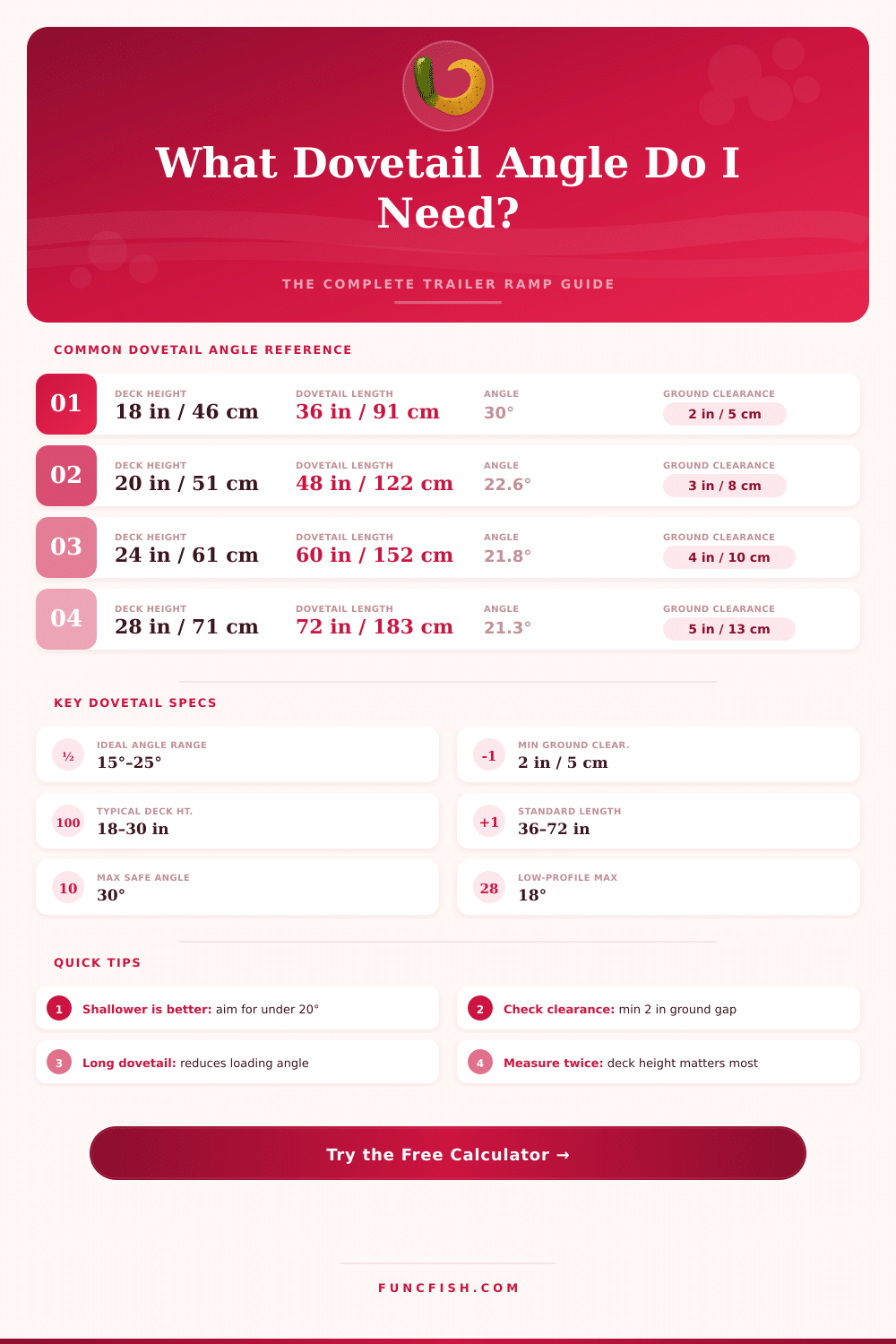
For most loading scenarios, a dovetail angle under 25° prevents vehicle hang-ups and reduces stress on the hinge point. For low-clearance vehicles (sports cars, race trailers), target 18° or less. Increasing the dovetail length by 12 inches typically reduces the angle by 2–4° depending on deck height.
Always verify the tip of the dovetail clears the ground when the trailer is level. A minimum of 2 inches (5 cm) of clearance is recommended for standard use; 3–4 inches for off-road or uneven surfaces. Trailer sag under load can reduce ground clearance by 0.5–2 inches — factor this into your design.
The dovetail angle of a trailer is something that comes up a lot during building or buying a trailer. There is no perfect angle that works for every case. It depends a lot on the kind of gear being loaded and on the height the deck of the trailer sits above the ground.
A simple way to figure out the angle is to park the trailer level from front to back. Then take a piece of lumber for instance 2×4 or 1×4, cut it to the length of the planned dovetail, and hold it against the back of the trailer, copying the slope. Like this you can measure the angle easily in degrees.
How to Pick and Measure a Trailer Dovetail Angle
The created “pie shape” will be half on every side.
Another way is to lay a piece of material, just as big as the sides of the trailer, flat on the floor. Then lay a five-foot piece of same material on top, angled according to the way of the dovetail. Mark where the two pieces cross at the upper and bottom edges.
Then measure the angle or make a temlpate and copy it to the real pieces.
The angle itself is not that important. A cheap protractor from a store like Walmart or Staples does the job just fine.
Most dovetails are around three to four feet long with a drop of only four inches or so. A two-foot dovetail does not work well. An 18-foot trailer is a bit too short anyhow.
Better is a 22-foot trailer with a 20-foot deck and a two-foot dovetail. For building one, 2×2 angle iron in 3/16 or 1/4-inch thickness is all you need. One builder used four-inch angle from 3/8-thick material, welded to the sides flush with the deck.
That gave a two-inch drop in 16 inches on the dovetail.
Some trailers come with a 12.5-degree angle on a 12-foot dovetail, which makes loading and off-loading easy. Slide-out ramps on a straight deck trailer can create a loading angle from the ground of around 22 to 23 degrees.
Hydraulic dovetails deserve attention. There angle is much less aggressive than with tilt decks. They get rid of losing full deck space, because ramps do not need to be flipped up or locked in a high position.
They make loading and unloading of vehicles easier. If weight does not matter, they are a great choice.
Without a dovetail you need seriously long ramps to reach a good angle. Think about dealing with a set of 10-foot ramps that must be strong enough to support a tractor. A dovetail also keeps gear like mowers or box blades from dragging during loading.
Even so mind this: a dovetail can act like an anchor when you pull off the road, especially from pavement to off-roadsituations without road prep.
A trailer dovetail angle calculator can also help. It takes into account the length and height of the trailer, the load weight, and axle position to figure out the right angle for balanced load distribution.