Trolling RPM Calculator
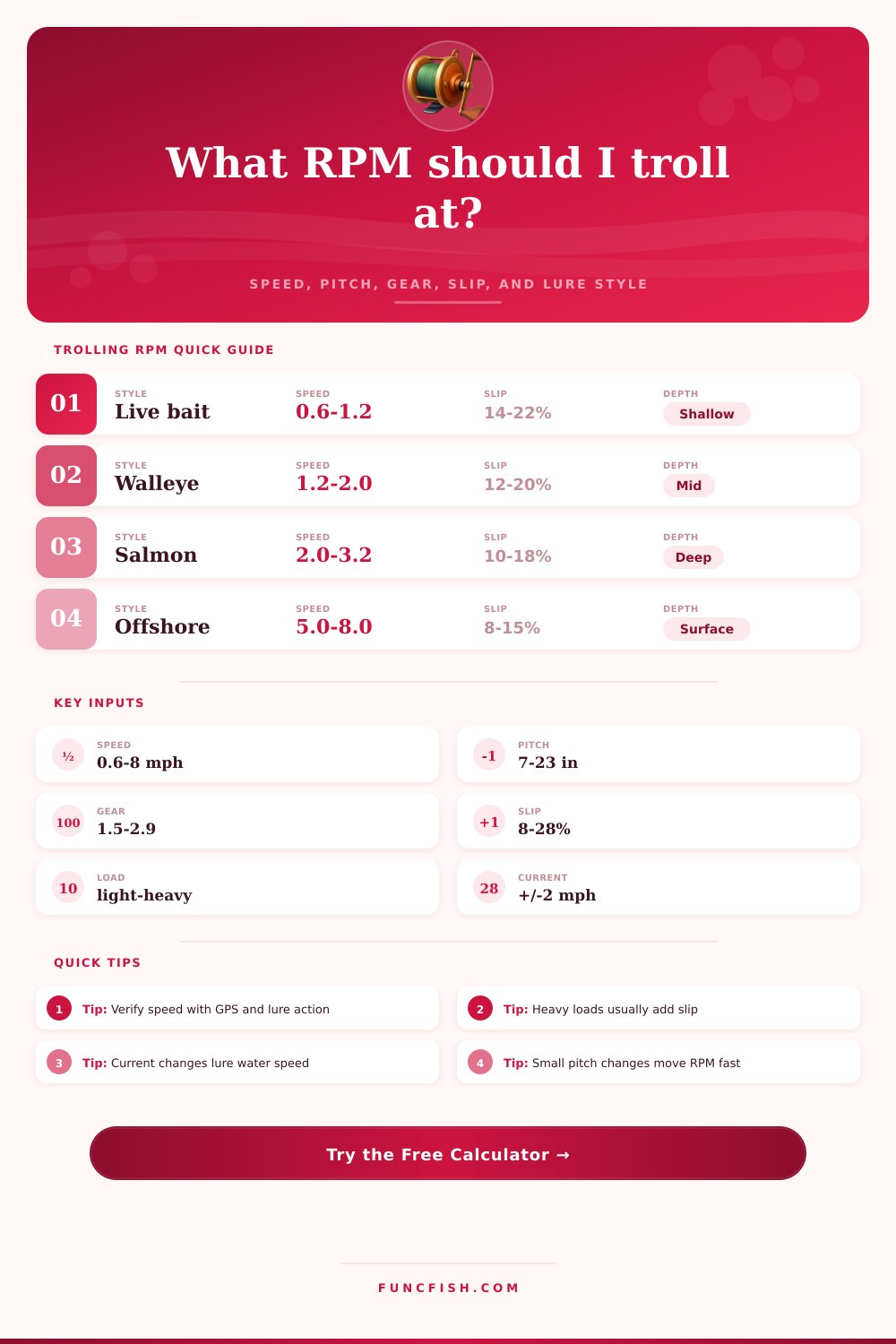
Estimate engine RPM, prop RPM, corrected trolling speed, and slip/load score from target speed, prop pitch, gear ratio, slip, boat load, wind or current, lure depth, and lure speed style.
📌Trolling Presets
⚙RPM Inputs
Enter positive wind/current correction when the boat must push against current, wind, or lure drag to keep the lure working. Enter negative correction for a following current.
Trolling RPM Results
Full breakdown
📊Boat, Prop, And Lure Comparison Grid
Kicker Motor
Walleye Boat
Salmon Rig
Offshore Spread
📋Reference Tables
| Trolling style | Typical speed | Common lure depth | RPM note |
|---|---|---|---|
| Live bait slow roll | 0.6-1.2 mph / 1.0-1.9 km/h | 5-25 ft / 1.5-7.6 m | Use steady idle or kicker range |
| Kokanee dodger and hoochie | 1.0-1.6 mph / 1.6-2.6 km/h | 10-60 ft / 3-18 m | Small changes affect lure kick |
| Walleye crankbait | 1.4-2.4 mph / 2.3-3.9 km/h | 8-30 ft / 2.4-9.1 m | Watch current and turn speed |
| Salmon spoon or flasher | 2.0-3.2 mph / 3.2-5.1 km/h | 25-120 ft / 7.6-37 m | Deep gear adds drag and slip |
| Offshore skirt or plug spread | 5.0-8.0 mph / 8.0-12.9 km/h | 0-20 ft / 0-6.1 m | Main engine RPM dominates |
| Prop setup | Pitch range | Likely slip at troll | Best use |
|---|---|---|---|
| Low-pitch kicker prop | 7-9 in / 178-229 mm | 18-28% | Slow bait and precise boat control |
| All-purpose aluminum prop | 13-17 in / 330-432 mm | 14-24% | Multi-species trolling and cruising |
| Stainless fishing prop | 15-21 in / 381-533 mm | 10-20% | Heavier boats and clean bite |
| High-pitch offshore prop | 19-23 in / 483-584 mm | 8-16% | Fast spreads in open water |
| Load condition | Slip add | RPM effect | Use in calculator |
|---|---|---|---|
| Solo light load | -1% | Lower RPM needed | Clean hull, low gear weight |
| Two anglers normal gear | 0% | Baseline RPM | Typical day setup |
| Family and full livewell | +2% | Moderate RPM increase | Extra people and fluids aboard |
| Heavy tackle and fuel | +4% | Higher RPM needed | Loaded offshore or tournament gear |
| Rough water trim-down | +5% | Less efficient push | Control priority over efficiency |
| Wind/current sign | Example | Speed correction | Result meaning |
|---|---|---|---|
| Positive correction | Head current or head wind | Adds to through-water target | RPM rises to hold lure action |
| Near zero | Calm lake, light drift | Uses target speed directly | Baseline prop calculation |
| Negative correction | Following current | Subtracts from through-water target | RPM drops for same ground pace |
| Crosswind drag | Planer boards pulling wide | Use small positive value | Accounts for sideways load |
🎣Setup Matching Cards
Slow Bait
0.8 mph target with low pitch and high slip toleranceCrankbait
1.9 mph target where turns and current change actionDeep Spoon
2.6 mph target with cable, ball, or diver dragFast Spread
6.5 mph target where main engine RPM is expectedℹRPM Tips
Speed check: GPS shows speed over ground, while lure action follows water speed. In current, compare both directions and average the RPM that makes the lure work cleanly.
Slip check: If real RPM is much higher than the estimate, inspect load, trim, prop condition, weed drag, and whether the prop pitch is too tall for slow trolling.
Trolling RPM is the number of revolution that the engine performs in one minute while trolling a boat. The RPM that a fisherman uses when trolling will affect the speed of a fishing lure that is being used. If the trolling RPM are too high, the lure will move too fast for the fish.
Alternatively, if the trolling RPM is too low, the lure will move too slowly and the fish may not be interested in the lure. Many angler will use the GPS to determine the trolling speed that the boat is traveling. However, the GPS will only measure the speed of the boat over ground, not the speed of the fishing lure through the water.
How Trolling RPM Affects Lure Speed
The speed that the fishing lure is traveling can be effect by a few different factor related to the trolling boat. For instance, the pitch of the propeller is the distance that the propeller blades travels forward during one complete revolution of the propeller. The pitch of the propeller will impact the amount of thrust that the propeller creates.
The gear ratio of the boat is the relationship between the number of rotations of the engine crankshaft versus the propeller. The gear ratio determine how fast the propeller will move based off the speed of the engine. Finally, the prop slip is the difference between the theoretical distance that the propeller should travel versus the actual distance that the propeller move through the water.
Prop slip occur due to the resistance of the water against the propeller. Prop slip is typically between five and twenty-five percent of the theoretical distance of the propeller movement. If an angler dont account for prop slip, the trolling speed that is displayed on the GPS may not reflect the actual speed that the fishing lure is traveling.
The load of the boat and the environment in which the trolling fish are found can alter the trolling RPM that should be used. For example, an empty boat will move more easy than a boat that is heavy with added items. Thus, a heavy boat will require a higher trolling RPM to move at the same rate as a light boat.
Additionally, the speed of the boat can change according to environmental factor like the wind or current in the water. If trolling against a current in the water, you will have to increase trolling RPM to maintain a steady position within the water. Alternatively, if trolling with the current the boat will travel at a faster rate, thus, trolling RPM will have to be decreased.
The different type of fishing lures have different recommended trolling speeds and trolling RPMs. For instance, live bait rig will move at a slow trolling speed of approximately one mile per hour. However, deep spoons and other heavy lure may require trolling speeds of at least two-point-five miles per hour.
Additionally, depending upon the trolling speed that is required with a given type of lure, different types of propellers may have to be utilized. For instance, short propellers with a seven to nine inch pitch are used for trolling speeds that is lower than those that use taller propellers with a greater pitch. In addition to calculating the trolling speed by the items described above, a trolling motor may have preset for trolling speeds for different scenarios.
For instance, if trolling for crankbaits with a fifteen-inch pitch propeller with a two-to-one gear ratio, there will be a preset trolling speed that is calculate for the boat load and water current. Additionally, if the engine speed is below seven hundred RPMs, the trolling motor will indicate that the motor is idling too low for the trolling speed that is required. Similarly, if trolling RPMs is too high, the trim of the boat can be adjusted.
Finally, the speed of the boat as measured by the GPS may not match with the speed of the fishing lure. The GPS will measure the speed of the boat over the ground, but the fishing lure moves at a speed based upon the movement of the boat through the water. Thus, factors like the depth of the water, the tension of the fishing line, and the wind will impact the trolling RPM of the boat.
If the trolling RPM calculated by the angler do not match the actual speed of the boat being trolling at, there may be an issue with the propeller or hull of the boat. Thus, if there is a difference in speed between the calculated trolling RPM and the speed at which the fishing lure is moving, the angler should of check the propeller for damage and check the hull for slime build up. Thus, by ensuring that trolling RPM is set to the proper rate, the angler can ensure that the fishing lure move at the appropriate rate to attract the attention of the fish.