⛵ Boat Horsepower Calculator
Find the ideal engine HP for your boat based on weight, length, boat type & use case
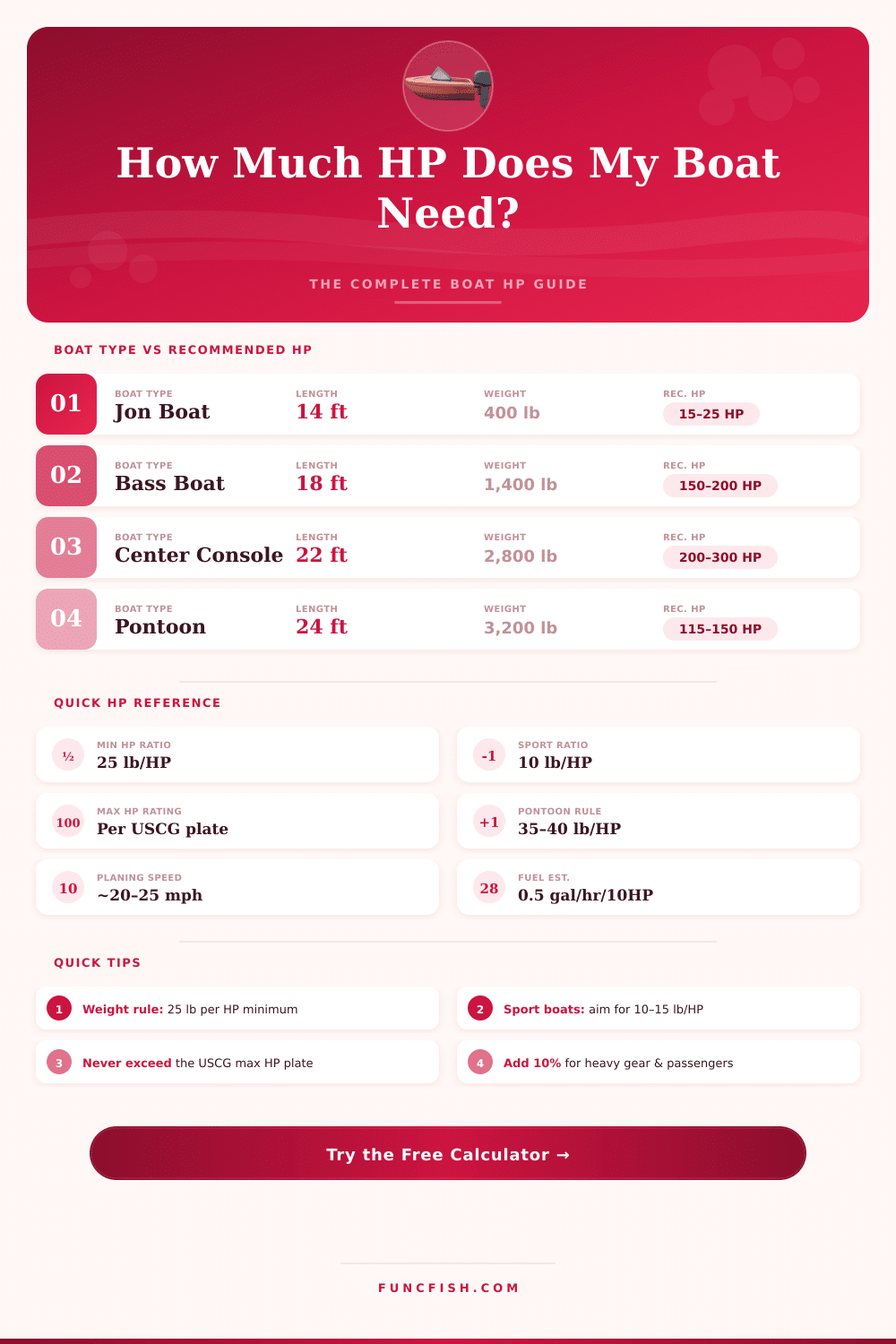
| Boat Type | Typical Length | Loaded Weight | Min HP | Rec. HP | Max HP | lb/HP Ratio |
|---|---|---|---|---|---|---|
| Jon Boat | 10–16 ft (3–5 m) | 300–600 lb (136–272 kg) | 10 HP | 15–25 HP | 40 HP | 20–30 lb/HP |
| Bass Boat | 17–21 ft (5.2–6.4 m) | 1,200–1,800 lb (544–816 kg) | 115 HP | 150–200 HP | 250 HP | 8–12 lb/HP |
| Center Console | 18–28 ft (5.5–8.5 m) | 2,000–4,000 lb (907–1,814 kg) | 150 HP | 200–300 HP | 400+ HP | 10–18 lb/HP |
| Pontoon Boat | 20–28 ft (6–8.5 m) | 2,800–4,500 lb (1,270–2,041 kg) | 60 HP | 115–150 HP | 200 HP | 25–40 lb/HP |
| Bowrider | 17–23 ft (5.2–7 m) | 1,800–3,200 lb (816–1,451 kg) | 100 HP | 135–175 HP | 250 HP | 12–20 lb/HP |
| Flats Skiff | 14–18 ft (4.3–5.5 m) | 800–1,400 lb (363–635 kg) | 20 HP | 25–60 HP | 90 HP | 15–25 lb/HP |
| Inflatable / RIB | 10–17 ft (3–5.2 m) | 400–900 lb (181–408 kg) | 15 HP | 25–50 HP | 70 HP | 12–22 lb/HP |
| Deep V Hull | 21–28 ft (6.4–8.5 m) | 3,000–5,500 lb (1,360–2,495 kg) | 200 HP | 250–400 HP | 600 HP | 10–15 lb/HP |
| Motorized Kayak | 10–14 ft (3–4.3 m) | 200–500 lb (91–227 kg) | 2 HP | 3–6 HP | 9.9 HP | 35–60 lb/HP |
| Walleye Boat | 17–21 ft (5.2–6.4 m) | 1,400–2,400 lb (635–1,089 kg) | 75 HP | 115–150 HP | 200 HP | 12–18 lb/HP |
| Performance Goal | lb/HP Target | kg/kW Target | Approx. Top Speed | Best For |
|---|---|---|---|---|
| Trolling / Displacement | 50–80 lb/HP | 30–49 kg/kW | 5–10 mph | Slow trolling, rivers |
| Economical Cruising | 30–50 lb/HP | 18–30 kg/kW | 10–18 mph | Pontoons, leisure |
| Planning / General Use | 20–30 lb/HP | 12–18 kg/kW | 18–28 mph | Fishing, family boats |
| Moderate Performance | 12–20 lb/HP | 7–12 kg/kW | 28–40 mph | Bass boats, watersports |
| High Performance | 8–12 lb/HP | 5–7 kg/kW | 40–60 mph | Tournament bass, offshore |
| Sport / Racing | Under 8 lb/HP | Under 5 kg/kW | 60+ mph | Performance boats |
| Fishing Type | Typical Boat | Rec. HP Range | Key Consideration |
|---|---|---|---|
| Bass Tournament | Bass Boat 18–21 ft | 175–250 HP | Fast travel between spots |
| Offshore / Bluewater | Center Console 22–28 ft | 250–400+ HP | Safety in rough conditions |
| Inshore / Flats | Flats Skiff 16–18 ft | 25–60 HP | Shallow draft, quiet |
| Walleye Trolling | Walleye Boat 18–20 ft | 115–150 HP | Speed control & range |
| Pond / Small Lake Bass | Jon Boat 12–16 ft | 10–25 HP | Quiet, maneuverability |
| River Catfishing | Jon/Flat Bottom 16–18 ft | 40–75 HP | Current handling ability |
| Ice Fishing Access | Small Aluminum 14–16 ft | 25–50 HP | Light weight, trailering |
| Charter / Guide Boat | Center Console 22–26 ft | 200–350 HP | Passenger load, reliability |
Horsepower is a unit of power that equals 550 foot-pounds per second One uses it mainly to measure the power of engines in cars and boats, although it first served to describe the power of the steam engine that James Watt made. Just think of it like this: one horsepower can lift 550 pounds one foot in one second.
How much horsepower does a boat really need? For every 40 pounds of weight, the engine needs one horsepower on smooth waters to reach 20 miles per hour. A boat weighing 4,000 pounds needs around 100 horsepower for steady smooth cruisng.
How Much Horsepower Does a Boat Need?
A small engine works for slow fishing on small lakes, but to cross strong currents or for more speed you need bigger power.
Some follow this general rule: 25 to 40 pounds of weight for one horsepower. To count the horsepower, divide the weight of the boat by 25 for the high end or by 40 for the low end. Another rule of thumb says 4 horsepower for every 1,000 kilos of weight.
All that matters is the weight of the full ship and the speed the owner wants.
The horsepower rating on a capacity plate does not deal with speed. It relates only to weight. The U.S. Coast Guard Federal Boat Safety Act of 1971 requires that boats under 20 feet long with engines made after November 1 1972 have a capacity plate with safe load limits, including maximum horsepower.
Boats over 20 feet do not need to show horsepower or maximum number of people.
In the rules is a exact formula. It reduces to: twice the length of the boat times the width of the transom, minus 90, equals the rated horsepower. The rule of thumb for minimum power is no less than 75 percent of the maximum horsepower rating for that boat.
Boating on calm lakes is different from sailing in rough coastal waters. More severe conditions usually require more power to control the ship. Engines with more horsepower cost more, consume more fuel and can need more care.
The less horsepower, the more plow effect. A big engine raises the front part, cuts through waves and reaches more speed in less RPM. Too much power adds weight to the back, and some boats then take on water.
Many customers choose the maximum engine because you can always slow down, but adding power later isnot possible.