⚓ Boat Propeller Thrust Calculator
Calculate propeller thrust from diameter, pitch, RPM & efficiency — imperial & metric
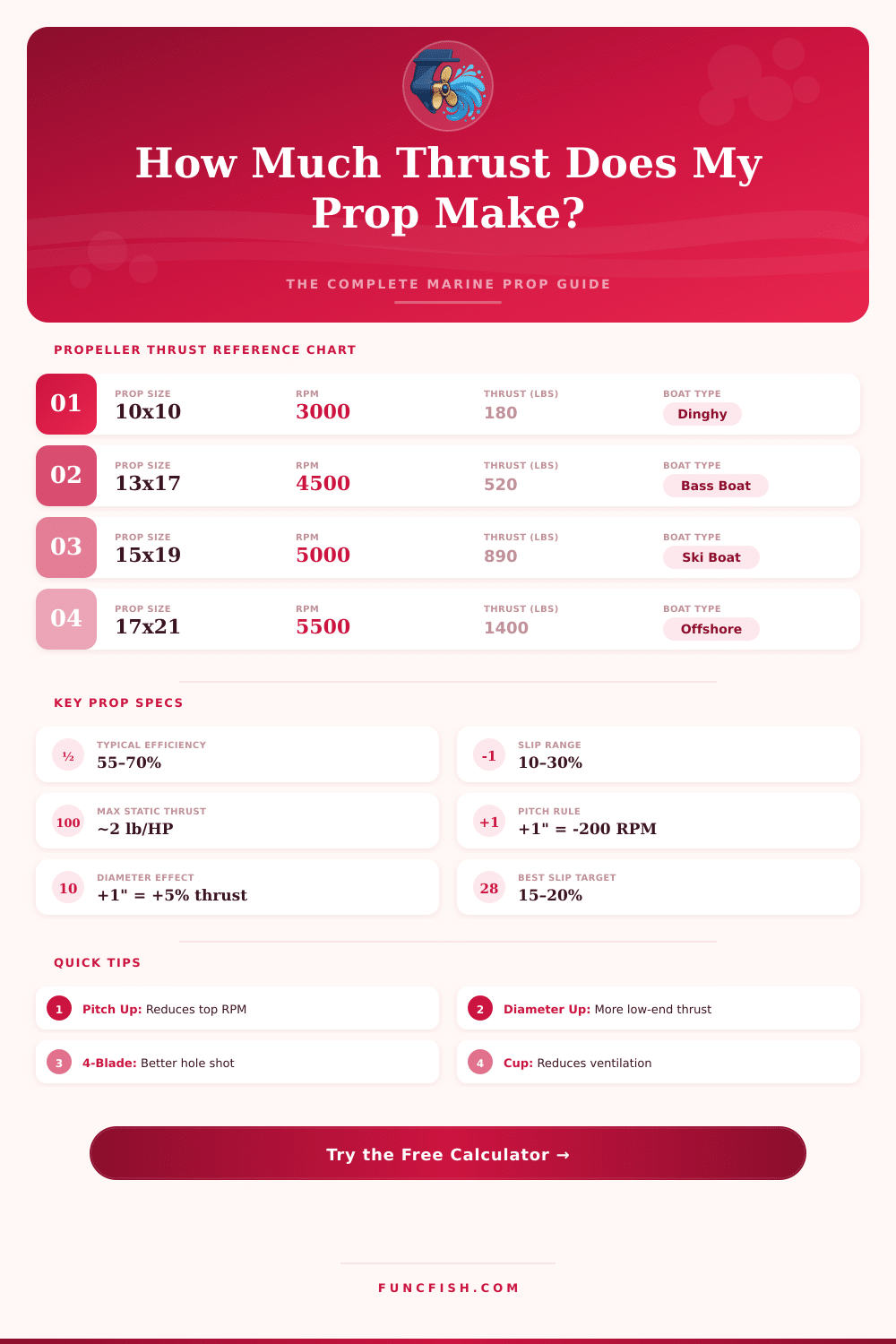
| Boat Type | Typical HP | Prop Diameter | Prop Pitch | WOT RPM | Est. Thrust (lbs) |
|---|---|---|---|---|---|
| Kayak Motor / Small Dinghy | 2–5 HP | 7–9" | 6–8" | 4000–5000 | 40–100 |
| Jon Boat / Aluminum | 10–25 HP | 9–11" | 9–13" | 4500–5500 | 100–250 |
| Bass Boat | 50–250 HP | 13–15" | 17–21" | 5000–6000 | 300–900 |
| Pontoon Boat | 60–150 HP | 13–15" | 13–17" | 4500–5500 | 350–700 |
| Ski / Wakeboard Boat | 300–450 HP | 15–16" | 14–16" | 4200–4800 | 1000–1800 |
| Center Console | 150–400 HP | 15–16" | 17–21" | 5000–6000 | 700–1500 |
| Offshore Cruiser | 400–1000+ HP | 17–22" | 19–26" | 3000–4500 | 2000–5000+ |
| Trolling Motor (Electric) | 0.5–2 HP eq. | 8–10" | 8–10" | 900–1200 | 30–112 |
| Material / Type | Efficiency | Typical Slip | Blade Flex | Best For | Durability |
|---|---|---|---|---|---|
| Aluminum 3-Blade | 55–60% | 18–25% | High | Recreational / Budget | Moderate |
| Aluminum 4-Blade | 57–62% | 16–22% | High | Pontoon / Heavy Loads | Moderate |
| Stainless 3-Blade | 62–70% | 12–18% | Low | Speed / Performance | High |
| Stainless 4-Blade | 63–71% | 11–17% | Low | Hole Shot / All-Round | High |
| Composite 3-Blade | 54–59% | 18–26% | Medium | Budget / Trolling | Low–Moderate |
| Bronze 3-Blade | 60–65% | 14–20% | Low–Medium | Displacement Hulls | Very High |
| Cupped SS 3-Blade | 65–72% | 10–15% | Very Low | Performance / Offshore | High |
| Contra-Rotating | 68–75% | 8–14% | Very Low | Commercial / High Perf | Very High |
| Pitch (in) | Pitch (mm) | Theoretical Speed (mph) | Speed w/ 15% Slip (mph) | Speed w/ 20% Slip (mph) | Typical Use |
|---|---|---|---|---|---|
| 10" | 254 mm | 21.4 | 18.2 | 17.1 | Heavy / Low Speed |
| 13" | 330 mm | 27.8 | 23.6 | 22.2 | Pontoon / Utility |
| 15" | 381 mm | 32.1 | 27.3 | 25.7 | All-Round |
| 17" | 432 mm | 36.4 | 30.9 | 29.1 | Bass / Sport |
| 19" | 483 mm | 40.6 | 34.5 | 32.5 | Performance |
| 21" | 533 mm | 44.9 | 38.2 | 35.9 | High-Speed Sport |
| 23" | 584 mm | 49.2 | 41.8 | 39.3 | Offshore Speed |
| 26" | 660 mm | 55.6 | 47.3 | 44.5 | High-Perf Offshore |
A propeller is a machine with a spinning hub and radiating blades that are set at a pitch to form a helical spiral. When it spins, it gives linear push to a fluid like water or air. Propellers of boats turn spinning motion into thrust, which moves the boat forward through the water.
They do that by creating a pressure difference between the front and back side of the blades.
How Boat Propellers Work
A propeller moves water down and backwards when it moves forward. That process creates thrust from water and pressure difference between the two sides of the blade. The blades form twisted hydrofoils, and every section helps with the total thrust.
Usually you use two to five blades. Most motor boats have three blades.
In water a propeller always slips. The more push it must produce, the more it slips. Slip is greatest, when a boat is tied to a bollard or heavily loaded.
Thrust comes from water in the propeller slipstream. Moving a bigger mass just as fast requires more energy. That energy, given to surrounding water, pushes in the opposite direction against the boat according to the third law of Newton.
So you get more thrust per swipe.
Thrust of a propeller is determined mainly by three related variables: diameter, pitch and spinning speed. Area of blades, shape of airfoil and number of blades also change those factors. A propeller works like a screw, where pitch multiplied by RPM gives the speed through water.
The needed force depends on diameter of the propeller and shape of the hull.
Thrust drops as a function of forward speed. At some speed the propeller starts to produce drag instead of thrust and you say it is windmilling. Typical efficiency of a propeller stays in the single digit range under 10 knots.
Short, large bladed high thrust propellers move more water and give better control four big boats at slow speeds. The term “high thrust” for outboard motors is simply a ratio of gear proportions and size of propeller. Some designs expand reverse thrust by 50% and improve turning as well as launching to plane.
Big boats like cruise ships use azimuth thrusters. They are made up of big spinning pods with an electric motor, powered by a diesel generator in the engine room. A propellerworks the same way an airplane propeller does, or a fan, or a swimmer doing the front crawl.
When propellers push water one way, the boat moves the opposite way.