Fly Rod Weight Calculator
Estimate fly rod weight from target species, fly size, fly weight, wind, casting distance, line taper, water size, skill level, tippet strength, and imperial or metric units.
📌Fly fishing presets
⚙Rod matching inputs
Fly rod weight recommendation
Calculation breakdown
📊Rod and line data cards
Light Water
All-Around Trout
Warmwater
Salt / Big Fly
📋Reference tables
| Rod weight | AFTMA target grains | Typical flies | Common use |
|---|---|---|---|
| 2 wt | 80 grains, about 74-86 | #24 to #14 dries | Short casts, panfish, tiny trout |
| 3 wt | 100 grains, about 94-106 | #22 to #12 dries | Small streams and delicate trout |
| 4 wt | 120 grains, about 114-126 | #20 to #10 dries and light nymphs | Trout, grayling, small rivers |
| 5 wt | 140 grains, about 134-146 | #18 to #6 trout flies | All-around trout and light bass |
| 6 wt | 160 grains, about 152-168 | #14 to #4 nymphs and streamers | Wind, indicators, larger trout |
| 7 wt | 185 grains, about 177-193 | #10 to #1 bass bugs | Bass, carp, light saltwater |
| 8 wt | 210 grains, about 202-218 | #8 to 2/0 streamers | Bass, pike, bonefish, redfish |
| 9 wt | 240 grains, about 230-250 | #6 to 3/0 baitfish | Windy flats, pike, salmon |
| 10 wt | 280 grains, about 270-290 | Large saltwater flies | Baby tarpon, heavy sink tips |
| Target species | Practical rod range | Tippet range | Calculator bias |
|---|---|---|---|
| Panfish, brook trout, small grayling | 1 to 4 wt | 2 to 5 lb / 0.9 to 2.3 kg | Delicacy and short distance |
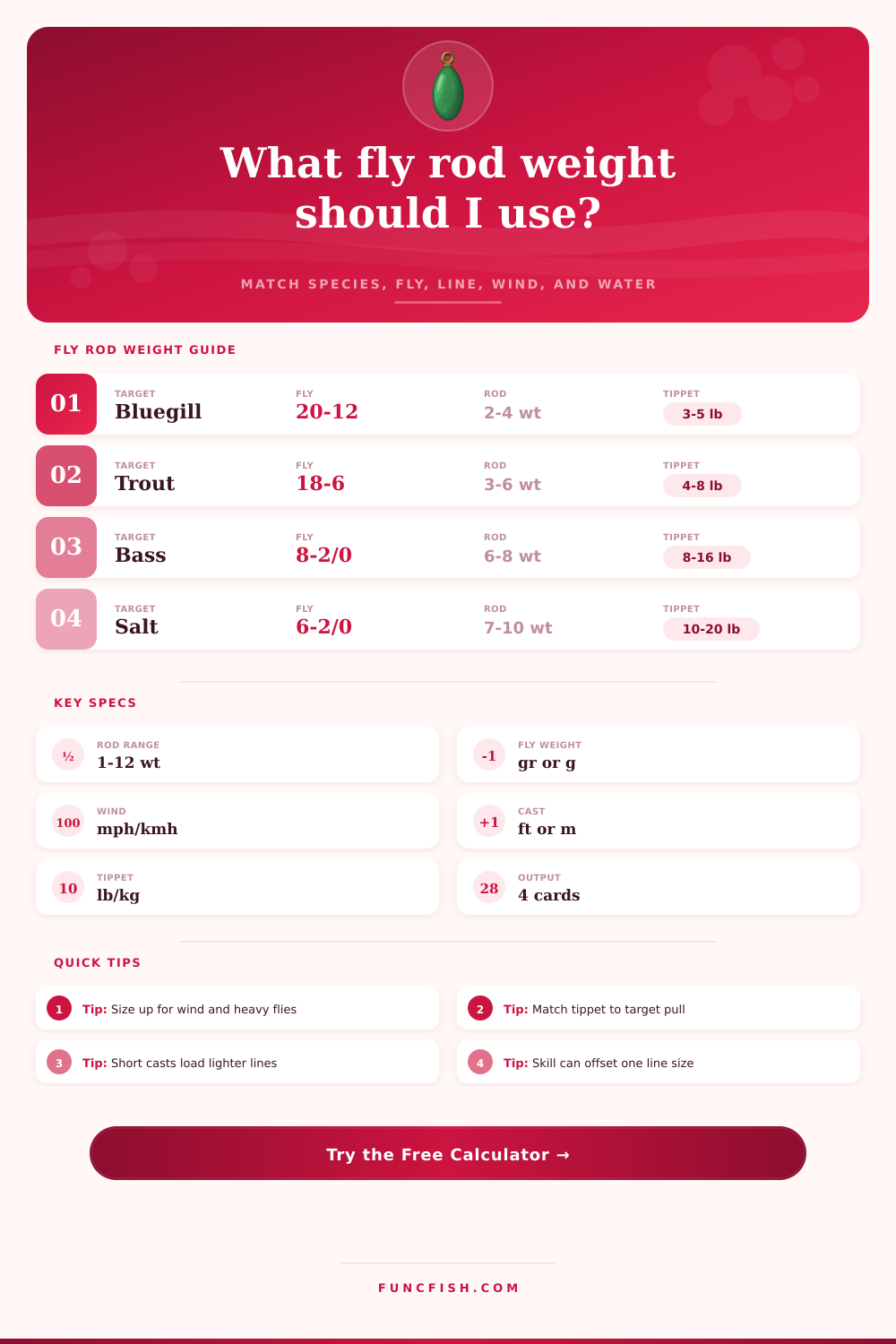
| General trout | 4 to 6 wt | 4 to 8 lb / 1.8 to 3.6 kg | Balanced casting and protection |
| Bass and carp | 6 to 8 wt | 8 to 16 lb / 3.6 to 7.3 kg | Fly bulk and hook authority |
| Pike, steelhead, salmon | 8 to 10 wt | 10 to 20 lb / 4.5 to 9.1 kg | Streamer mass and fighting power |
| Bonefish, redfish, baby tarpon | 7 to 11 wt | 10 to 25 lb / 4.5 to 11.3 kg | Wind, distance, and line speed |
| Line type | Head behavior | Rod-weight effect | Best fit |
|---|---|---|---|
| Double taper floating | Smooth full-length aerial mend | Neutral to slightly lighter | Small water, dries, roll casting |
| Weight-forward floating | General purpose compact load | Neutral baseline | Most trout and warmwater fishing |
| Nymph or indicator taper | Front-loaded turnover | Adds load for heavy rigs | Split shot, bobbers, tungsten flies |
| Sink-tip streamer line | Dense front section | Often favors one size stronger | Streamers, current, boat banks |
| Shooting head | Short heavy head | Needs grain window awareness | Distance, surf, compact backcasts |
| Saltwater tropical taper | Stiff coating and firm turnover | Favors line speed and power | Flats, wind, larger shrimp or baitfish |
| Condition | Typical adjustment | Why it matters | Result effect |
|---|---|---|---|
| Wind over 12 mph / 19 kmh | Add 0.4 to 1.0 wt | More line speed turns over the leader | Rod weight increases |
| Casts under 25 ft / 8 m | Favor lower or true-to-line rod | Less line is outside the guides | Load score can drop |
| Bulky flies or poppers | Add 0.5 to 1.5 wt | Air resistance is often larger than mass | Rod weight increases |
| Very light tippet | Cap overpowering recommendations | Protects fine leaders and small hooks | Tippet match changes |
| Expert caster | Can fish slightly lighter | Better timing carries tighter loops | Skill offset lowers demand |
Line grain values use common single-hand fly line reference weights for the first 30 ft. Actual specialty heads may list a separate full-head grain rating.
🎣Fly, rod, and species comparison grid
Spring Creek Trout
Small dries, fine tippet, and close presentation favor a lighter rod.
Tailwater Trout
Indicators, split shot, and wind often move the match toward a 5 or 6 wt.
Stillwater Trout
Long leaders, open water, and sinking lines reward extra line control.
Smallmouth Bass
Poppers and crayfish flies need authority even when fish are not huge.
Carp Flats
Medium flies, stealth, and sudden power make 7 or 8 wt a common match.
Pike Streamer
Large air-resistant flies and wire leaders push the setup into heavy rods.
Bonefish Flat
Distance and wind matter as much as fly size on open shallow flats.
Baby Tarpon
Bulky baitfish flies and shock tippet favor a powerful saltwater stick.
ℹCalculator tips
Fly weight tip: If the fly is wet, articulated, weighted, or tied with deer hair, weigh the whole rig or choose a bulkier fly profile so the rod recommendation reflects turnover load.
Tippet tip: If the calculator shows a strong rod but a light tippet match, use smoother acceleration and avoid overpowering the hook set even when the line casts well.
To select the proper weight for your fly rod, several variable should be considered. The correct fly rod weight is important to consider because using a rod that is too light will prevent the line from loading correct, while using a rod that is too heavy will impact the fish that is being targeted. Some of the variables to consider when selecting the proper weight for your fly rod include the weight of the fly that will be targeted, the speed of wind, the size of the water where the fish is being targeted, and the type of fish that live in those waters.
If the weight of the fly rod does not match the environmental condition in which the fish are to be targeted, there will be difficulty in casting the fly. The weight of the fly rod is determined by the weight of the first 30 feet of the line, measured in grains. 5-weight fly rods is used to cast lines that weigh 140 grains and are suited for medium sized flies when the wind is moderate.
How to Choose the Right Fly Rod Weight
2-weight and 3-weight rods are used for smaller varieties of flies and fish. These lighter rods requires more precision when casting the flies. 8-weight and 9-weight rods is used for larger sized flies and when there is heavy winds in the area where the fish are to be targeted because these rods generate the line speed necessary to cast the heavier flies.
The type of fish that will be targeted can influence the weight of the fly rod that is used. For instance, 2-weight and 3-weight rods are used to target small fish species like panfish or brook trout. For larger fish species like bass or carp, you should use a 6-weight, 7-weight, or 8-weight rod to match the strength of the fish.
For those targeting bonefish in the salt water fish habitats, an 8-weight or 9-weight rod should be used because the salt water environment often have strong winds in them. The profile of the fly will impact the weight of the rod. For instance, small dry flies has very little mass and can be cast with a light weight rod.
However, larger flies such as streamers or deer hair poppers have more air resistance and require a heavier weight rod to turn the fly over in the air. Wet flies and sink-tip lines add to the mass of the fly line, therefore adding more mass to the line require a heavier weight of fly rod. The environment where the fishing is to occur will impact the weight of the rod that is used.
For instance, for creeks and smaller bodies of water that has light resistance, a light weighted rod can be used. However, for larger areas like lakes or the ocean, a more heavier weighted rod is required. Because wind adds to the resistance of the line, a heavier weight of rod is required when there are strong winds in the area.
Lastly, the strength of the tippet should match with the weight of the fly rod. Using a heavy weight rod with a thin tippet may result in the tippet snapping when fighting with a fish. Using a very light weight rod with a very thick tippet will prevent the rod from being able to successfully cast the fly.
Both situations indicates the need for the rod and tippet weight to match to experience succes in fishing for fish.