
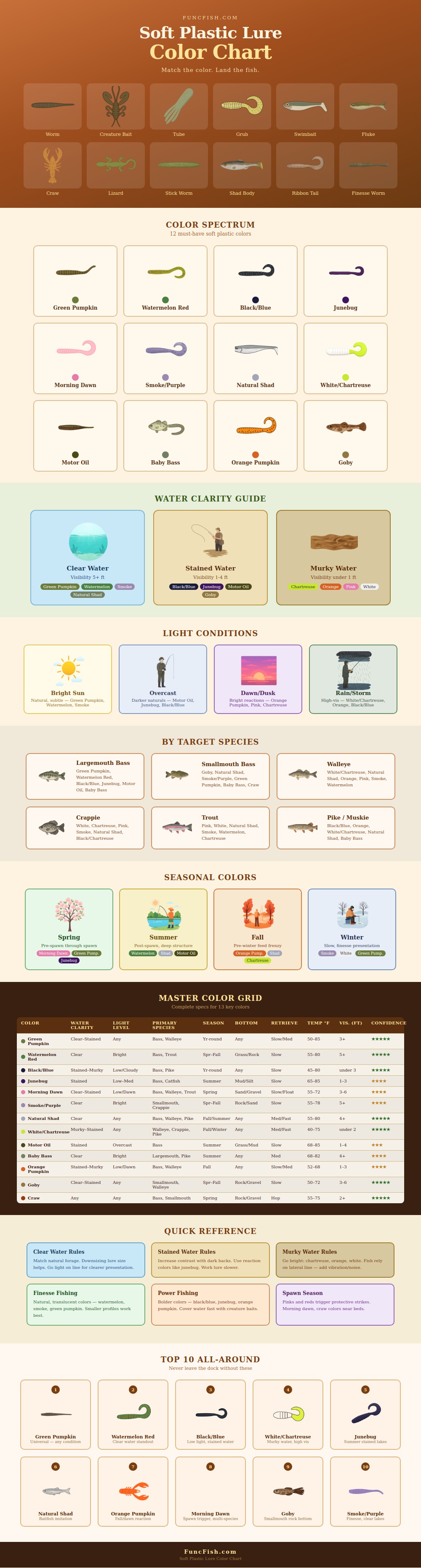
When fishing for fish, the color of the soft plastic bait you use is one of the primary factor to determine whether or not the fish will bite on your bait. Fish dont has the same vision as humans. If you use a color for your soft plastic bait that does not contrast with an environment, the fish will not see the bait.
Conversely, using the apropiate color for the environment will entice the fish to bite on your bait. There are many different type of soft plastic baits that can be used when fishing for fish. These include worms, creatures, swimbaits, and grubs.
How to Pick the Right Color for Your Soft Plastic Bait
The color of the bait that you use rely upon the clarity of the water. In water that is very clear, fish can easily see your bait. In this case, use subtle colors for your bait.
For instance, use greens and translucent colors for bait in clear water. In the opposite scenario, when the water is stained or murky, use dark colors for your soft plastic bait. If the water is very dirty, use bright reaction colors for your bait.
Another factor to consider is the light in which the lake are reflected. If the light is bright, fish are likely to be more cautious around bait. In this case, use natural colors for your soft plastic bait.
If it is overcast, use deeper color for your bait. In addition, during the hours of sunrise and sunset, use orange and pinks for your bait. Finally, during the time of rain, use high visibility colors for your soft plastic bait.
Next, the type of fish you are targeting will play a major role in the color of your soft plastic bait. If you are targeting largemouth bass, use green colors because these fish is attracted to the green colors of the perch that they eat. Smallmouth bass should use tan colors because these fish eat the creatures that live on the bottom of the lake.
For species like walleye or crappie, use pink and white colors for the bait because these colors are visible for fish with poor eyesight. Pike will be most interested in using bold colors in the bait because these colors mimic wounded shad. Seasonal changes to the water require changes to the color of your soft plastic bait.
When the water is in the spring, use soft pinks because these colors mimic fish eggs. During the summer, use brown colors for your soft plastic bait. In the fall, use silver and orange colors to mimic the baitfish that travel in the area during this season.
During the winter months, use smoke and subtle green colors for your soft plastic bait. These subtle colors works best when the fish are moving slow in the cold water. In order to simplify your fishing tackle box, use only certain colors.
Use a universal green that works in various situation. Other colors to include in your fishing tackle box would include black for murky water, chartreuse for dirty water, and natural colors for clear water. Additionally, determine the color of the lake bottom.
If the lake bottom is rocky and gravel, use bait with tan or smoke colors in the soft plastic bait. If the lake bottom is muddy and flat, use a silhouette color with a dark back to the bait. Lastly, consider the temperature of the lake water and the retrieval speed of your soft plastic bait.
If the water is fifty degrees, use a slow retrieve rate for your soft plastic bait. Change to an aggressive retrieve rate for water temperatures of eighty degrees. For example, use power fishing techniques for bold reaction soft plastic bait to quickly cover the water with your bait.
Use finesse techniques for thin, translucent worms. Finally, if you take time to consider the water clarity, the sky and the color of the lake bottom, you can select the correct color for your soft plastic bait.