🐟 Fish Brine Ratio Calculator
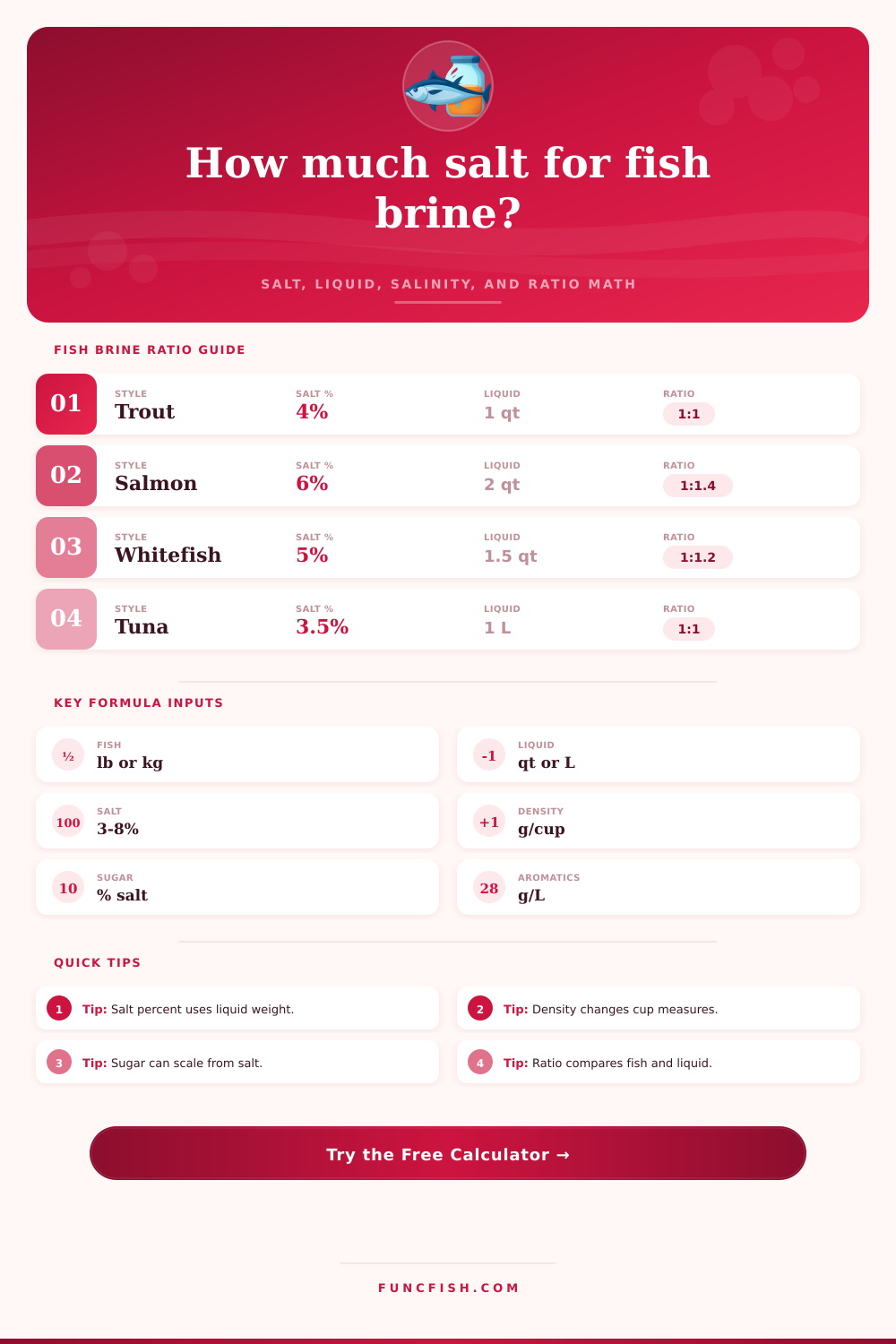
Estimate salt mass, salt volume, liquid volume, salinity percentage, optional sugar and aromatic formula inputs, and fish-to-liquid ratio from one reference panel.
📌 Brine style presets
⚙ Ratio inputs
Calculated as salt weight divided by liquid weight.
Adds a volume reference for vessel headroom math.
🧂 Salt density cards
🔄 Species and process comparison grid
📊 Salinity reference table
| Target salinity | Salt per liter | Salt per quart | Math note |
|---|---|---|---|
| 3% | 30 g | 28 g | Low-salt reference |
| 4% | 40 g | 38 g | Light brine math |
| 5% | 50 g | 47 g | Midpoint reference |
| 6% | 60 g | 57 g | Medium brine math |
| 8% | 80 g | 76 g | Strong brine math |
| 10% | 100 g | 95 g | High salinity math |
⚖ Salt volume conversion table
| Salt type | Density | 50 g measure | 100 g measure |
|---|---|---|---|
| Fine table salt | 292 g/cup | 0.17 cup | 0.34 cup |
| Pickling salt | 280 g/cup | 0.18 cup | 0.36 cup |
| Fine sea salt | 288 g/cup | 0.17 cup | 0.35 cup |
| Morton kosher | 218 g/cup | 0.23 cup | 0.46 cup |
| Diamond kosher | 144 g/cup | 0.35 cup | 0.69 cup |
| Flake salt | 120 g/cup | 0.42 cup | 0.83 cup |
🧮 Optional formula input table
| Input field | Formula basis | Example ratio | Calculator output |
|---|---|---|---|
| Sugar ratio | % of salt weight | 50% | 0.5 x salt mass |
| Aromatic ratio | weight per liquid volume | 0.5 oz/gal | scales to volume |
| Displacement | % of liquid volume | 12% | headroom reference |
| Time category | salinity x category factor | 1.4x | contact index |
⏱ Time category math table
| Category | Factor | Index formula | Reference label |
|---|---|---|---|
| Quick reference | 1.0x | salinity x 1.0 | light contact |
| Standard reference | 1.4x | salinity x 1.4 | baseline contact |
| Extended reference | 2.1x | salinity x 2.1 | longer contact |
| Dense cut reference | 2.8x | salinity x 2.8 | thicker cut math |
Brining is a process that cooks place fishes in a salt and water solution to change the texture and the flavors of the fish. Brining is a chemical process because the salt will enter the fish and the water will leave the fish, which is a process known as osmosis. The salt will change the structure of the fish, as well as allow the fish to retain moist when it is cooked.
The most important aspect of brining is salinity, which is the ratio of the salt in a brine solution to the weight of the liquids. If the ratio of salt to water is too low, the brining process wont work proper, and the fish will become mushy. However, if the ratio is too high, the salt will brine too deep into the fish, and the fish will become tough.
How to Brine Fish
The salinity levels must be different for different types of fishes. For instance, oily fish can take higher levels of salinity because the fat in the fish will preserve the texture of the fish. Lean fish will dry out when exposed to too higher of a salinity level, so a cook must use a lower level of salinity for lean fish.
Another aspect to consider with the brining of fish is the type of salt to be used. Different types of salt has different densities. Fine salt is more dens than coarse salt.
Therefore, a specific weight of fine salt will take up less spaces in a measuring cup compared to the same weight of coarse salt. The weight of the salt should of been measured on a scale in gram or ounces instead of measuring the salt by how many cup of salt are used. Using salt with sugar is another process used to brine fishes.
Sugar should be used in amounts equal to half the weight of the salt. Sugar will balance the saltiness of the salt and create a better texture of the fish. Another necessary aspect of the brining process is the amount of liquid to be used in the brine.
The amount of liquid should be sufficient to cover the fish completely when using the brining process. If the fish isnt fully covered in the liquid, the parts of the fish will not brine proper and can have an uneven texture once cooked. In addition to the weight of the fish, the amount of space that the fish will take up in the container should also be accounted for.
When the fish is placed into the liquid, the fish will push on the liquid. Therefore, the container should be large enough that the brining liquid will not spill over the fish. The temperature of the brine is also important.
Fish should always be brined in a cold environment in order to keep the fish safe for eat. If fish is brined at room temperature, it can spoil. Another aspect to consider with brining is time.
The time that the fish will be in the brine solution determines the amount of salt that enters the fish. The thicker the cut of the fish is, the more longer it will take for the salt to travel to the center of the fish. Thinner fish fillets will take less time for the salt to reach the center.
If the fish is left in the brine for too long, it will become too salty. However, if the fish is not left in the brine for long enough, the fish will not season proper. Once the fish is done brining, it must be rinsed in order to remove an excess salt from the fish.
Once rinsed, the fish must be patted dry with a towel. Patting the fish dry will allow the fish to cook better and contain a better texture when prepared. Brining involves the consideration of salinity, the type of salt to be used, the amount of liquid to be used, the amount of space that the fish will take up in the container, the temperature at which the brining process is to occur, and the length of time that the fish is to be in the brine solution.
If the salinity levels are set up correctly, the fish will have a better texture. However, if the time that the fish is in the brine and the temperature at which the brining takes place are correctly managed, the fish will be safe to eat and will have a consistent flavor throughout the individual fishes.