
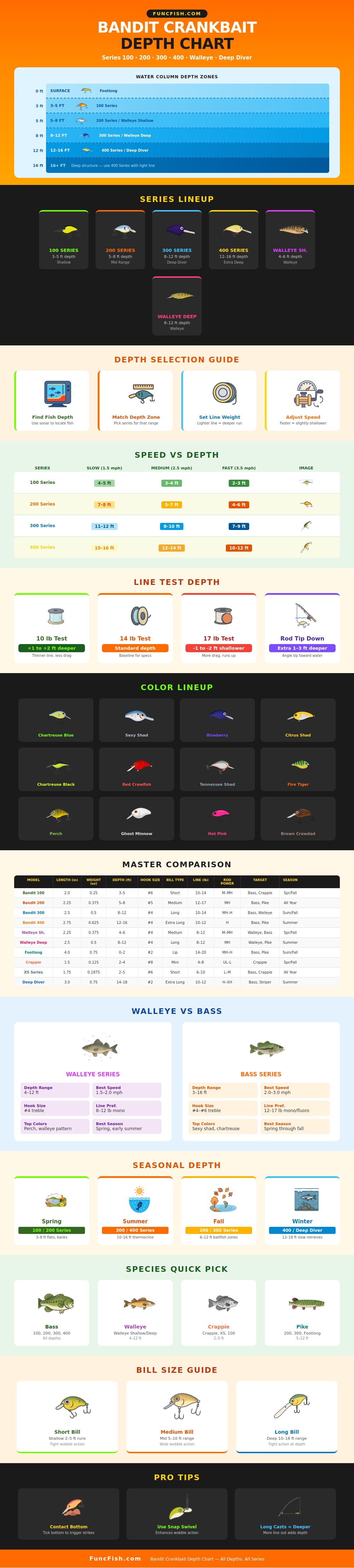
Crankbaits is fishing lures that are designed to travel through the water column to the depth that is determined by the length of an bill of the crankbait. The bill of a crankbait is the plastic protrusion from the front of the crankbait. The size of the bill of a crankbait will determine to what depth the bait will travel in the water column.
Crankbaits that has short bills will travel near the surface of the water. Crankbaits that have long bills will travel to depths much deeper within the water column. The bill of the crankbait catches the water as the bait perform its movements in the water, which creates the wobble in the crankbait that causes it to descend to those specific depth within the water column.
How Crankbaits Reach Different Depths
Depending upon the depth at which the fish lives in a body of water, a person can select crankbaits that will allow the person to target those depths. For instance, a person can use small billed crankbaits to target fish that live in shallow waters that range in depth from three to five feet. Medium billed crankbaits can be used to target fish that live in depths of five to eight feet.
Additionally, long billed crankbaits can be used to target fish that live in depths between eight and sixteen feet. Thus, by selecting crankbaits with bills of various lengths, a person can effectively fish for fish of any depth. Beyond the length of the bill of the crankbaits, other factors influences the depth at which crankbaits travel.
For instance, the diameter of the fishing line that a person uses can affect the depth at which the crankbaits travel. If thin fishing lines, such as lines with 10-pound test monofilament are used, the crankbaits will travel to greater depths. However, if thick lines, such as those that is 17-pound test monofilament are used, the crankbaits will travel to shallower depths in the water.
Additionally, the speed at which the angler retrieves the crankbaits from the fishing rod can impact the depth at which the crankbaits travel. If the crankbaits are slowly retrieved from the rod, the crankbaits will travel to its maximum depths. However, if the angler quickly retrieves the crankbaits from the fishing rod, the depths to which the crankbaits will travel will be shallower than intended.
Additionally, the angle of the fishing rod will impact the depths at which the crankbaits travel; if the person adjusts the fishing rod so that the tip of the rod is pointed toward the water, the crankbaits will travel to more greater depths. The depth at which a person fishes with crankbaits may need to be changed with the change of the water temperature throughout the year. In the spring, when the water temperature begin to rise, the fish may begin to move to shallow depths in the water.
During the summer seasons, the fish may move to deeper depths in the water. During the fall seasons, the fish may move to depths that is in the middle of the water. Finally, during the winter months, the fish may move to the deepest depths in the water.
The type of fish that is being targeted with crankbaits may impact the type of crankbaits that is used. For instance, walleye live in depths within the water column. Thus, slim crankbaits with slow retrieval speeds of 1.5 to 2 miles per hour should of been used when fishing for walleye.
Additionally, bass can live in depths within the water column. Thus, crankbaits with faster retrieval speeds of 2 to 3 miles per hour should be used when fishing for bass. Additionally, the size of the hook that is used will vary with the type of fish that is being targeted.
For instance, when targeting small fish species like crappie, smaller sized hooks should be used. For larger fish species like pike, larger hooks will be needed. Finally, the power of the fishing rod should also vary with the fish species that are to be targeted.
Additionally, the rate at which the angler retrieves the crankbaits from the fishing rod should be adjusted to ensure that the crankbaits remain within the depth at which the fish live. Thus, if the crankbaits are retrieved too quickly from the fishing rod, the crankbaits will travel out of the depth zone where the fish live.