
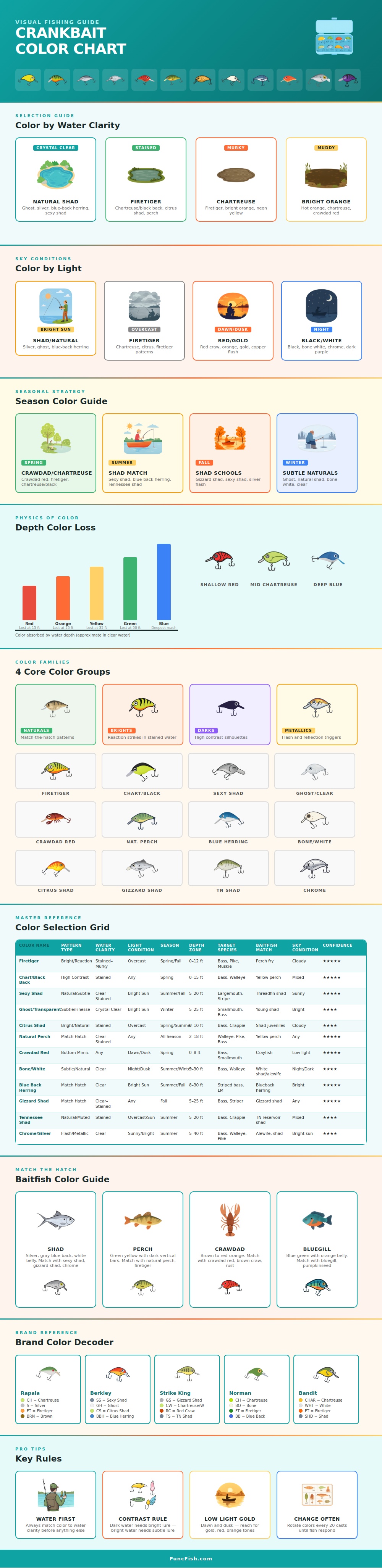
Crankbaits comes in a variety of colors, and there is several factors that affect the proper selection of crankbaits according to the environment in which they will be used. The selection of the proper color of crankbaits will determine the success of the bass in striking at a bait. Many people has issues in successfully catching bass due to there use of the wrong color of crankbaits for the water in which they is fishing.
In order to select the proper color for the crankbaits, an understanding of several factor of the water in which they will be used is required. One of the main factors in the selection of the color of the crankbaits is the clarity of the water in which they will be used. The clarity of the water will impact the type of colors that the bass in that area can see.
How to Choose Crankbait Colors
In clear water, you should use natural colors of the crankbaits, as these colors mimics the prey of the bass, such as shad or minnows. In stained water that is tinted green, high contrast colors, such as firetiger colors for the crankbaits, should be used. In murky water that is stained with mud, bright colors such as chartreuse or orange should be used for the same reasons that bright colors are effectives in murky water, the bass can see them from a distance.
The level of light in the water where the crankbaits are to be used will also impact the color of the crankbaits. For instance, in bright light from the sun, silver and shad colors is best used. When the sky is cloudy, chartreuse colors are the bestest options.
Dawn and dusk have warm tones, like red or gold in the crankbaits, that will mimic the insects that the bass eats during these time of day. At night, when there is no visible light in the water, black and bone white colors for the crankbaits will be the most effective. The time of the year that the crankbaits are to be used will also impact the color of the crankbaits.
During the spring, red and orange colors will mimic the crawfish that the bass eats during that season. During the summer, gray-blue and herring colors is used to mimic the shad that the bass eat during this time. During the fall, silver colors are used to mimic the baitfish that the bass eat during this time of year.
During the winter, when the bass are lethargic, the use of bone white or clear colors for the crankbaits will be most effective. The depth at which the bass are to be caught will also impact the color of the crankbaits that are used. For instance, red colors dissapears at depths of fifteen feet in clear water.
Orange colors can disappear at depths of twenty-five feet, and yellow colors at thirty-five feet. Blue colors penetrates the deepest into the water. Thus, depending upon the depth at which the bass are to be caught, the angler should chose the color of the crankbaits accordingly.
There are four main groups of colors for crankbaits. Natural colors will mimic the color of the prey of the bass, and is useful when the fish should not be startled easy. Bright colors will provoke the bass to strike at the crankbaits, and are useful in waters with poor visibility.
Dark colors for the crankbaits will create silhouettes of the crankbaits that will be visible to the bass in low light condition. Metallic colors will flash in the light of sunny days, and are thus only useful during these times. If the natural prey in the water can be observed, the colors of the crankbaits should be chosen to match the color of the prey.
Additionally, rather than using only one color of crankbaits all day, the crankbaits color should be rotated every twenty casts into which the crankbaits is thrown into the water.