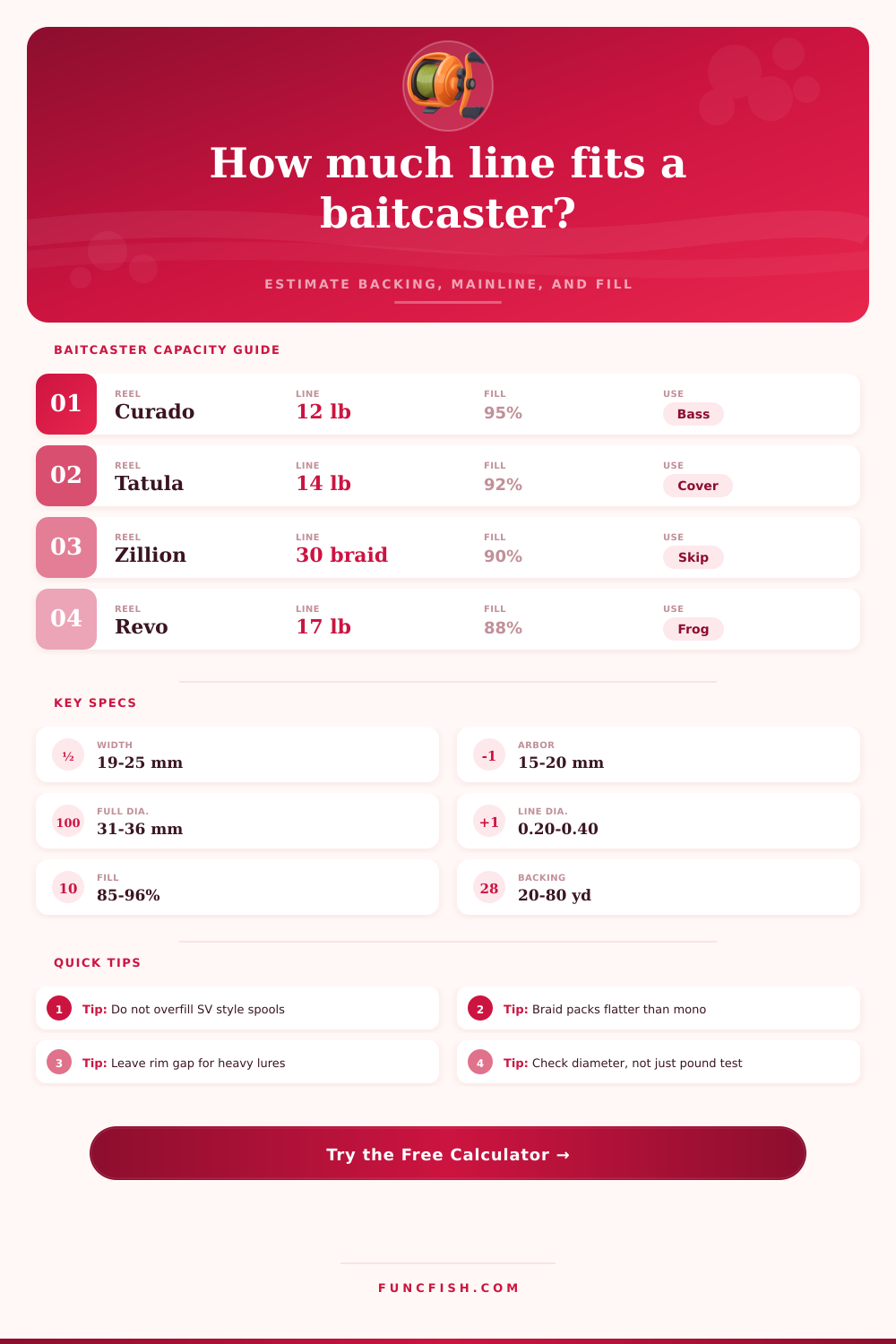
Baitcaster Line Capacity Calculator
Estimate how much backing and main line fit a baitcaster spool using spool width, arbor diameter, fill level, line diameter, material, and cast style.
📌Baitcaster presets
⚙Spool and line inputs
Baitcaster capacity forecast
Full breakdown
📋Line material packing grid
Braided PE
Monofilament
Fluorocarbon
Copolymer
📏Line diameter reference
| Common line | Typical diameter | Baitcaster use | Capacity effect |
|---|---|---|---|
| 10 lb mono | 0.28 mm / 0.011 in | Crankbaits, topwater | Medium capacity |
| 12 lb mono | 0.31 mm / 0.012 in | General bass casting | Baseline capacity |
| 15 lb fluorocarbon | 0.33 mm / 0.013 in | Jigs and Texas rigs | Slightly lower capacity |
| 17 lb fluorocarbon | 0.37 mm / 0.015 in | Cover and spinnerbaits | Lower capacity |
| 30 lb braid | 0.28 mm / 0.011 in | Grass, swim jigs | Higher capacity |
| 50 lb braid | 0.36 mm / 0.014 in | Frogs and punching | Lower capacity |
| Fill target | Rim gap | Best cast style | Baitcaster note |
|---|---|---|---|
| 96% | Very small | Long casting | Fast but touchy |
| 92% | Balanced | All-around | Good default |
| 88% | Moderate | Skipping | More control |
| 84% | Larger | Frogging / close cover | Reduces fluffing |
🎣Reel and line comparison grid
| Baitcaster class | Typical spool width | Useful line range | Capacity personality |
|---|---|---|---|
| Compact 70 size | 18-20 mm | 8-12 lb mono / 20-30 braid | Light lures, shallow fill |
| Standard 100 size | 21-23 mm | 10-15 lb mono / 30 braid | Best all-around balance |
| 150 size | 22-25 mm | 12-17 lb mono / 40 braid | More reserve for hard casts |
| 200 size | 24-28 mm | 14-20 lb mono / 50 braid | Heavy cover and larger baits |
| Cast style | Reserve target | Fill adjustment | Why it matters |
|---|---|---|---|
| Pitching | 35 yd / 32 m | -2% | Control beats max distance |
| All-around | 55 yd / 50 m | 0% | Balanced spool speed |
| Long casting | 80 yd / 73 m | +2% | Needs extra working line |
| Skipping | 40 yd / 37 m | -5% | Lower fill calms overruns |
| Frogging | 45 yd / 41 m | -4% | Thick line and hard hooksets |
| Swimbait | 90 yd / 82 m | +1% | Long casts plus heavy line |
💡Capacity checks
Tip: For baitcasters, the last few percent of fill changes spool speed quickly. A slightly lower fill is often cleaner for skipping, frogging, and heavy fluorocarbon.
Tip: Line pound test is only a shortcut. Capacity follows actual diameter, so update the diameter when switching between braid, mono, fluorocarbon, or copolymer.
Baitcaster line capacity refers to amount of fishing line that a baitcasters spool can hold. Baitcaster line capacity determine the amount of line you can use when you are fishing. Putting too much line on your baitcasters spool may result in the spool run over while you are casting.
However, putting too little line on the spool may result in you running out of fishing line while you are on a long retrieve. Therefore, understanding baitcaster line capacity is essential for baitcaster fishing enthusiast. Dimensions of the spool, the material of the fishing line, the use of backing, and your casting style influence baitcaster line capacity.
How Much Line a Baitcaster Can Hold
Baitcaster line capacity is mainly influence by the dimensions of the baitcasters spool. Spool dimensions include the width of the spool, the arbor diameter, and the outer diameter of the spool. The width of the spool determines the length of the line that can be lay on the spool in even layers.
The arbor diameter determines the volume of line that can build up within the spool prior to add the fishing line. Lastly, the outer diameter of the spool determines how far the line can build up on the spool before the line reach the outer rim. A wider spool with a smaller arbor will hold more line then a narrower spool with a larger arbor, even if the baitcaster reels is of the same make.
The material of the fishing line will also impact the line capacity of your baitcaster. Braided fishing lines tend to pack more tightly around the spool than monofilament lines. Furthermore, braided lines also pack more tightly around the spool than fluorocarbon lines.
Fluorocarbon lines are stiffer than braided lines. This stiffness within the fluorocarbon line allow for air gaps to form between the wraps of the fluorocarbon line. Therefore, fluorocarbon lines reduces the line capacity of your baitcaster.
For these two reason, a baitcaster spool loaded with 12-pound braided line can hold more line than the same baitcaster spool loaded with 12-pound fluorocarbon line. Another factor that will impact your baitcasters line capacity is the use of backing. Backing is a short length of monofilament or braided fishing line that you place on the spool prior to adding the main fishing line.
Backing help to even out the main fishing line on the spool. However, because the backing takes up some of the volume within the spool, it reduce the amount of main fishing line that can be added to the baitcaster. Your casting style will also impact the amount of fishing line that should be on your baitcasters spool.
If you like to cast your line long distance, you will need to load your baitcasters spool with a higher percentage of the maximum line capacity. This higher percentage allow the line to build up closer to the outer diameter of the spool, allowing it to come off the spool at a faster rate. However, a higher percentage of line on your spool will increase the chance of an overrun when you are fishing close to heavy cover.
A lower percentage of line on your spool will give you more control over the movement of the line. However, this lower percentage will reduce the total line capacity of your baitcaster. The diameter of the fishing line is more important than the pound test of the fishing line.
Two different brands of 15-pound fishing lines can have slightly different diameters. The small difference in diameter in each pound of line can have a significant effect on the total line capacity of your baitcaster. The other factor that will impact the line capacity of your baitcaster is the tension that you apply to the fishing line when you are loading your line onto the spool.
The higher the tension that you apply to the line when you are loading it onto the spool, the tighter that the line will pack onto the spool. Therefore, the higher the tension that you use when loading the line, the more higher the line capacity of your baitcaster. Finally, there are a few additional factor that will impact the total amount of line that you can use when you are on the water.
These factors are not listed on the specification sheet for most baitcasting reels. The temperature will impact the stiffness of your line. Water will add weight to your braided line when you are fishing in the water.
Finally, the repeated action of casting your line will work the line into tighter wrap around the spool. Each of these factors will impact the actual line capacity of your baitcaster when you are fishing. However, understanding how each of these factor interact with each other will allow you to make a deliberate decision about the line capacity of your baitcaster.
You should of considered this when picking your reel.