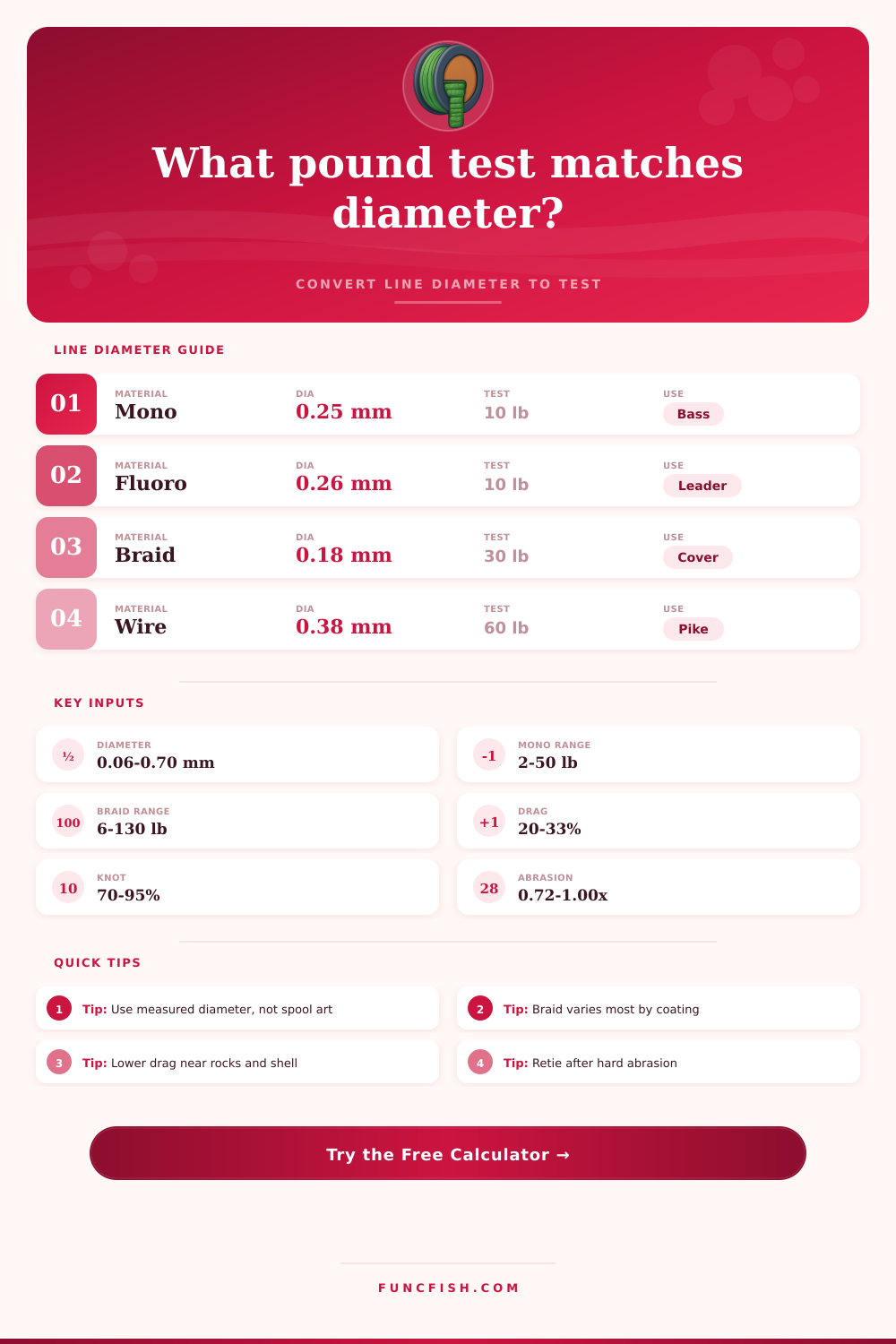
Line Diameter to Pound Test Converter
Estimate fishing line pound test from measured diameter using material reference arrays, technique band checks, abrasion loss, knot efficiency, and drag safety.
📌Line conversion presets
⚙Converter settings
Line conversion result
Full breakdown
🧵Line material comparison grid
Monofilament
Fluorocarbon
Copolymer
Braided PE
📋Reference tables
| Material | Common diameter samples | Test range used | Best calculator use |
|---|---|---|---|
| Nylon monofilament | 0.10, 0.25, 0.37, 0.55 mm | 2-40 lb | General main line |
| Fluorocarbon | 0.14, 0.26, 0.40, 0.60 mm | 4-40 lb | Leader and clear water |
| Copolymer | 0.12, 0.24, 0.35, 0.52 mm | 4-40 lb | Casting and cranking |
| Braided PE | 0.06, 0.15, 0.28, 0.45 mm | 6-100 lb | Thin diameter power |
| Fused superline | 0.10, 0.17, 0.31, 0.43 mm | 6-80 lb | Spinning braid substitute |
| Single strand wire | 0.23, 0.38, 0.55, 0.70 mm | 20-175 lb | Toothy fish leader |
| Technique | Usable test band | Typical drag | Diameter note |
|---|---|---|---|
| Finesse spinning | 3-10 lb | 20-25% | Thin line helps small lures |
| General spinning | 6-15 lb | 22-28% | Balanced casting distance |
| Baitcaster casting | 10-25 lb | 25-30% | Handles larger baits |
| Heavy cover flipping | 30-80 lb | 25-33% | Usually braid or heavy fluoro |
| Surf casting | 12-50 lb | 22-28% | Shock leader may be separate |
| Trolling | 20-80 lb | 25-30% | Diameter affects lure depth |
| Fly leader / tippet | 2-12 lb | 20-25% | Tippet rating varies by maker |
| Toothy fish leader | 20-130 lb | 20-28% | Wire is not a casting mainline |
| Species class | Line target | Drag fraction | Safety cue |
|---|---|---|---|
| Panfish / perch | 2-6 lb | 0.20 | Protect small hooks |
| Trout / finesse bass | 4-10 lb | 0.22 | Clear water favors thin line |
| Bass / walleye | 8-20 lb | 0.26 | Match cover and hook wire |
| Catfish / carp | 15-40 lb | 0.28 | Knots see long steady load |
| Inshore saltwater | 10-50 lb | 0.27 | Watch shell and dock posts |
| Pike / musky | 30-100 lb | 0.24 | Leader damage matters most |
| Offshore pelagic | 30-130 lb | 0.30 | Smooth drag is critical |
| Adjustment | Factor | What it models | When to use |
|---|---|---|---|
| Open water | 1.00x | No major surface damage | Clean bottom and suspended fish |
| Grass / weeds | 0.94x | Minor fray and wraps | Vegetation or lily stems |
| Wood / docks | 0.86x | Rubs and pressure angles | Pilings, timber, brush |
| Rock / riprap | 0.78x | Hard edge abrasion | Jetty, riprap, ledge fishing |
| Shell / coral | 0.72x | Sharp cut risk | Oyster bars and reef edges |
| Unknown knot | 0.65x | Old knot or heat damage | When the knot was not just tied |
💡Diameter conversion checks
Tip: Braid diameter labels vary more than mono because coating, carrier count, and flattening change the measured cross section. Treat the confidence score as a range cue.
Tip: Recommended drag is based on usable test after abrasion and knot factors, so it should be lower than the printed breaking strength on worn or rough-water setups.
Choosing an correct fishing line requires an understanding of the relationship between the diameter of the fishing lines and the pound test of the fishing line. The diameter of the fishing line is the thickness of the fishing line. The pound test of the fishing line is the amount of weight that the fishing line can hold before it break.
You must consider the diameter of the fishing line because it determines how far you can cast your lure and how much fishing lines can fit on a spinning reels spool. The pound test of the fishing line must also be considered because it will determine if the fishing line can hold the weight of a fish and can take the abrasion of the environment in which you are fishing. The relationship between the diameter and the pound test are not the same for each type of fishing line material.
How to Choose the Right Fishing Line
Monofilament lines will stretch out when a fish is pulling on the line. Fluorocarbon lines will sink in the water and are more resistant to abrasion. Braided lines are the strongest for their diameter because the fibers are straight; however, the ratio of the diameter to the pound test of braided lines is not the same than monofilament lines.
Because each material has a different relationship between the diameter and pound test of the line, there is no single chart that can provide you with the pound test for each materials. The strength of the fishing line will change based on a few different factors. For instance, tie a knot in the line can lessen the strength of the line; the more poorly tied the knot is, the less strength the line has.
Another factor that can lessen the strength of the fishing line is the age of the fishing line. Fishing lines that are tie to rocks or plants will experience abrasion over time; the more abrasion the line endures, the less strength it will have. In order to account for these different factor, anglers can use a fishing line calculator.
The fishing technique that you use will change the diameter of the fishing line that is required for that type of fishing technique. For instance, finesse fishing techniques will require thin lines to allow the bait move, but other fishing techniques that require the line to withstand more abrasion will require lines with a higher pound test. Surf fishing techniques require a fishing line with a certain diameter to withstand the distance that must be cast.
Additionally, trolling require fishing lines that can take the loads at great depths. The types of fish that you are fishing for and the habitat where they live will change the requirements of the fishing line. For instance, fish in open water will have a higher pound test of the line than fish in thick weed.
Saltwater fish live in environments full of docks and oyster bars that cause abrasion in the fishing line. Therefore, you should adjust the diameter and pound test specifications of the fishing line according to the type of habitats in which the fish live. Many people make the mistake of not measuring the diameter of their fishing line when it come with a printed pound test.
The pound test printed on the fishing line package may not be accurate about the pound test of the line due to the age of the line and the coating on the line. You should measure the diameter of the fishing line. Additionally, the drag on the fishing line should not be set only according to the printed pound test on the fishing line; the drag should also be adjusted according to the abrasion of the line and the strength of the knot in the line.
The tool that is provided include tables that show the relationship between the different materials of fishing lines. These tables can show the relationship between the diameter and the pound test of fishing lines of different materials so that anglers can determine the appropriateness of the fishing line for the fishing technique that they use. Additionally, the tool can estimate the pound test and drag range for the line that the angler select.
These numbers can tell an angler if their fishing line is too thick or thin for their fishing technique. Using this information, an angler can make decisions about what type of fishing line to use for their fishing needs. For instance, an angler can increase the diameter of the fishing line to allow it to better withstand abrasion from rocks and plants; however, an increase in the diameter of the line will decrease the distance that the line can be cast.
An angler can also opt to use a thinner fishing line so the bait will move more easy through the water; however, there is a risk that the line may break when the fish pull on it in areas with heavy abrasion. The angler has to make each of these decisions by understanding the trade-offs between the diameter and the pound test of the fishing line for their specific environment.