Bass Fishing Leader Length Calculator
Size a bass leader from species, clarity, cover, technique, mainline, leader material, lure weight, rod length, knot travel, and casting distance.
📌Bass-specific presets
⚙Leader calculator inputs
Bass leader recommendation
Detailed breakdown
🧵Leader material data
Fluorocarbon
Monofilament
Copolymer
Hard Mono
📊Line and cover comparison grid
Braid to fluoro
Best for clear finesse, rock points, and bass that inspect the bait before eating.
Braid to mono
Useful for walking baits, poppers, and setups where a floating leader keeps action free.
Straight fluoro
Often needs a short leader only when cover abrasion or shock absorption calls for a splice.
Heavy cover
Wood, mats, and dock cables shorten the leader and raise the test before stealth matters.
📋Bass leader reference tables
| Bass species | Typical leader band | Common test | Calculator bias |
|---|---|---|---|
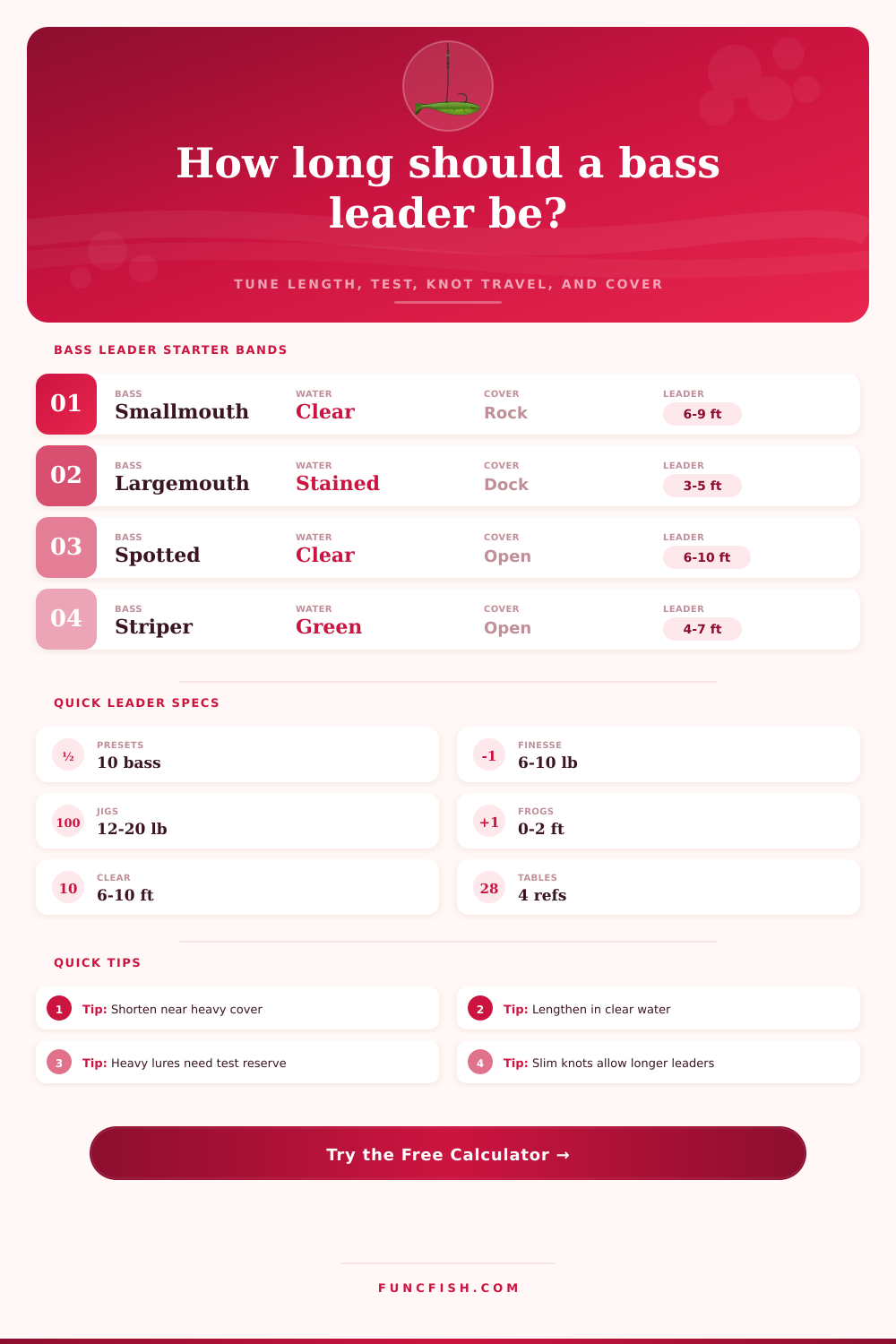
| Largemouth bass | 2 to 6 ft / 0.6 to 1.8 m | 12 to 20 lb / 5.4 to 9.1 kg | Cover strength first |
| Smallmouth bass | 5 to 10 ft / 1.5 to 3.0 m | 6 to 12 lb / 2.7 to 5.4 kg | Clear water stealth |
| Spotted bass | 5 to 9 ft / 1.5 to 2.7 m | 6 to 10 lb / 2.7 to 4.5 kg | Finesse and distance |
| Striped bass | 4 to 8 ft / 1.2 to 2.4 m | 15 to 30 lb / 6.8 to 13.6 kg | Shock and pull |
| Peacock bass | 1.5 to 5 ft / 0.5 to 1.5 m | 20 to 40 lb / 9.1 to 18.1 kg | Structure abrasion |
| Water clarity | Visibility cue | Length change | Leader note |
|---|---|---|---|
| Muddy | Under 1 ft / 0.3 m | Shorten 12 in / 30 cm | Cast control beats stealth |
| Stained | 1 to 2 ft / 0.3 to 0.6 m | Shorten 5 in / 13 cm | Moderate leader is enough |
| Green | 2 to 4 ft / 0.6 to 1.2 m | Neutral | Good all-around baseline |
| Clear | 4 to 8 ft / 1.2 to 2.4 m | Add 16 in / 41 cm | Longer leader hides braid |
| Gin clear | Over 8 ft / 2.4 m | Add 28 in / 71 cm | Use slim knots and lighter test |
| Technique | Leader tendency | Lure weight range | Test tendency |
|---|---|---|---|
| Drop shot / Ned | Longer | 1/16 to 1/4 oz / 2 to 7 g | 6 to 10 lb / 2.7 to 4.5 kg |
| Jerkbait / crankbait | Medium | 1/4 to 5/8 oz / 7 to 18 g | 8 to 14 lb / 3.6 to 6.4 kg |
| Jig / Texas rig | Medium-short | 3/8 to 1 oz / 11 to 28 g | 12 to 20 lb / 5.4 to 9.1 kg |
| Swimbait / glide | Shorter | 1 to 4 oz / 28 to 113 g | 17 to 30 lb / 7.7 to 13.6 kg |
| Frog / punch | Very short | 1/2 to 2 oz / 14 to 57 g | 20 lb plus / 9.1 kg plus |
| Knot travel preference | Usual cap | Best with | Tradeoff |
|---|---|---|---|
| Outside guides | 12 to 30 in / 30 to 76 cm | Baitcasters, heavy cover | Less stealth length |
| Tip guide only | Rod length minus tip space | Skipping and pitching | Moderate leader cap |
| Through guides | About 1.2 rod lengths | Slim FG-style knots | Check knot wear often |
| Onto spool | Up to about 2 rod lengths | Clear finesse spinning | More casting noise |
💡Leader calculation tips
Guide cap: If the recommended length is capped by knot travel, the calculator shows both the raw stealth length and the shorter castable length. A slimmer knot can unlock more leader.
Cover check: When the selected leader test reads light, raise test before adding length. Around wood, rock, mats, and dock cables, abrasion reserve usually matters first.
A fishing leader is the section of fishing line between the mainline and the fishing hook. The fishing leader has a variety of different functions, and each of those functions are essential for a person fishing for bass. For example, a leader needs to be invisibly to the fish in cases when the water is very clear.
The leader must also be able to stand up to scraping against various object in the water like stumps. Additionally, the leader must allow the bait to exhibit natural movement after being cast into the water. If the length or the test weight of the leader that a person selects for their fishing setup is incorrect, the person will not be succesful in their fishing effort from the bass.
How to Choose the Right Leader for Bass Fishing
The species of bass that you are targeting will impact the type of leader that is use when fishing. For example, smallmouth bass live in areas with plenty of rocky structures and clear water, and they take longer to eat the bait placed into the water. In contrast, largemouth bass live in areas with mats of grass or wood, and people usually catch them using a short and heavy leader so as to avoid breakage of the leader against these cover object.
Finally, spotted bass live over deep structures and use a longer and lighter leader to avoid alerting the fish to the presence of the leader. The clarity of the water will also play a role in the length of leader that is used in the fishing process. In cases where the water is murky or stained, it is acceptable to use a short leader since the fish wont be able to see into the water.
In cases, however, where the water is especially clear and visibility is greater than four foot in those waters, a longer leader must be used. This is due to the fact that the fish will notice the contrast of the braid mainline to the leader. In these cases, though, the person must also consider the length of the fishing rod, since too longer of a leader could cause the knot of the fishing line to get jammed in the guides of the rod.
The type of cover in which the bass live will impact the focus that is placed upon the fishing leader. In open waters, where the fish are not exposed to cover, the leader can have a longer length to remain stealthy in the approach to the bass. In areas with heavy cover of wood, docks, grass mats, the strength of the leader is more important than stealth.
For instance, when using a frog bait in mats of grass, there is no need for a leader; however, a drop shot technique require a leader in open water. The fishing techniques that you will use will impact the shock load that the leader experiences. For techniques using heavy lures, such as jerkbaits and swimbaits, the shock load on the leader is high.
Finesse techniques, on the other hand, like shaky heads and ned rigs create a low shock load on the leader. If the person chooses the fishing technique in the leader calculator, the leader will suggest a certain test weight for the line. Using a leader with a test weight that is too low will impact the leaders score for the suggested fishing technique.
The materials out of which the fishing leader is made will impact the leader’s performance in the water. Fluorocarbon lines are known to sink and be difficult for fish to see when the water is very clear. Monofilament lines will remain on the water’s surface and have some give when the bait is moved.
Hard monofilament lines can take the strongest baits and cover, but it is more visible to fish. The leader calculator determines these materials in the final score for the leader. A persons preference in the type of knot used with their fishing line will limit the length of leader that a person can use in their fishing setup.
For instance, if a person want the knot to remain outside of the guide on the fishing rod, the leader will need to be shorter. If a person is okay with the knot traveling through the guides on the rod, the leader will have more length to remain stealthier in the approach to the bass. In addition to the factors mentioned in this paragraph, there are other additional variables that will impact the length and test weight of the fishing leader.
For example, the weight of the bait that will be used will increase the shock load that the leader experiences. Additionally, longer casts will allow the fish to view the leader for longer periods of time, requiring a longer leader if the clarity of the water allows it. These relationships between the different variables can be seen in the reference tables for each of the variables.
From these tables, a person can determine what leader characteristics is best for their fishing scenario. With this information, a person could of used the leader calculator to determine the exact number for their specific fishing rod, bait, and knot.