Fluorocarbon to Mono Leader Calculator
Convert leader test between fluorocarbon and mono while checking diameter match, knot strength, stretch, visibility, cover load, lure weight, and safety factor.
📌Leader conversion presets
⚙Leader match settings
Leader conversion results
Calculation breakdown
🧵Material comparison grid
Fluorocarbon
Mono
Braid Mainline
Copolymer
📊Leader diameter reference
| Leader test | Mono diameter | Fluoro diameter | Common use |
|---|---|---|---|
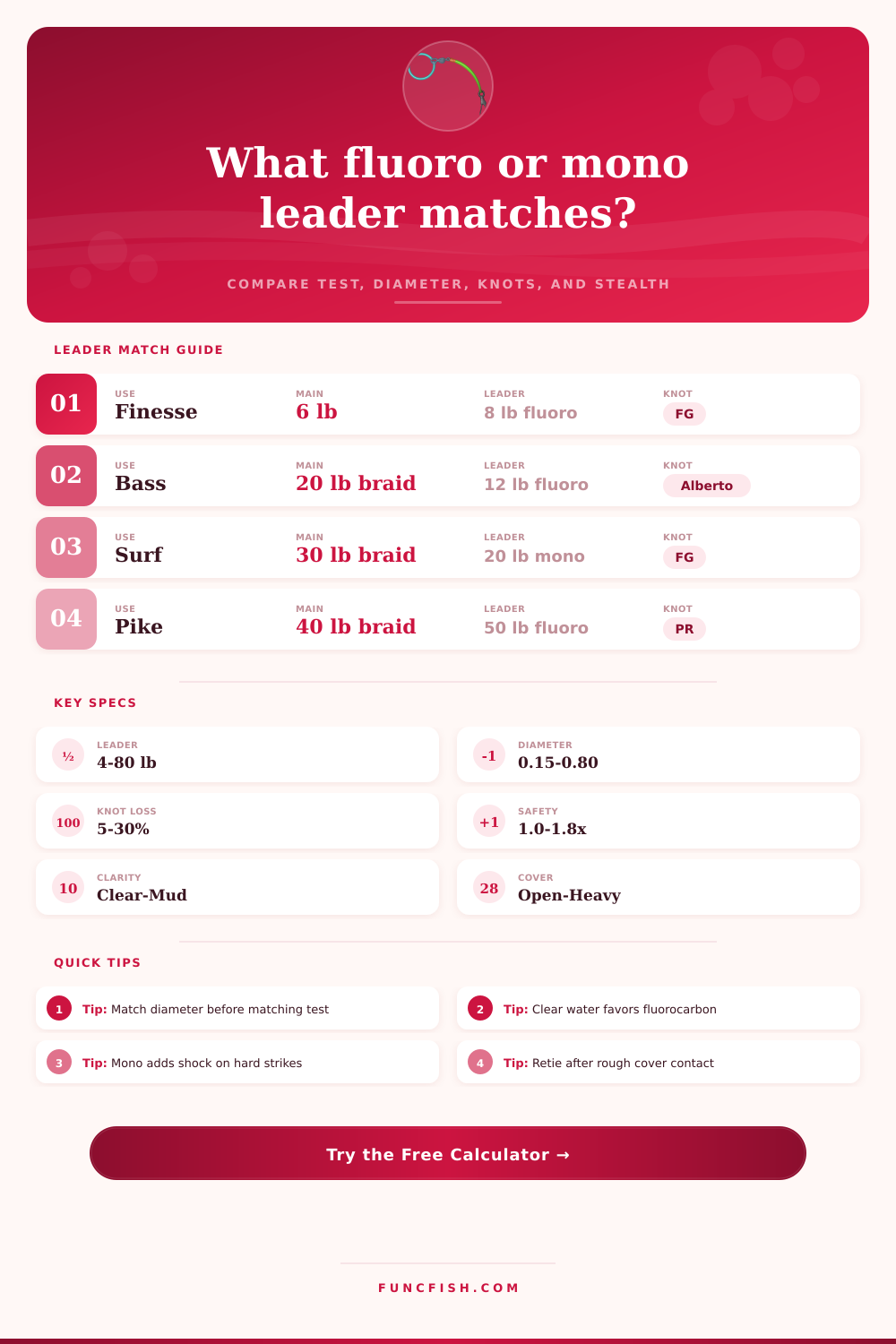
| 4 lb / 1.8 kg | 0.007 in / 0.18 mm | 0.006 in / 0.16 mm | Trout, panfish, ice jigs |
| 8 lb / 3.6 kg | 0.011 in / 0.28 mm | 0.010 in / 0.25 mm | Finesse bass, walleye |
| 12 lb / 5.4 kg | 0.013 in / 0.33 mm | 0.012 in / 0.30 mm | Jigs, jerkbaits, docks |
| 20 lb / 9.1 kg | 0.018 in / 0.46 mm | 0.016 in / 0.41 mm | Inshore, surf, heavy bass |
| 40 lb / 18.1 kg | 0.024 in / 0.61 mm | 0.023 in / 0.58 mm | Pike, musky, reef edges |
🔗Knot efficiency reference
| Knot | Typical efficiency | Best match | Diameter note |
|---|---|---|---|
| FG knot | 88-95% | Braid to fluoro or mono | Strong when cinched evenly |
| PR / bobbin knot | 90-97% | Heavy braid to leader | Excellent for big diameter gaps |
| Alberto knot | 82-90% | Braid to leader | Good all-around casting knot |
| Double uni | 75-85% | Similar diameters | Bulky with heavy leaders |
| Blood knot | 72-82% | Mono to fluoro | Works best near equal diameter |
🎯Species leader starting points
| Species | Typical leader | Material lean | Adjustment trigger |
|---|---|---|---|
| Trout | 3-8 lb / 1.4-3.6 kg | Fluoro in clear water | Drop diameter for refusals |
| Bass | 8-20 lb / 3.6-9.1 kg | Fluoro near cover | Step up around wood or rock |
| Walleye | 6-12 lb / 2.7-5.4 kg | Fluoro for jigs | Add test around zebra mussels |
| Redfish / snook | 20-40 lb / 9.1-18.1 kg | Mono shock or fluoro stealth | Step up around oysters |
| Pike / musky | 40-80 lb / 18.1-36.3 kg | Heavy fluoro only | Use bite-ready diameter |
📏Lure weight and safety guide
| Lure / sinker load | Suggested floor | Safety factor | Leader length note |
|---|---|---|---|
| 1/32-1/8 oz / 1-4 g | 3-6 lb / 1.4-2.7 kg | 1.0x-1.15x | Longer for stealth casts |
| 1/4-1/2 oz / 7-14 g | 8-14 lb / 3.6-6.4 kg | 1.15x-1.3x | 4-8 ft balances casting |
| 3/4-2 oz / 21-57 g | 15-30 lb / 6.8-13.6 kg | 1.3x-1.5x | Shorten if knot catches guides |
| 3-6 oz / 85-170 g | 30-50 lb / 13.6-22.7 kg | 1.5x-1.8x | Shock leaders need extra wraps |
🔍Material decision notes
Choose fluorocarbon
Use it when clear water, bottom contact, rock, shell, or pressured fish make low visibility and abrasion resistance more valuable than shock stretch.
Choose mono
Use it for topwater, surf shock leaders, boatside surges, or treble-hook lures where extra stretch can keep fish pinned.
Watch diameter
A stronger leader is not always cleaner if it creates a large knot. Keep casting knots compact when the leader enters the guides.
Tip: When converting mono to fluorocarbon, start by matching diameter, then raise or lower one test class for visibility, cover, and knot efficiency.
Tip: Heavy lure weight and hard cover both reduce the useful margin of a leader-to-mainline knot, so the calculated knot strength matters more than printed leader test.
Choosing an leader material is an important decision in the fishing process because the leader material will determine whether you catch or lose the fish. You must make a choice between use fluorocarbon or monofilament for your fishing line. Fluorocarbon materials has the ability to quickly sink in the water and reflect less light then the monofilament materials.
Because fluorocarbon materials reflect less light, they are harder to see for fishes in clear water. Additionally, fluorocarbon materials have high abrasion resistance, which makes them suitable for environment where the fishing line may come into contact with rocks or shells. Monofilament materials will typicaly floats longer in the water than fluorocarbon materials and will also have more stretch in the fishing line.
How to Choose the Right Fishing Leader
The extra stretch of the monofilament will allow for the line to absorb the shock of the fish striking at the lure and prevent the hook from flying out of the mouth of the caught fish. Another important consideration for the leader material is the diameter of the leader material. You should match the leader material to the mainline of the fishing line.
Using a leader material with a much larger diameter than the mainline will create a bulky knot. Bulky knots can easily get caught in the rod guides and reduce the distance from which you can effectively cast your line. Therefore, matching the diameter of the leader material is more important than its test rating.
The third consideration for the type of leader material to use is based off the clarity of the water and the presence of any cover in the fishing area. In clear water, anglers prefer fluorocarbon leader materials due to their low visibility and the difficulty that fish have in detecting these materials. However, in muddy or stained water, anglers prefer monofilament materials as the stretch of the line will allow fishes to be kept hooked while running quick.
Any cover such as wood, rocks, or oysters will cause abrasion in the fishing line. Therefore, you should use leader materials with high abrasion resistance in areas with heavy cover. In these areas, abrasion resistance will be more important than the stretch of the fishing line.
Using the correct knots in your fishing line is another important consideration. Every knot will reduce the strength of the leader material. Certain knots, such as the FG and the PR knots will have more of the strength of the leader material than a double uni knot.
However, the FG and the PR knots will require more wrap of the line and you’ll have more difficulty to seat the knot properly. Additionally, if the knot slips under the load of the fish, it will become a weak point in the fishing line. A weak point will cause the loss of the fish.
The fourth consideration for leader materials is the weight of the lure and the length of the leader material. Using heavy leader materials place more strain on the fishing knot. Additionally, the heavy leader materials will place more strain on the fishing knot when the fish strikes at the lure.
Using leader materials with a long length will make the leader material less visible to the fish. However, using long leader materials will increase the chance of the fishing knot getting caught in the rod guides. Short leader materials will reduce the chance of the knot getting caught in the guides but will make the connection between the mainline and the leader material more visible to the fish.
Lastly, the different fish species require different types of leader materials. Trout will refuse to eat the bait if the leader material is too thick. Therefore, you should use thin leader materials for trout.
Pike have strong teeth that will damage the fishing line. Therefore, people use heavy leader materials to protect the fishing line. Additionally, redfish and snook require leader materials that match the specific environment in which they are being targeted.
Many people make a mistake when selecting leader material for fishing lines. These individuals only focus on the test rate of the leader material. For instance, some people will increase the test rate of the leader material for cases in which there is alot of cover in the fishing area.
However, increasing the test rate of the leader material will increase its diameter. The increased diameter of the leader material will make it difficult to use the knot. Additionally, some people will ignore the stretch of the fishing line when selecting leader materials.
This will cause them to lose the fish due to the leader material not having the ability to absorb the shock of the fish striking the lure. When selecting leader material, people should consider the diameter of the leader material, the type of knot in the line, the cover in which they are fishing, and the different species of fish in that area. Considering these factors will ensure that the leader material will work correct with the rest of the fishing system.