Bottom Fishing Sinker Weight Calculator
Estimate bottom-fishing sinker weight from depth, current, drift, line angle, bait size, rig drag, bottom grip, species target, and sinker style.
📌Bottom-fishing presets
⚙Depth, drift, rig, and bottom inputs
Bottom sinker match
Your bottom-fishing sinker recommendation will appear here.
Calculation breakdown
📊Sinker style comparison grid
Bank
Good for wrecks, ledges, and bottom with snag risk.
Pyramid
Digs into sand, shell, mud, and mixed bottom.
Grapnel
Best for pinning baits in heavy flow on open bottom.
Torpedo
Streamlined for deep drops and fast descents.
📋Depth and current reference
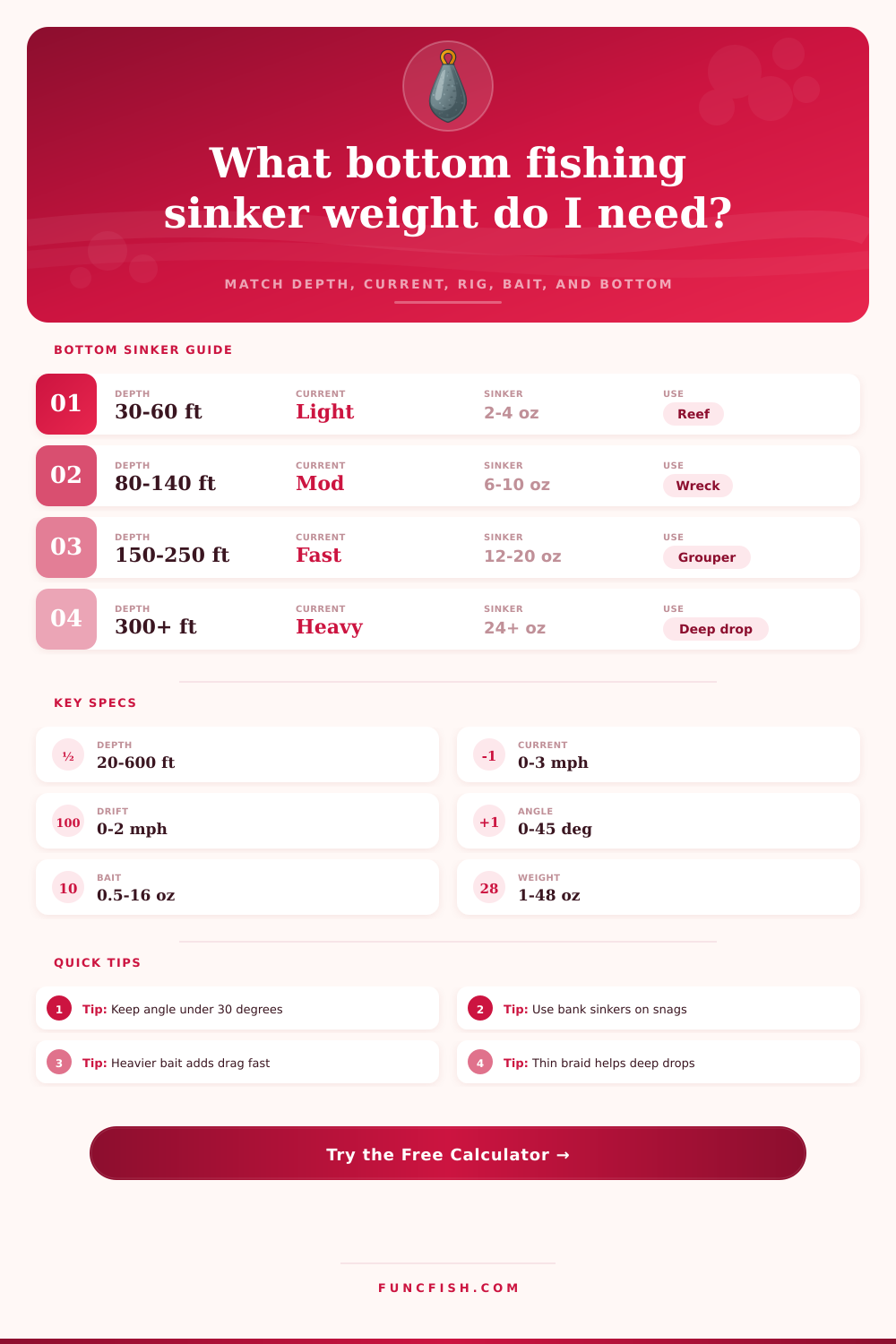
| Depth band | Light current | Moderate current | Fast current |
|---|---|---|---|
| 20-60 ft / 6-18 m | 1-4 oz / 28-113 g | 3-6 oz / 85-170 g | 6-10 oz / 170-283 g |
| 60-120 ft / 18-37 m | 3-8 oz / 85-227 g | 6-12 oz / 170-340 g | 10-16 oz / 283-454 g |
| 120-240 ft / 37-73 m | 8-14 oz / 227-397 g | 12-24 oz / 340-680 g | 20-32 oz / 567-907 g |
| 240-600 ft / 73-183 m | 16-32 oz / 454-907 g | 24-48 oz / 680-1361 g | 32-64 oz / 907-1814 g |
📋Bottom, rig, and species comparison
| Target | Common bottom | Typical rig | Sinker note |
|---|---|---|---|
| Snapper | Reef / rock | Knocker or fish finder | Bank or egg for fewer snags |
| Grouper | Ledge / reef | Fish finder or sliding | Heavy bank keeps bait close |
| Fluke | Sand / mud | Three-way or bucktail teaser | Just enough to tick bottom |
| Cod | Wreck / gravel | High-low or bait rig | Bank sinks fast and clears snags |
| Tilefish | Mud slope | Deep drop chicken rig | Torpedo lowers line belly |
| Blackfish | Rock pile | Short dropper rig | Bank or bell stays compact |
📋Line angle and drift guide
| Line angle | Bottom feel | Drift effect | Adjustment |
|---|---|---|---|
| 0-10 degrees | Excellent | Nearly vertical | Use calculated minimum |
| 10-20 degrees | Good | Manageable scope | Add one common size if bait is large |
| 20-30 degrees | Fair | Line belly building | Increase weight or slow drift |
| 30-45 degrees | Poor | Dragging or lifting | Use heavier style or reset drift |
📋Sinker style data
| Style | Best bottom | Holding factor | Use case |
|---|---|---|---|
| Bank | Rock, wreck, reef | 0.70 | Snag control and fast drop |
| Pyramid | Sand, mud, shell | 0.95 | Better bite on soft bottom |
| Egg | Sand, mud | 0.62 | Sliding rigs and light flow |
| Torpedo | Deep water | 0.80 | Low drag and fast descent |
| Grapnel | Open sand | 1.35 | Maximum hold in heavy current |
| Cannonball | Deep drift | 0.78 | Vertical presentation and feel |
💡Bottom-fishing calculation tips
Line angle check: if the line passes about 30 degrees from vertical, the rig is usually dragging more than fishing. Add weight, slow the drift, or reset over the structure.
Bottom type check: use compact bank or torpedo styles around wrecks and rock. Use pyramid or grapnel styles only when extra bite matters more than snag avoidance.
Selecting the correct sinker weight for a fishing trip will have a direct effect upon teh bottom fishing trip. If the sinker weight is too light for the fish to be caught, the bait will lift from the bottom of the lake or river, the fishing line will bow, and it will be impossible to feel if the fish are biting the bait. If the sinker weight is too heavy, the sinker will either drag the fishing rig across the bottom, or the sinker may get stuck on one of the structures at the bottom of the water body.
Thus, selecting the correct sinker weight is necessary to ensure that the fishing rig remain in the proper position for the bait to remain in contact with the bottom. The depth of the water is one of the factors that will impact the weight of the sinker that should be selected. The deeper the water, the more pressure the water will exert upon the bait, and the way that the water currents behave at the bottom of the water body will be different than those that exist at the surface of the water.
How to Choose the Right Sinker Weight for Bottom Fishing
Thus, water depth alone is not a factor in the determination of sinker weight, though depth will have an impact upon sinker weight if the water current change. For instance, a sinker weight of two ounces may be sufficient for sixty feet of water on a calm day, but the same depth of water may require an eight-ounce sinker weight when tides is moving swiftly through the water body. Thus, depth, current, and drift will be factored into the calculation of the necessary sinker weight.
Current and drift are two factors in the water that will impact sinker weight. Current is the movement of water in the lake or river that may impact the fishing line and the bait. Drift is the movement of the boat.
Because the movement of the boat impact the angle of the fishing line, the drift of the boat will impact sinker weight, as well. Thus, current and drift must be accounted for in the calculation of sinker weight so that it is impossible for the fisherman to rely upon estimates of how drift may impact sinker weight. The angle of the fishing line impacts sinker weight.
If the angle of the fishing line is too wide from vertical, the fisherman will lose the ability to feel the bottom of the lake or river with the fishing line. In these situations, the fishing rig may either lift the bait off of the bottom, or the fishing rig may drag along the bottom. Additionally, there are attempts to combat this by using heavy sinker weights to create more downward pressure upon the bait.
However, this may create issue in that more weight than is required for that specific bait may be placed upon the line. Thus, in order to determine the proper sinker weight for that specific bait and line, a calculator may help to determine the angle of the fishing line so that the fisherman can decide if the sinker weight need to be increased. Bait size and the profile of the bait will also impact sinker weight.
For instance, bait that is very heavy, such as a whole squid or a live pinfish will place more drag upon the fishing line than a strip of bait that is small and thin. Thus, a small strip of bait may allow the fishing rig to remain upon the bottom, but a larger bait will cause the fishing rig to skate along the bottom. Thus, the size of the bait and the drag that it will create is a factor in the determination of sinker weight.
The type of bottom of the lake or river will also impact sinker weight. For instance, pyramid sinkers will work well upon sandy bottoms, but they may get stuck upon rocks or wrecks at the bottom of the lake or river. Bank sinkers will work well upon areas with rock or wrecks, but they may not work well in areas with strong currents that exists in large portions of the lake or river.
Thus, the type of bottom will impact sinker weight, and the type of sinker that is used will impact sinker weight. The species of the fish will also impact sinker weight. For instance, some fish species requires that the bait be pinned to the bottom, while other species will feed at areas along the bottom where the bait may crawl across the bottom.
Thus, sinker weight should be correlated with the feeding habits of the specific fish species that are to be targeted. A calculator can provide information regarding the sinker weight that should be used for the specific fishing line and bait. Most sinker weight calculators will provide information regarding the contact index for the sinker, which will tell the fisherman how well the sinker will remain upon the bottom.
Second, the calculator may provide information regarding the line scope for the fishing line. Scope will explain how much extra line the fisherman will create based off the angle of the fishing line. Finally, the calculator will provide information regarding a match score for the fishing line.
The match score will factor in the strength of the fishing line, the drag upon the fishing line, and the needs of the fish species that are to be targeted. Each of these factor will allow the fisherman to understand whether the sinker weight that is to be used is conservative or aggressive. In addition to the measurements that are taken prior to setting out to fish, there may be additional changes to the sinker weight that should be made while fishing.
For instance, changes in the wind will change the drift speed. Additionally, the movement of the baitfish will change the way that the current is felt by the fishing line at the depth at which the fish live. Finally, changes in the water temperature according to the seasonal changes may change the location of the fish relative to the structures that they use to feed.
Thus, while the sinker weight calculator can provide the best estimate of sinker weight to use for fishing, the fisherman must also continue to monitor the behavior of the fishing line while fishing.