Surf Fishing Sinker Weight Calculator
Estimate surf sinker weight from sweep, wave lift, cast distance, bait drag, rig style, line diameter, bottom grip, wind, and target species.
📌Surf presets
⚙Surf conditions and tackle
Surf sinker match
Recommended for the entered surf conditions.
Full breakdown
📋Sinker, rig, and species comparison grid
Pyramid
Sputnik
Storm
Bank
Fish Finder
High-Low
Clipped Rig
Slide Rig
Pompano
Red Drum
Striper
Shark / Ray
📊Surf sinker holding reference
| Sinker style | Holding factor | Best bottom | Cast profile | Common surf window |
|---|---|---|---|---|
| Pyramid | 1.00 baseline | Soft to firm sand | Stable, average distance | 2-8 oz / 57-227 g |
| Sputnik / breakaway | 1.55 strong grip | Firm sand and sweep | Long, streamlined | 4-10 oz / 113-283 g |
| Storm / hurricane | 1.20 extra bite | Soft sand and chop | Moderate range | 3-8 oz / 85-227 g |
| Frog tongue | 1.10 shallow bite | Flat sand bars | Good distance | 2-5 oz / 57-142 g |
| Bank / torpedo | 0.70 low grip | Calm troughs | Short to moderate | 1-5 oz / 28-142 g |
| Coin / flat surf | 0.82 sliding drift | Gentle sweep | Moderate | 1-4 oz / 28-113 g |
| Spider claw | 1.40 fixed grip | Firm sand pockets | Shorter, bulky | 4-12 oz / 113-340 g |
📏Rig and wind adjustment table
| Rig or wind factor | Drag multiplier | Cast effect | When it matters |
|---|---|---|---|
| Fish finder rig | 1.08 | Neutral | Sliding bait rigs for drum, striper, and shark |
| High-low rig | 1.18 | More bait lift | Two baits, floats, beads, or longer droppers |
| Pompano rig | 1.12 | Moderate | Small bait spread over a sand bar |
| Clipped distance rig | 0.92 | Best range | Long cast targets and headwind control |
| Slide bait rig | 1.38 | Bulky | Large bait, heavy leader, and shark-class setups |
| Crosswind | 1.10 | Line belly | Line forms a bow and lifts the sinker |
| Headwind | 1.18 | Distance loss | Use compact rigs and avoid overloading rods |
🐟Species line and load reference
| Target species | Typical sinker range | Main line range | Preferred rig | Load note |
|---|---|---|---|---|
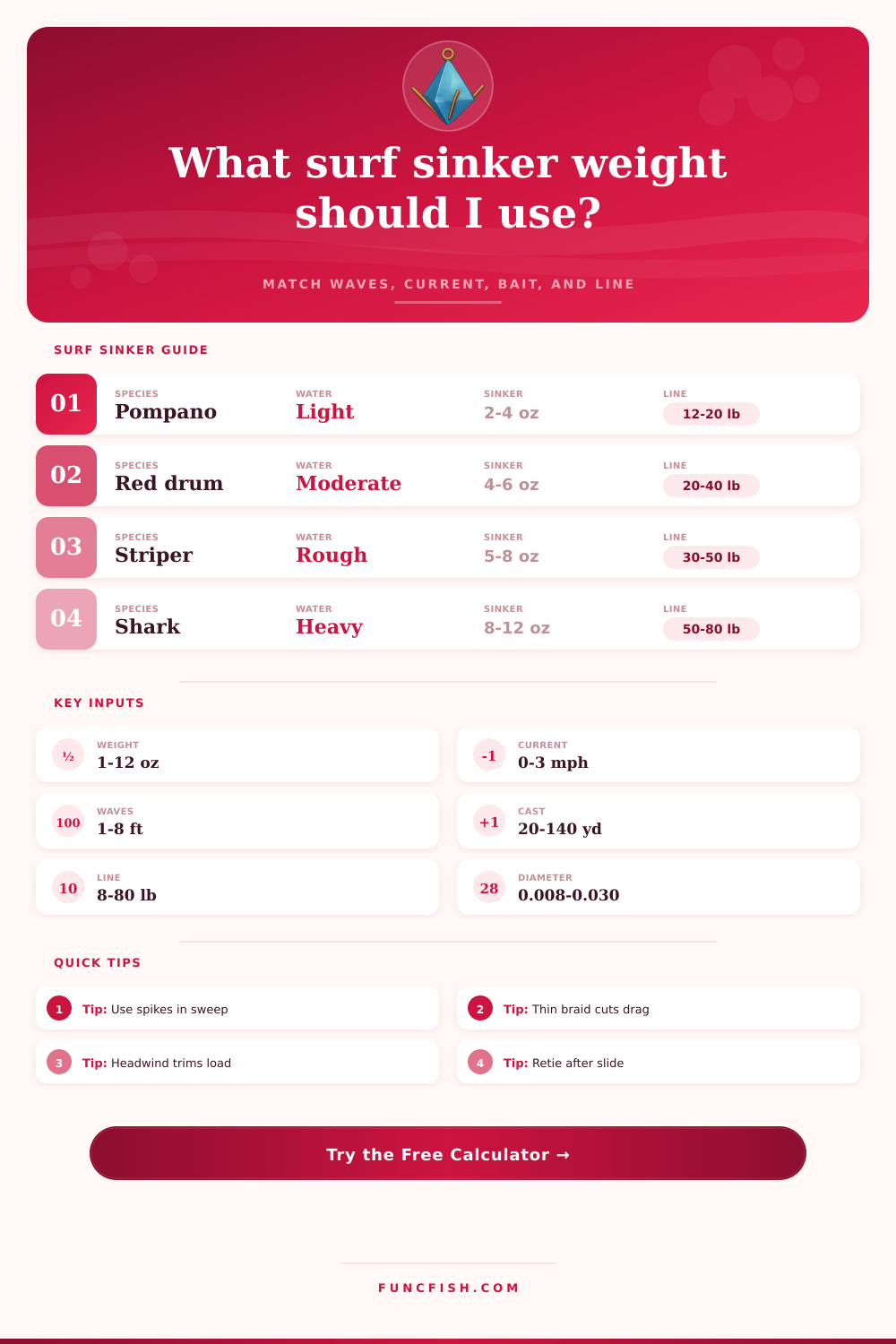
| Pompano | 2-4 oz / 57-113 g | 12-20 lb / 5-9 kg | Pompano dropper | Small baits, long range |
| Whiting / kingfish | 1-3 oz / 28-85 g | 8-15 lb / 4-7 kg | High-low | Light trough fishing |
| Red drum | 3-8 oz / 85-227 g | 20-40 lb / 9-18 kg | Fish finder | Cut bait and sweep |
| Striped bass | 4-8 oz / 113-227 g | 25-50 lb / 11-23 kg | Fish finder | Clam, bunker, or crab |
| Bluefish | 3-6 oz / 85-170 g | 20-40 lb / 9-18 kg | Clipped rig | Cut bait, wire leader |
| Sea trout | 1-3 oz / 28-85 g | 10-20 lb / 5-9 kg | Carolina rig | Light current edges |
| Black drum | 4-10 oz / 113-283 g | 30-60 lb / 14-27 kg | Pulley rig | Heavy crab and clam |
| Shark / ray | 6-12 oz / 170-340 g | 50-80 lb / 23-36 kg | Slide bait | Large bait and leader |
🌊Bottom and condition reference
| Bottom or condition | Grip factor | Demand effect | Practical sinker choice |
|---|---|---|---|
| Soft sand | 1.08 | Sinker digs well | Pyramid or storm |
| Firm packed sand | 1.00 | Baseline hold | Pyramid, sputnik, frog tongue |
| Shell / broken bottom | 0.92 | More skid and snag risk | Sputnik or bank if moving bait |
| Pebble / small stone | 0.86 | Lower bite | Claw style or heavier pyramid |
| Weed / grass patches | 0.80 | Line and sinker foul | Compact rig, avoid extra droppers |
| Rip trough / rolling sand | 0.76 | Rolling bottom breaks hold | Sputnik or move one size up |
💡Calculation checks
Tip: If the rig creeps a few feet and then settles, the sinker is close. If it tumbles continuously, move up one common size or switch to a gripping style.
Tip: For hard casting, compare total load against your rod rating and use shock leader practices appropriate for the line, sinker, and local surf conditions.
When you choose a sinker for fishing, there is several different forces that will act upon that sinker. Moving water, waves, or the movement of the wind that act upon the fishing line can cause sinker movement. If the sinker that are selected for fishing is too light for the conditions, the sinker wont be able to remain in one place.
Thus, the sinker need to be selected in a way that balance these different forces to ensure that the sinker remains in one place while on the bottom. One of the main force that will act upon the sinker is the current in the water. Currents tend to have the ability to move a light sinker along the bottom of the water due to the way that the current can interact with the fishing line.
How to Choose the Right Sinker for Fishing
By using a calculator, you can determine the weight of the sinker that is necessary to counteract the strength of the current, as well as the distance that the sinker should be able to hold in the water. Wave height is another of the main forces that will act upon the sinker. However, wave height acts in a vertical movement rather than a horizontal movement.
As the waves move vertically, they tend to lift the bait that is being used for fishing, which creates horizontal movement of the fishing line that can loosen the sinker that is attached to the line. Thus, another consideration in the selection of the sinker is the type of sinker that can remain in place despite these vertical movement. Another consideration is the size and the profile of the bait that will be used in the fishing process.
If large bait is to be used, the large bait will create resistance in the water as it moves through the water due to the current. A sinker that work for a small piece of shrimp may not work for large pieces of bait due to this resistance in the water. Thus, you must consider the profile of the bait that will be used when selecting the proper sinker.
Another consideration is the diameter of the fishing line that will be used. If thick monofilament line is used, the thicker line will create a larger surface area for the current and the wind to push against the line. Because these force will act against the thick monofilament line, a heavier sinker will be necessary.
Braided fishing line has a smaller diameter than monofilament line. Thus, the water creates less drag in relation to braided line. However, the force of the sinker, the bait, and the leader must not be too strong for the fishing rod that is being used.
The type of bottom that is to be fished can also impact the choice of sinker. In sandy bottoms, pyramid sinkers will naturaly dig into the sand and allow the sinker to remain in place. However, if the bottom contains shells or troughs, the sinker may not remain in place.
In these situation, a sputnik or spider claw sinker may be necessary. Thus, you should consider the type of bottom that is to be fished in the selection of the sinker, as should the adjustments that may have to be made to that selection if the sinker begins to move. The last of the main forces that act upon the sinker are the forces of the wind.
A headwind will push against the belly of the fishing line, increasing the force that acts upon the sinker. A tailwind will not create a push against the fishing line, which reduces the force that act upon the sinker. A calculator allows anglers to account for these different variables of the wind.
However, if the wind is too strong to allow for proper casting with the fishing rig that is being used, the style of the rig may have to be altered. The calculator provides a recommendation for the type of sinker that should be used based off the forces that will act upon the sinkers. The calculator balance the holding score of the sinker with the total load that the fishing rod will endure.
For instance, if the holding score is high but the total load is too strong for the fishing rod, a lighter sinker should be used. However, if the holding score is low and there is strong wind, a heavier sinker or a different type of sinker may be required. Thus, not only should sinkers be selected according to the parameters created by the calculator, but those fishing for the sinkers should also observe the water in which they are fishing and adjust the type of sinker according to the behavior of the sinker during the first few casts.