Hook Size for Catfish Calculator
Size catfish hooks for channel cats, blue cats, and flatheads by matching bait length, bait girth, hook family, line test, current, and target fish class.
📌Catfish hook presets
⚙Catfish rig settings
Catfish hook match
Recommended hook size and rig fit will appear here.
Full breakdown
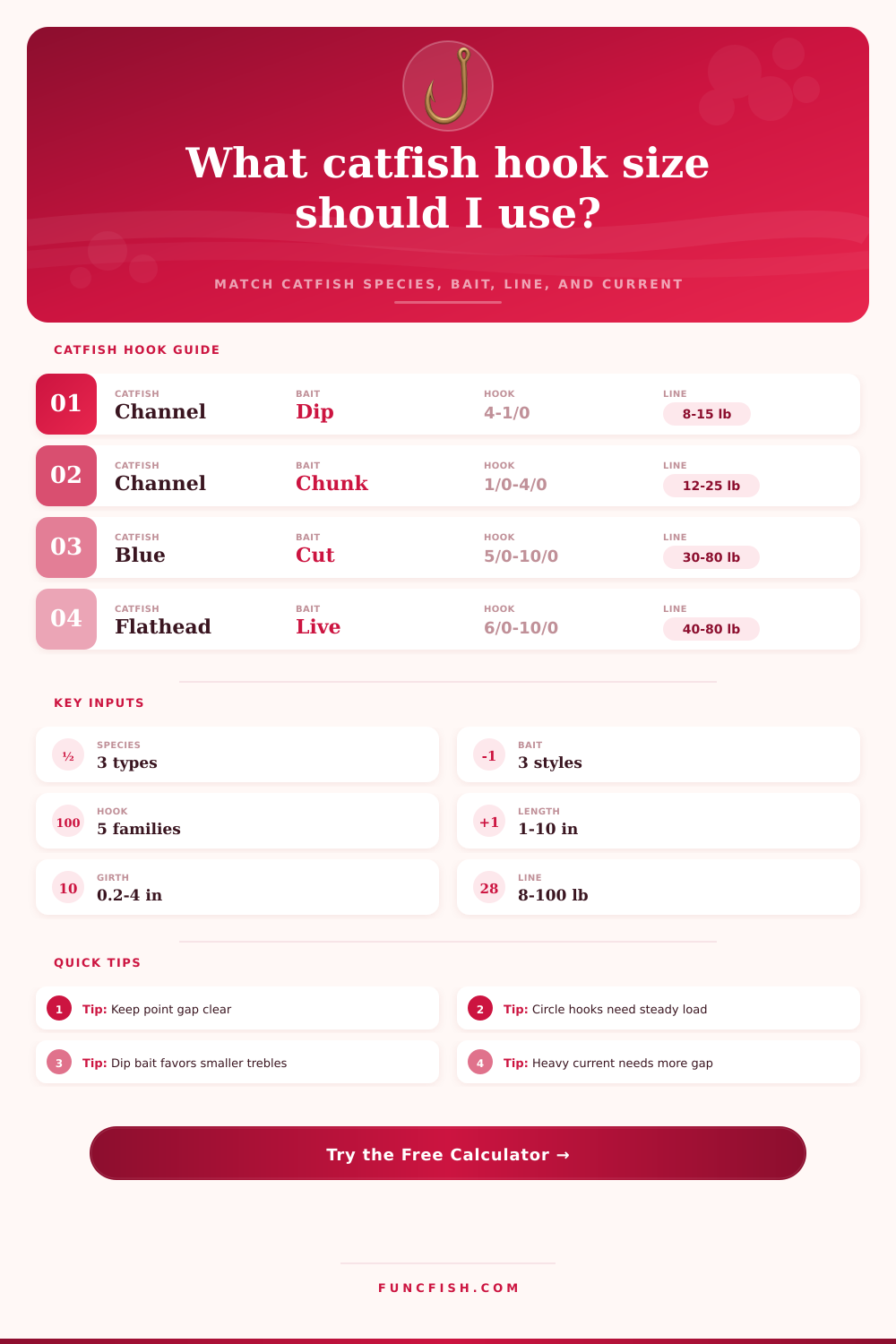
📋Catfish bait, hook, and line comparison grid
Channel Dip
Channel Cut
Blue Cut
Flathead Live
📏Catfish hook reference tables
| Species and class | Typical weight | Hook range | Line window |
|---|---|---|---|
| Channel eater | 1-5 lb / 0.5-2.3 kg | #4-2/0 | 8-15 lb / 3.6-6.8 kg |
| Channel trophy | 10-25 lb / 4.5-11.3 kg | 3/0-7/0 | 20-40 lb / 9.1-18.1 kg |
| Blue trophy | 25-60 lb / 11.3-27.2 kg | 6/0-10/0 | 40-80 lb / 18.1-36.3 kg |
| Flathead trophy | 25-70 lb / 11.3-31.8 kg | 6/0-10/0 | 40-80 lb / 18.1-36.3 kg |
| Bait style | Best families | Gap rule | Common line |
|---|---|---|---|
| Dip / punch bait | Treble, J | Small exposed points | 8-20 lb / 3.6-9.1 kg |
| Cut bait chunk | Circle, J, octopus | Gap at least 1.7x girth | 15-80 lb / 6.8-36.3 kg |
| Live bait | Kahle, circle, octopus | Gap at least 1.5x girth | 25-80 lb / 11.3-36.3 kg |
| Large head section | Circle, J | Wide gap with clear point | 40-100 lb / 18.1-45.4 kg |
| Hook family | Useful catfish sizes | Gap behavior | Best match |
|---|---|---|---|
| Circle | 1/0-12/0 | Turns into corner | Cut bait, steady load |
| Kahle | 1/0-10/0 | Wide open bite | Live bait, flatheads |
| J hook | 1/0-10/0 | Direct set power | Chunks, short leaders |
| Treble | #6-2/0 | Multiple small points | Dip bait, punch bait |
| Octopus | #2-8/0 | Compact curved gap | Small live or cut bait |
| Current | Size shift | Line shift | Hook note |
|---|---|---|---|
| Still water | -0.3 rank | Baseline | Smaller bait stays natural |
| Light current | 0 rank | +0 to +5 lb | Baseline river drift |
| Moderate current | +0.4 rank | +5 to +15 lb | More exposed gap helps |
| Heavy current | +0.8 rank | +15 to +30 lb | Use bigger gap and wire |
💡Catfish hook checks
Tip: After threading a cut bait chunk, look at the hook from the side. The point and barb area should sit outside the bait, not buried in skin or scales.
Tip: For circle hooks, avoid oversizing just for looks. A hook that can rotate cleanly under steady pressure usually lands more fish than one packed full of bait.
Choosing the correct hook for catfish requires that the hook is match to the bait that will be used with the hook, and the correct hook for catfish also requires that the hook is matched to the size of the catfish that will be targeted with the hook. A person may experience a missed fish if the gap between the point of the hook and the bait is too large, or if the bait is blocking the point of the hook. A calculator help to avoid these scenarios by using various parameters of the targeting catfish (species, line test, current) and the bait that the angreter will use to calculate the proper gap size between the point of the hook and the bait to which that hook will be attached.
The calculator helps to remove the guesswork that may accompany hook selection by determining the amount of clearance that a circle hook’s point must have relative to the kahle hook’s point, given the girth of the bait that will be used, and the speed of the current in the water where the targeted catfish live. Bait is one of the considerations to make in the selection of the proper hook for the catfish that will be targeted. For instance, dip bait and punch bait are small globs of bait that can be introduced into the water that tend to be caught by trebles or J hooks of small sizes.
How to Choose the Right Hook for Catfish
Cut bait and chunks of shad or skipjack contain the scales of the fish that may bury the point of the hook if the gap between the point and the shank of the hook is too small for the chunk of bait of that size. Additionally, live bait require that the hook is not likely to snag the fins of the live bait such as baitfish; in this instance, the length and girth of the live bait can be provided to the calculator to help with the determination of the proper hook size. The species of the targeted catfish can play a role in the determination of the size of the gap between the point of the hook and the shank of the hook.
For instance, channel catfish has smaller mouths than the other catfish species, and tend to nibble on the bait instead of taking large chunks of the bait; thus, the gap between the point of the hook and the shank of the channel catfish hook does not need to be as large as for other species of catfish. Additionally, blue catfish often take large chunks of cut bait in strong currents in there favorite habitats; thus, the gap between the point and shank of the hook must be larger for the blue catfish hook to allow for the current to not bury the point of the hook. Finally, flathead catfish use live bait that is placed near structures in the water, and their bites are strong head shakes that may bury the point of a hook with a small gap; thus, the point of the hook with a larger gap is required for the flathead catfish.
These different species of catfish are accounted for in the calculator by the fish class setting. The line test of the bait and the current of the water in which the targeted catfish live can play a role in the gap between the point and shank of the hook. For instance, if the fishing location is in still water, the strength of the bait’s line can be more light, and the size of the hook can be smaller.
By contrast, if the current in the water is faster, the current will load the line with the force more quickly, which will require a larger gap between the point and the shank of the hook. These parameters is incorporated into the calculator in the adjustment of the target rank for the bait being used, so that anglers do not have to memorize the different mathematical coefficients of the line test of the bait and the current. Reference tables are provided on the page that include the different sizes of hooks for the different species of catfish.
For instance, a channel catfish fisherman using dip bait will rarely need a hook size larger than a 1/0 treble on 12-pound test line. Additionally, a blue catfish fisherman that is targeting trophy fish with six-inch chunks of bait may need to use an 8/0 circle hook on 65-pound braided line. These sizes are suggested sizes that may help anglers make their hook selections, but the actual conditions of the river or lake in which they are fishing, and the preference of the anglers themselves, may change that recommendation.
It is common for anglers to make a mistake in the sizing of the hook when selecting hooks for fishing for catfish, they may base the sizing of the hook on the size of the fish that they are targeting, not the size of the bait. For instance, a large flathead catfish may be caught on a 3/0 kahle hook if the bluegill bait is small in size. However, the same angreter may experience missed fish if they attempt to use a 5/0 circle hook to fish for channel catfish with a thick chunk of cut bait that may bury the point of the hook.
Anglers can use the exposure percentage relative to the bait that will be used to identify if this mistake is being made; if the percentage of the hook that is exposed from the bait is too low, it is likely that the point of the hook will be buried in the bait; the fish will feel the hook before they will feel the food. Not all circle hooks are alike. For instance, some circle hooks are offset from the shank of the hook, while other circle hooks are made to be inline with the shank of the hook.
For bait that is attached to the shank of the circle hook, the offset circle hooks may require a slightly smaller gap between the point of the hook and the shank than that required by inline circle hooks. The user can change the family of the hook in the calculator to determine the effect that changing from a circle hook to a kahle hook or from a J to an octopus hook will have on the size of the hook; the size of the hook will change by one or two sizes within the same family of hook when the family of hook is changed; changing the size of the hook by one or two sizes will affect whether or not the hook will successfully land on the corner of the mouth of the catfish, and not slide out of the mouth of the fish during a head shake of the fish. The environment in which the fish are being targeted contains various variable that the hook size calculator cannot account for.
For instance, the clarity of the water will affect how aggressively the targeted catfish take the bait; the temperature of the water will affect how lively the live bait is; and the force of the wind may affect the rate at which the bait is drifting in the water. Thus, while the calculator includes provisions for the consideration of some of these variables, anglers must pay attention to the fish that are being targeted; they may need to change the size of the hook that they plan to use by one size. The process for selecting the proper hook requires the angreter to measure the bait that will be used, to note the species of the targeted catfish, to note the size of the targeted catfish, and to use the calculator to select the size and family of hook that will ensure that the point of the hook is clear of the bait.
Thus, anglers must pay attention to the fish while they are fishing, and they must be ready and willing to change the size of the hook by one size to accommodate any changes in the behavior of the targeted catfish.