
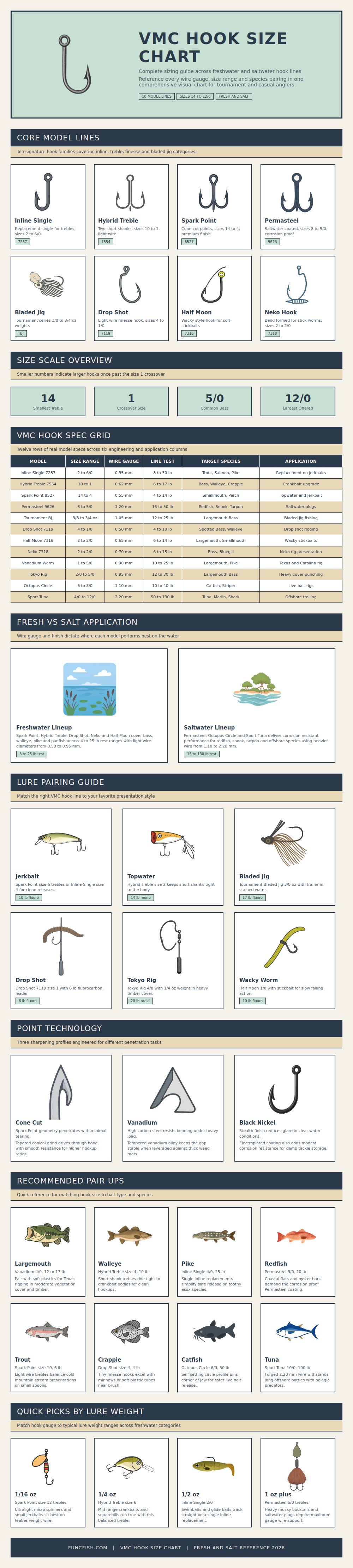
Selecting the correct hook size is a necesary step in fishing, as using a hook that is the wrong size for the fish that you are fishing for will often result in the hook becoming embedded in the fish but then pulling free from it mouth. The angreter must match the hook to the fish that is being targeted, as using a hook that is too large for small fish will prevent the fish from being able to take the hook into its mouth, while using a hook that is too small for large fish may result in the hook bending or break when the large fish attempts to pull the line towards the angreter. Hook sizes use a system that can be confusing for new angler.
Small sizes use large numbers, such as a size 14 hook; these are very small hooks. As the size of the hook increases, the numbers decreases until the size of the hook reaches a number of 1. After number 1, the sizes use a slash and a zero, such as an 12/0 hook, which indicates that those hooks are much larger than a size 1 hook.
How to Pick the Right Fishing Hook
Thus, the smaller the number used for the size of the hook, the larger the hook; the larger the number, the smaller size of the hook. Anglers should also use a reference chart to identify the sizes of hooks that are available, as this will help anglers to properly select the size of the hook according to the size of the fish that the angreter is targeting. There are many type of hooks that are available to anglers, and manufacturers often make these hooks for specific types of fishing techniques.
For instance, inline single hooks are used for jerkbaits when fishing for species like pike and salmon. Hybrid treble hooks has short shanks and are often used for crankbaits. Finesse hooks, such as drop shot hooks, are used for fishing techniques that require the hook to enter the mouth of the fish without causing any damage to the fish; these hooks use light wire.
Finally, fishermen use heavy gauge hooks, such as permasteel hooks, in saltwater environment due to the corrosion-resistant coating that covers those hooks. The wire gauge for the hook determines the strength of the hook. Thin wire gauge hooks will allow the hook to easily penetrate soft baits, and are often used for finesse fishing technique.
Thick wire gauge hooks provide more strength to the hook, which is beneficial when fishing for large fish, such as tuna or marlin. The wire gauge of the hook should match the pound test of the fishing line. For instance, light wire hooks are used with fishing lines that test for 4 to 10 pound of line test, while heavy gauge hooks are used in conjunction with 50 pound test lines.
The weight of the hook will impact the way the lure moves in the water. If the weight of the hook is too heavy for the lure, it will change the movement of the lure; it will not move in the way that it should move. Too light a hook may not allow the lure to adequately fight against the fish that is being targeted.
In order for the lure to move in the proper way when being fished, the weight of the hook should be matched to the weight of the lure. For instance, light wire hooks are often used for freshwater environments to target species like bass and walleye, while heavier hooks are used in saltwater environments due to the stronger fish that is often found in these environments. Certain types of hooks are often used for specific fishing tasks.
For instance, conical point hooks are used for jerkbaits, while offset hooks are used with soft plastic bait. Circle hooks are used for tasks where live bait is used. The type of hook that should be used can be determined according to the specific fishing task that is to be performed, as well as the type of bait that is to be used in the fishing task.
Certain species of fish require specific hook sizes and types. For instance, largemouth bass often require 4/0 worm hook when using Texas rigs to catch the fish. Pike require inline single hooks because the teeth of these fish are strong and resist the teeth of the inline hooks.
Trout require tiny treble hooks, while redfish require coated treble hooks to prevent them from corroding in the water. Finally, tuna require large, forged hooks since tuna often put strength on the line when anglers catch them. These species of fish should always be considered when selecting the type of hook that will be used in the angreters fishing efforts.
In order to properly select the hook for the angreters fishing efforts, there are several factor that must be considered. The species of the fish that is to be caught, the type of lure that will be used in the fishing task, the wire gauge of the hook, the weight of the hook, as well as a hook chart and how the lure will move in the water when being fished must all be considered in order to ensure that the angreter has selected the appropriate hook for the different fishing tasks. You should of thought about the species first to avoid a mistake.