🐟 Bass Out-of-Water Survival Time Calculator
Estimate safe air-exposure time for bass based on water temp, air temp, fish size & conditions
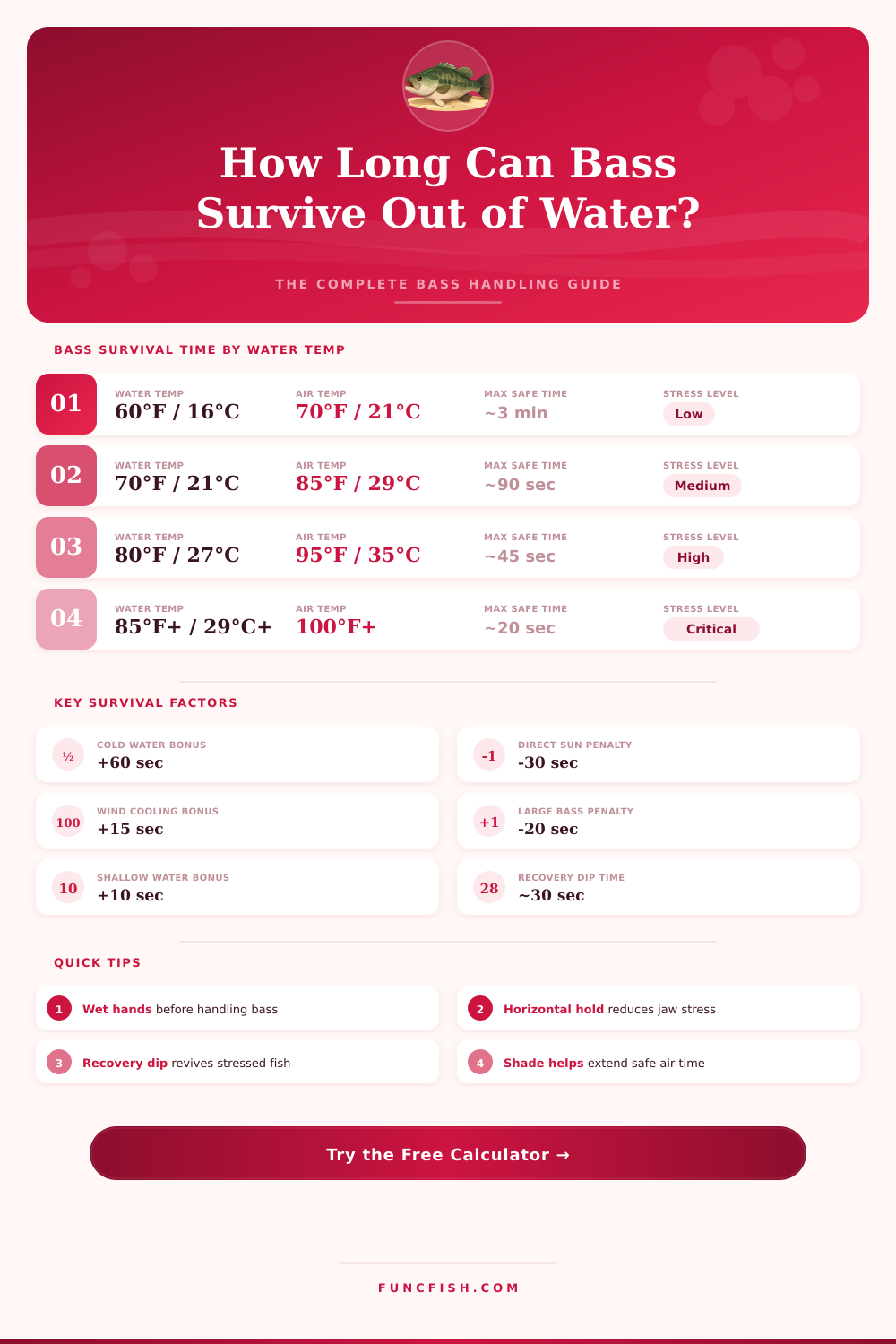
| Water Temp (°F / °C) | Baseline Safe Time | Stress Level | DO Saturation (%) | Recovery Time |
|---|---|---|---|---|
| 50°F / 10°C | 3–5 min | Very Low | ~98% | 30–60 sec |
| 60°F / 16°C | 2–3 min | Low | ~95% | 30–60 sec |
| 68°F / 20°C | 90–120 sec | Moderate | ~90% | 1–2 min |
| 72°F / 22°C | 75–100 sec | Moderate | ~87% | 1–2 min |
| 76°F / 24°C | 60–80 sec | Elevated | ~84% | 2–3 min |
| 80°F / 27°C | 40–60 sec | High | ~80% | 3–5 min |
| 84°F / 29°C | 20–40 sec | Very High | ~76% | 5–10 min |
| 88°F+ / 31°C+ | <20 sec | Critical | <74% | 10+ min (if survives) |
| Species | Optimal Water Temp | Thermal Max (Lethal) | Stress Onset | Air Tolerance Factor |
|---|---|---|---|---|
| Largemouth Bass | 65–75°F / 18–24°C | ~95°F / 35°C | 76°F / 24°C | 1.00 (baseline) |
| Smallmouth Bass | 60–70°F / 16–21°C | ~90°F / 32°C | 72°F / 22°C | 0.90 (more sensitive) |
| Spotted Bass | 63–73°F / 17–23°C | ~93°F / 34°C | 74°F / 23°C | 0.95 |
| Striped Bass | 60–68°F / 16–20°C | ~86°F / 30°C | 68°F / 20°C | 0.80 (most sensitive) |
| White Bass | 65–72°F / 18–22°C | ~90°F / 32°C | 74°F / 23°C | 0.95 |
| Weight (lb / kg) | Length (in / cm) | Size Factor | Handling Recommendation |
|---|---|---|---|
| 0.5–1.5 lb / 0.2–0.7 kg | 10–13 in / 25–33 cm | +10% | Quick vertical hold |
| 1.5–3 lb / 0.7–1.4 kg | 13–16 in / 33–41 cm | Baseline | Thumb grip, horizontal |
| 3–5 lb / 1.4–2.3 kg | 16–20 in / 41–51 cm | -10% | Two-hand support |
| 5–8 lb / 2.3–3.6 kg | 20–24 in / 51–61 cm | -20% | Cradle horizontally |
| 8+ lb / 3.6+ kg | 24+ in / 61+ cm | -30% | Cradle, minimize time |
| Condition | DO Level (ppm) | Effect on Bass | Adjust Safe Time By |
|---|---|---|---|
| Excellent (cool, aerated) | 9–12 ppm | Minimal pre-stress | +20% |
| Good (normal) | 7–9 ppm | Normal baseline | 0% |
| Marginal (warm, stagnant) | 5–7 ppm | Moderate pre-stress | -20% |
| Poor (very warm) | 3–5 ppm | High pre-stress | -40% |
| Critical (hypoxic) | <3 ppm | Severe pre-stress | -60% |
Bass and other fish species requires water to breathe. Additionally, these type of fish experience stress when they is removed from the water. Fish use gills to extract the dissolved oxygen from the water that it breathe into.
If the fish are removed from the water, the gills cannot perform this function of extracting the dissolved oxygen from the water. Furthermore, the protective slime coat that cover the body of the fish begin to dry. When the fish lose the protective slime coat, the fish is more vulnerable to damage from its environment.
Why Fish Should Stay in Water
The third reason that the fish should not be removed from the water is that the body temperature of the fish will rise when the fish are removed from it’s natural environment. The specific species of fish that is caught will determine how long the fish can remain out of the water. For instance, largemouth bass can remain out of the water for approximately ten minutes.
Smallmouth bass can remain out of the water for nine minute. Striped bass can remain out of the water for only eight minutes because the size of the striped bass require more support when you remove the fish from the water. Each type of fish will have a different tolerance for remain out of the water.
The environmental factors that may impact the length of time that the fish can remain out of the water include the temperature of the water and air, and the humidity in the air. If the water is 72 degrees and the air is 85 degrees, the fish will experience stress from the difference in these temperature. If the humidity is high, the gills of the fish will remain moist.
If the humidity is low or if the wind in the air is strong, the gills will dry quick. Additionally, if there is wind that is blowing the fish, the water will evaporate from the body of the fish. This will cause the fish to lose its protective slime coat at a more faster rate.
The way in which you handle the fish will also impact its survival. For instance, if you use a lip hook to catch the fish, the fish will experience less stress than if the fish has a deep hook in its throat. If the fish begins to thrash its body while out of the water, it will use up all of it’s energy quickly.
In these cases, you should try to hold the fish calm. You should always keep the fish wet and use a cradle or a net to hold the fish so that you preserve its slime coat. You should also avoid having the fish place on a dry deck as this will cause it to lose its slime coat, which will reduce the length of time that the fish can remain out of the water.
Another factor that will impact the way in which you handle the fish is the size of the fish. For instance, if the bass that is being caught is over 20 inches in length, its body will lose heat more slow than smaller bass fish. However, the large bass will require more support when out of the water.
Therefore, you should support the bass horizontally rather than vertical, as the weight of the bass can compress its organ. There are also tools that can be used to manage the amount of time that the fish remains out of the water. For instance, you can use a stopwatch to track the length of time that the fish is out of the water.
A spray bottle can also be used to wet the fish so that the slime coat remain intact. However, the fish should not be removed from the water for long period of time to take photograph of the fish. If the air temperature is above 70 degrees, the fish should be returned to the water immediately.
Additionally, you should return the fish to the water before the stress levels becomes too high for the fish, as high levels of stress can lead to the fish’s death after being release back into the water.