Trout Lifespan Calculator
Estimate trout age, lifespan range, maturity stage, and growth percentile from species, habitat, water temperature band, growth rate, measured size, origin, pressure index, and measurement confidence.
📌Trout lifespan presets
⚙Species, size, and habitat inputs
Trout lifespan estimate
Calculator output appears here after choosing a trout scenario.
Calculation breakdown
📊Species and habitat comparison grid
Brook trout stream
Rainbow pond
Brown tailwater
Lake trout basin
🐟Trout species lifespan reference
| Species | Reference lifespan | Maturity age | Growth pattern | Adult length reference |
|---|---|---|---|---|
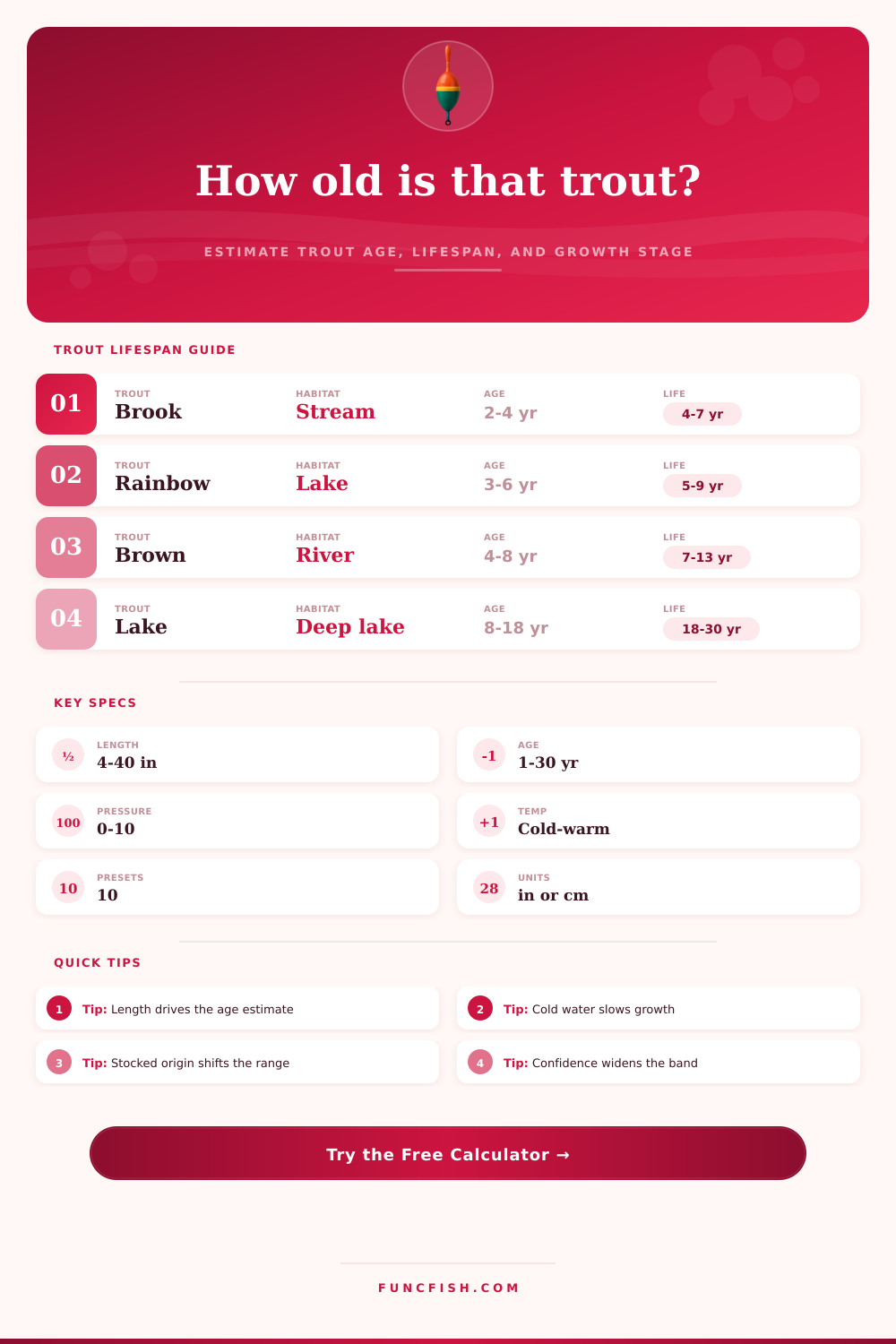
| Brook trout | 4-7 years, longer in some lakes | 2 years | Quick early growth, short stream lifespan | 6-14 in / 15-36 cm |
| Rainbow trout | 5-9 years, variable by origin | 2-3 years | Fast growth in productive water | 10-22 in / 25-56 cm |
| Brown trout | 7-13 years, longer in large systems | 3 years | Moderate growth with high top-end age | 12-28 in / 30-71 cm |
| Cutthroat trout | 5-10 years depending on water type | 3 years | Moderate, often cooler-water limited | 8-20 in / 20-51 cm |
| Lake trout | 18-30 years in deep cold lakes | 6-8 years | Slow growth and long life span | 20-40 in / 51-102 cm |
| Steelhead | 4-8 years for adult life history | 3-5 years | Rapid marine growth, variable freshwater age | 20-34 in / 51-86 cm |
| Bull trout | 8-15 years in cold river-lake systems | 5 years | Slow growth with late maturity | 16-30 in / 41-76 cm |
| Golden trout | 5-9 years in high-elevation water | 3 years | Slow alpine growth, compact adult size | 6-14 in / 15-36 cm |
| Tiger trout | 5-10 years in lakes or reservoirs | 3 years | Hybrid growth, often strong early gains | 12-24 in / 30-61 cm |
🌊Habitat and temperature adjustment table
| Setting | Growth effect | Lifespan effect | Best model use | Temperature band cue |
|---|---|---|---|---|
| Freestone stream | Baseline to slower | Moderate range | Small and medium wild trout | Cold to cool seasonal water |
| Spring creek | Steady moderate growth | Slightly longer range | Consistent-size trout with stable food | Stable cool water |
| Tailwater river | Moderate to fast growth | Longer adult window | Brown, rainbow, and cutthroat estimates | Cool or optimal band |
| Alpine lake | Slow growth | Can extend lifespan | Brook, cutthroat, golden trout | Cold band most of year |
| Natural lake | Variable by productivity | Broad range | Lake, rainbow, brown, and cutthroat | Cold to variable band |
| Reservoir | Often faster early growth | Moderate to broad range | Rainbow, brown, tiger, lake trout | Variable seasonal band |
| Stocked pond | Fast early size gain | Shorter reference range | Recently stocked or holdover trout | Cool to warm band |
| Anadromous river | Fast adult size gain | Life-history dependent | Steelhead or migratory rainbow | Variable river band |
📏Size-to-age reference table
| Length class | Small stream species | Rainbow / brown | Lake trout | Reference read |
|---|---|---|---|---|
| 4-8 in / 10-20 cm | Age 1-3 | Age 1-2 | Age 1 | Juvenile to young adult in small water |
| 9-12 in / 23-30 cm | Age 2-5 | Age 1-3 | Age 2-3 | Common adult size for compact habitats |
| 13-18 in / 33-46 cm | Older adult | Age 2-6 | Age 3-6 | Productive growth or older stream fish |
| 19-24 in / 48-61 cm | Unusual size | Age 4-9 | Age 5-10 | Large adult class in many waters |
| 25-32 in / 64-81 cm | Outside range | Age 6-12 | Age 8-18 | Trophy class or long-lived lake fish |
| 33-40 in / 84-102 cm | Outside range | Rare top end | Age 15-30 | Deep-lake long-life reference class |
🧭Origin, pressure, and confidence reference
| Input | Low setting | Middle setting | High setting | Calculator effect |
|---|---|---|---|---|
| Origin | Recently stocked | Unknown | Wild or holdover | Changes lifespan window and growth curve |
| Predation / pressure index | 0-2 | 3-6 | 7-10 | Higher values narrow upper lifespan range |
| Measurement confidence | Visual estimate | Length only | Length plus weight | Lower confidence widens age and life bands |
| Reference age estimate | 0 years | Partial clue | Known estimate | Optional blend with size-based age |
| Growth rate | Slow | Moderate | Very fast | Same length reads older or younger |
💡Calculator notes
Age estimate tip: Size alone cannot identify exact trout age, so the calculator uses confidence to widen or tighten the result. A measured length and weight produces a narrower band than a visual length estimate.
Growth percentile tip: A high growth percentile means the entered trout is large for its estimated age in this reference model. It does not mean the trout is older; fast water productivity can make young fish look large.
Determining the age of a trout are a complex endeavor due to the fact that the relationship between the size of a trout and the age of a trout isnt a simple or straight relationship. Many people believes that the length of a trout is indicative of the age of that trout. However, the length of a trout can be the result of a variety of factors, including the temperature of the water in which the trout live, the availability of food for that trout, the level of competition for that food within its habitat, and the origin of the trout.
Each of these factors can have an impact upon the growth of that trout, thus making a calculator that considers each of these variable an accurate means of estimating the age of a trout. The calculator is useful in that it treats the growth of a trout as a curve rather then a straight line. Each species of trout has a specific growth rate as well as a maximum size for that species.
How to Estimate a Trout’s Age
However, each species have different growth rates and maximum sizes according to the habitat in which they live and the temperature of that habitat. For instance, a species of trout that lives in a spring creek will typically grow at a faster rate than the same species of trout that lives in a freestone stream. The design of the calculator considers each of these factors, which provides an estimated age for the trout that accounts for the possible inaccuracy of estimating the size of the trout.
The origin of the trout is one of the most important variable to consider in determining the age of the trout. For instance, trout that is from a hatchery will typically grow to a large length within a short period of time due to the diet provided to those trout. However, the lifespan of a hatchery trout is typically more shorter than that of a wild trout of the same length.
Thus, another important variable in the calculation is the lifespan of the trout according to its origin. Additionally, in areas where there is a high level of fishing pressure and where there is a high level of predation upon trout, the lifespan of trout in those areas will be shorter than in areas with less fishing pressure and fewer predator. The maturity stage of the trout is another important fact provided to the individual who utilize the calculator.
The maturity calculator can help to determine if the trout has reached the age to spawn. For instance, a fourteen-inch brook trout living in a small mountain stream may have reached the maturity age to spawn, but the same length of brook trout living in a productive tailwater area may be a younger fish. The calculator uses a timeline that is specific to the trout to calculate its age.
Trout, like most species, have a lifespan and growth that is affected by the water temperature in which it lives. The colder the water, the more slow the trout will grow and the longer its life will be due to its slow metabolism. The disadvantage to this slow metabolism, however, is that the trout will never grow to be very large.
If the water is warm, the trout will grow quick but its lifespan will be shorter than if it lived in colder water. The reference tables provided on the page have a different purpose than the calculator. The reference tables show the typical growth and lifespan of trout of each species in different habitats.
The data from the calculator can be compared to the reference tables to determine if the age of the trout seems to be too high or too low. For instance, the reference tables show that lake and bull trout grow slowly and live longer than stream trout, so deviations from these values could indicate that the trout is from a more stable population. Many people make mistake with trout when they believe that if the fish is large, then it is of high age.
If the trout had excellent conditions throughout its life, then it likely grew to be very large in size. However, the calculator will show the growth percentile of the trout, which is a figure that demonstrates whether the trout is growing at a faster rate than average trout of the same species. Percentiles above 50, for instance, will indicate that the trout is growing faster than the average trout of that species, likely because the environment in which it lives is excellent for trout or due to the individual growth of that specific fish.
While the calculator can provide a person with a reliable baseline of the age of a trout, it cannot account for every single event that occurs within its environment. For instance, sudden changes in the chemistry of the water or the age of the trouts habitat could impact its life in ways that are beyond the scope of the calculator. Such events could lead to trout that are much older or much smaller than expected according to the calculator.
Thus, while the calculator can provide a baseline for the age of the trout, the individual performs observations of the trout and its water environment that is also essential to gaining an understanding of the trout completely.