Marlin Lifespan Calculator
Estimate marlin age, maturity stage, expected lifespan range, body condition, and confidence from species, lower jaw fork length, girth, basin, sex, and growth zone.
🎯Named marlin presets
📏Calculator inputs
Calculation breakdown
📊Species lifespan snapshot
🧭Marlin growth and maturity table
| Species | Typical max age | Adult LJFL guide | Growth pattern used |
|---|---|---|---|
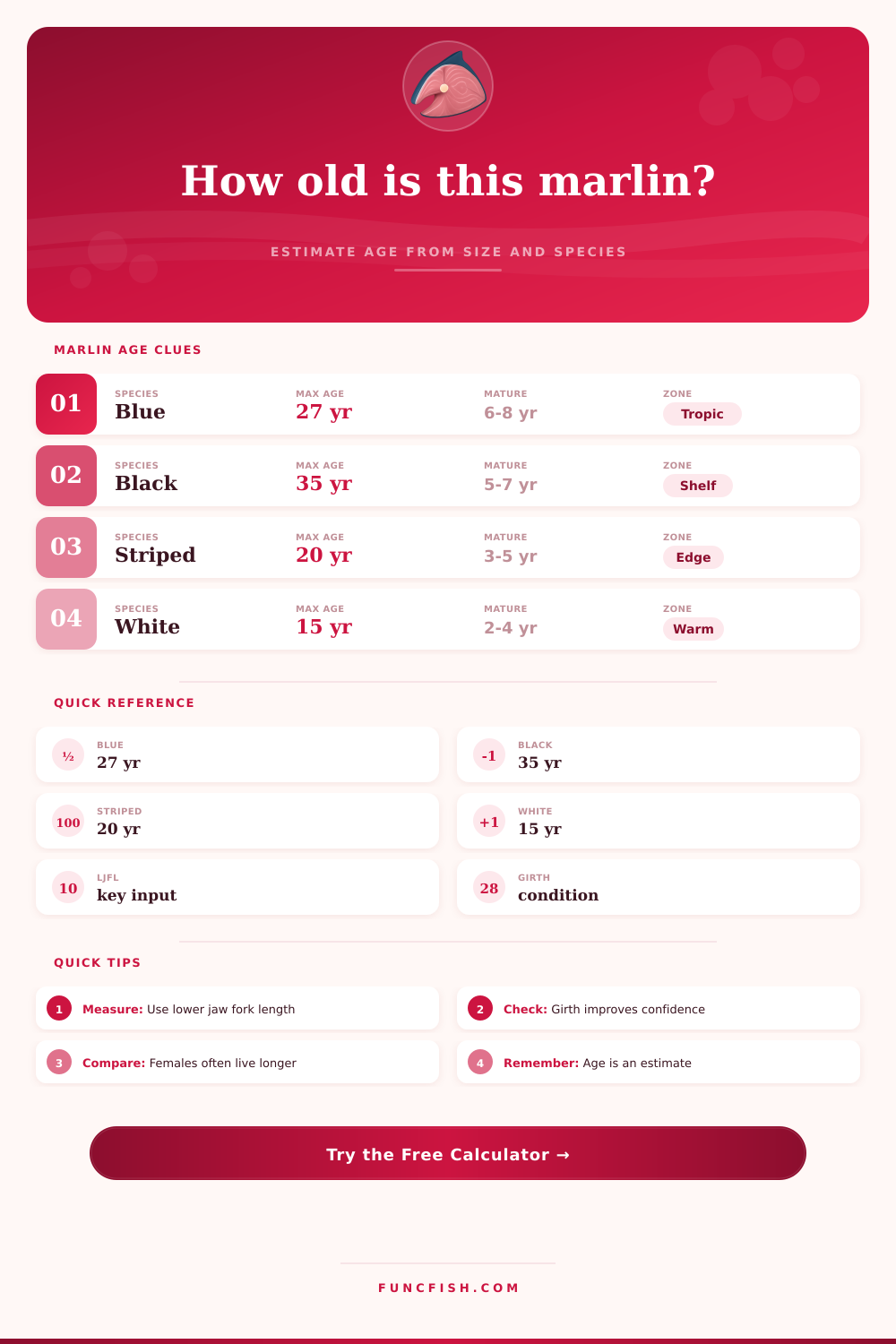
| Blue marlin | Up to about 27 years | 90–120 in / 229–305 cm | Fast early growth, long adult plateau |
| Black marlin | Up to about 35 years | 100–135 in / 254–343 cm | Large asymptotic size, slower late growth |
| Striped marlin | Up to about 20 years | 70–95 in / 178–241 cm | Moderate maximum size, clear subadult band |
| White marlin | Up to about 15 years | 55–75 in / 140–191 cm | Smaller billfish profile, earlier maturity |
🌊Ocean basin and growth zone modifiers
| Factor | Selection | Age effect | Confidence effect |
|---|---|---|---|
| Ocean basin | Atlantic, Pacific, Indian, Mediterranean edge | Small regional adjustment to growth curve | Higher for common species-basin pairings |
| Growth zone | Fast forage, typical, cooler edge, slow migration | Fast zones lower age for the same LJFL | Lower when the zone is inferred |
| Sex estimate | Unknown, female, male | Large females usually receive longer lifespan outlook | Unknown sex widens the age band |
| Body condition | Lean, average, robust, stressed | Condition shifts estimated weight and remaining range | Stressed or damaged fish reduce confidence |
📝Length, girth, and weight reference
| Measurement | Why it matters | Calculator use | Best practice |
|---|---|---|---|
| Lower jaw fork length | Most stable size input for billfish growth curves | Drives the base age estimate | Keep tape straight along body centerline |
| Maximum girth | Separates lean fish from heavy-bodied adults | Builds the weight estimate and condition check | Measure the widest body section |
| Observed weight | Improves condition confidence when known | Blends with formula weight if entered | Use scale weight, not rounded dock talk |
| Photo estimate | Useful but easily biased by angle | Applies lower confidence setting | Pair with a known object length when possible |
🏁Billfish species comparison grid
| Billfish | Relative longevity | Size profile | Calculator note |
|---|---|---|---|
| Blue marlin | Long-lived tropical marlin | Very large females, broad adult range | Use basin and sex carefully for giants |
| Black marlin | Longest marlin setting here | Heavy-bodied Indo-Pacific giant | Girth can change weight class sharply |
| Striped marlin | Moderate lifespan | Lean, active, medium-large billfish | Growth zone has visible effect |
| White marlin | Shorter-lived marlin | Smaller Atlantic species | Earlier maturity threshold than blue marlin |
💡Age estimate tips
This calculator estimates age from size-at-age curves and condition factors. Direct aging from hard parts or validated tag-recapture data is more precise for scientific work.
Marlin are large fish, but it can be difficult to age marlin due to the fact that there size isnt indicative of their age. A large marlin may be a young fish, while a smaller marlin may be an older fish that has lived for many years. Thus, size alone is not a means of aging a marlin; specific measurements of the fish must be taken, and mathematical models can help to scientifically estimate the age of the marlin.
One of the main measurement that can be used as a means of aging a marlin is the lower jaw fork length of the fish. This measurement is one of the most reliable measurements that can be taken on a marlin, as this length will not change whether the marlin is eating or spawning. Another important measurement is the girth of the fish.
How to Tell How Old a Marlin Is
The girth of a fish is its thickness. Thus, girth is slightly different than the length of the fish; two marlins of the same length may have different girth measurements, indicating different age for those two fish. A calculator can process each of these measurements, as well as other factors related to the marlin to provide an age estimation for the fish.
The calculator will require information about the species of the marlin, the ocean basin in which it lives, the growth zone in which it lives, and the sex of the fish; these factors play a role in the aging of the fish. The sex of the marlin is one of the factors that can significantly impact the calculation of the age of the fish. Females are typically larger and live longer than male marlin.
Thus, if the sex of the fish is not known, the age calculation will be less precise; the range for the age will be wider. Additionally, the maturity stage of the fish is another factor. A young marlin that is just reaching adulthood will have a different life stage than a marlin that is spawning for many year.
The individual can manually select this stage using the calculation tool, or it can be selected automatically in relation to the length of the marlin. Another group of factors that must be accounted for in calculating the age of the marlin is its ocean basin and growth zone. The environment in which the fish lives can impact the growth of the fish.
For instance, a blue marlin that lives in the pacific ocean may experience different environmental factors than one that lives in the Atlantic ocean. Additionally, a fish that lives in an area that is warm and contains abundant food will grow to the same size as a fish in a cooler environment with less available food. Body condition is another factor; a stressed or spawning marlin may weigh less than the calculation of the tool predicts.
Should the condition of the body of the marlin be poor, the lifespan of the fish will change. It is likely that many individuals will assume that the larger the marlin, the more years of age the fish is; however, this is often not true. As the size of the marlin increases, the rate at which it can grow decreases.
Thus, large marlins will grow at a slower rate than young marlins of the same species. Additionally, the tool will include a confidence score regarding the accuracy of the age calculation. Higher scores will be provided for calculations that use tape measurements of the fish; lower scores will be obtained for calculations based on estimations of the fish from photos.
Additionally, if the size of the fish is very large, or if the sex of the fish is not known, the confidence score will be lower. Reference tables provide information regarding the maximum lifespan of each species of marlin. For instance, blue marlin can live up to 27 years, and black marlin can live up to 35 years.
Additionally, striped marlin live to be approximately 20 years old, while white marlin live to be approximately 15 years old. These are the maximum ages of the species, and the majority of marlin will not live to reach their maximum lifespan. These ages can be used in the calculation of the age of the specific marlin that is being examined.
Aside from aging a specific marlin, this calculating tool can help to determine whether a released marlin has many years of spawning left in its life. Additionally, marlin from different trips can be compared to each other using this calculating tool. This calculating tool will also provide the estimated weight of the marlin.
Should the recorded weight of the fish be different from the calculated weight, the calculating tool will find a blend between the two weights so as to provide the true weight of the fish. It is impossible to accurately calculate the growth of a marlin along its growth curve; however, environmental changes can impact its growth. For instance, environmental changes in the ocean that impact the feeding habits of the marlin will impact its growth rate.
Thus, the inclusion of a confidence score for the age calculations indicates that the calculated age is an estimate of the true age of the fish. Such a score provides an understanding of the users that the age calculation is an estimate. There are many tools other than this calculating tool that can be used to learn about the marlin that is being observed.
Additionally, other observations of the fish in the ocean, as well as information from the tags of the marlin, can provide information that is valuable to the understanding of the life stage and age of the marlin. Additionally, the calculating tool can be used to recognize patterns in the life of the marlin; with enough time using the calculating tool, individuals can recognize how different ocean basins have different effects on the size and weight of the marlin. Thus, individuals can use the calculating tool to determine the life stage of the marlin that is being observed.
While not as precise as other calculating tools, such as tree ring calculations, the calculation of the age of the marlin is still a helpful tool for those interested in the fish. Knowing the age range of the marlin allows individuals to understand whether the marlin is a young or an old fish, which allows individuals understand its life stage.