Amberjack Lifespan Calculator
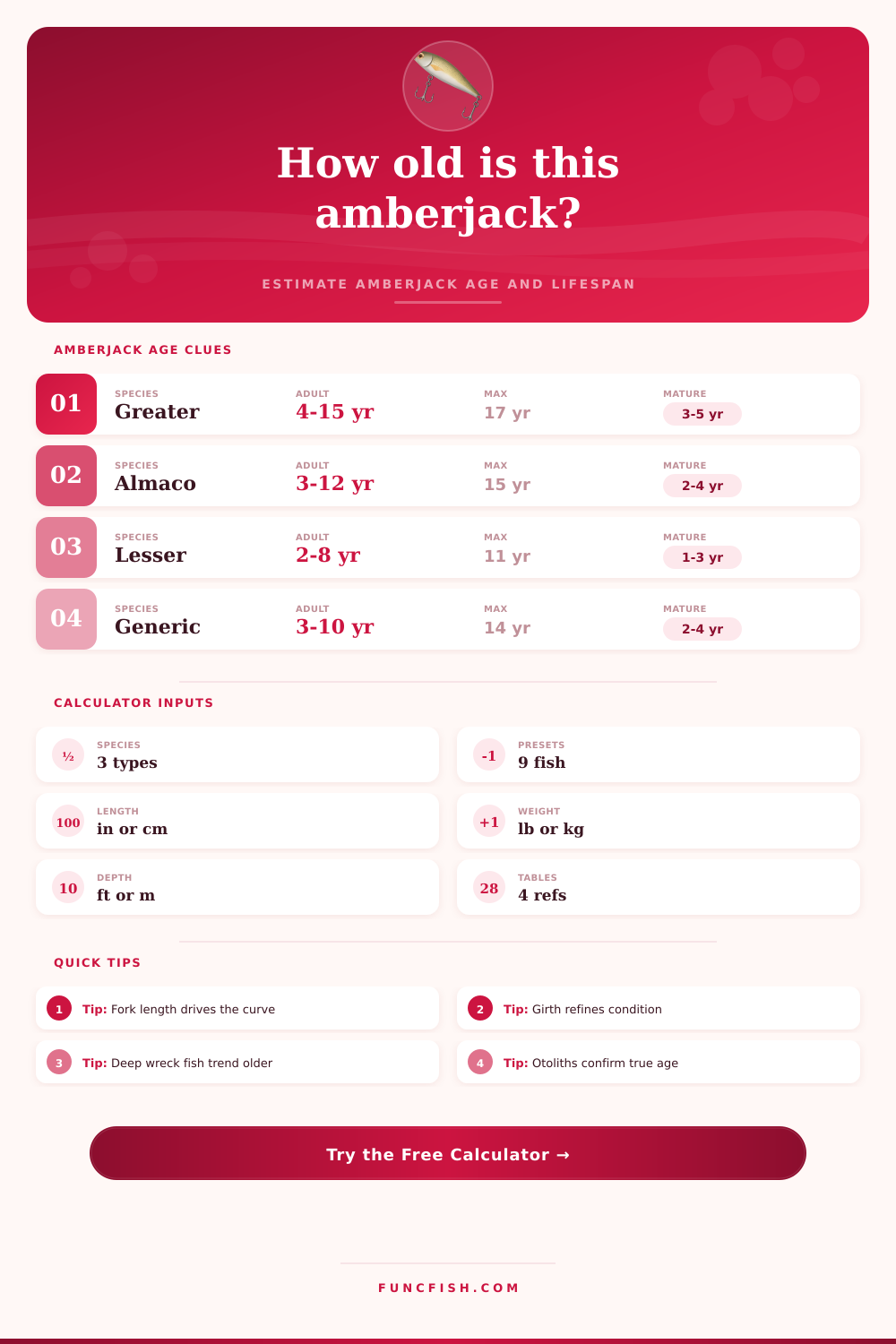
Estimate greater amberjack, almaco amberjack, and lesser amberjack age, likely lifespan, maturity stage, remaining growth window, and confidence from fork length, weight, girth, reef depth, growth region, and body condition.
📌Amberjack lifespan presets
⚙Amberjack measurements and reef setting
Amberjack lifespan estimate
Enter an amberjack profile to estimate age, maturity, lifespan, and confidence.
Calculation breakdown
📊Amberjack species comparison grid
Greater amberjack
Almaco amberjack
Lesser amberjack
📘Amberjack reference tables
| Species | Small juvenile | Young adult | Prime adult | Older fish signal |
|---|---|---|---|---|
| Greater amberjack | Under 24 in FL, usually under 2 yr | 28-38 in FL, often 3-6 yr | 40-55 in FL, often 6-12 yr | Very large, deep-structure fish can press the upper teens |
| Almaco amberjack | Under 18 in FL, fast early growth | 20-30 in FL, often 2-5 yr | 32-42 in FL, often 5-10 yr | Large slope or tropical fish may read into low teens |
| Lesser amberjack | Under 14 in FL, early life stage | 16-24 in FL, often 2-4 yr | 25-32 in FL, often 4-8 yr | Large adults are uncommon beyond about a decade |
| Reef depth | Typical amberjack setting | Age model effect | Lifespan signal | Confidence note |
|---|---|---|---|---|
| 0-80 ft | Patch reef, nearshore rubble, small structure | Slightly younger at same fork length | Fast growth can mask age | Use weight or girth when possible |
| 80-240 ft | Shelf reefs, towers, wreck edges | Neutral to slightly older | Common adult habitat signal | Best field match for most presets |
| 240-600 ft | Deep wrecks, ledges, shelf break | Older at same fork length | Slow growth and older adults more plausible | Depth strengthens mature adult reads |
| 600+ ft | Slope, deep current structure | Strong older-fish adjustment | Useful for almaco and deep greater profiles | Species ID matters more at depth |
| Growth region | Temperature and forage cue | Age factor | Condition cue | Best use |
|---|---|---|---|---|
| Gulf shelf reef | Warm shelf waters with strong reef forage | Balanced baseline | Average to robust bodies | Greater amberjack and mixed reef catches |
| Atlantic wreck or ledge | Current-swept wrecks and hard ledges | Slight older signal | Heavy shoulders common in adults | Wreck fish and vertical-jig profiles |
| Caribbean or tropical reef | Warm tropical water and fast early growth | Slight younger signal | Length can outpace weight early | Almaco and mixed tropical amberjack |
| Deep slope structure | Cooler deep structure and slope current | Older signal | Condition depends on forage pockets | Deep almaco and large adult reads |
| High-forage offshore structure | Bait-rich towers, rigs, wreck stacks | Slight younger signal | Robust and heavy fish are common | Use when weight is high for length |
| Input confidence | What it means | Typical age band | Best supporting input | Result impact |
|---|---|---|---|---|
| Rough visual estimate | Length, weight, or depth guessed | Wide | At least a tape photo | Lower confidence, wider band |
| Tape and field scale | Field length plus whole weight | Moderate | Fork length and weight | Useful for most anglers |
| Measured length, girth, weight | All measurements taken carefully | Narrower | Girth at deepest body section | Better condition correction |
| Otolith or tag reference | Validated age evidence or close match | Narrowest | Lab or tagging reference | Strongest confidence setting |
💡Amberjack age estimate tips
Amberjack age curves are usually most consistent when the tape starts at the closed mouth and stops at the tail fork. Total length can overstate size in a long-tailed fish.
A thick-bodied amberjack can be young and heavy, while a long lean fish may read older than its scale weight suggests. The best field estimate blends both.
Amberjack is a type of fish that can vary in size and ages. Some amberjack fish is known to be long and powerful, but other amberjack fish can be much more larger due to the fact that amberjack live in deep water. Because of the slow growth of amberjack in deeper waters, the larger an amberjack is the older it is likely to be.
A calculator can be used to estimate the age of an amberjack fish. The calculator ask for specific measurements of the amberjack that will allow it to estimate the age of the amberjack, how close it is to maturity, and how much longer it might live. The first measurement that you must obtain from the amberjack is the fork length of the fish.
How to Estimate the Age of an Amberjack Fish
Fork length is measured from the snout of the fish to the fork in its tail. Fork length is used as a measurement of age rather than total length because total length can vary with the spread of the fishs tail fin. The calculator will compare the fork length to the known growth curves of different species of amberjack.
For example, greater amberjacks tend to grow to larger sizes and live longer then almaco or lesser amberjacks. These difference are accounted for in the calculator. In addition to fork length, the calculator will request the weight of the amberjack and its girth.
The weight and girth indicate whether the amberjack is heavy and muscular or skinny and lean. A muscular amberjack may be younger than its fork length would suggest, while a skinny amberjack may be older than its weight would suggest. Thus, these two measurement are used along with the fork length to provide the age estimate.
Another measurement that is required is the depth at which the amberjack was caught. Different depths contain different amount of food for the amberjack and the water is warmer near the surface of the ocean than in deep waters. Thus, an amberjack caught in deeper waters may be older than an amberjack of the same size but caught in shallower waters.
Calculators increase the age estimate for amberjacks caught in deep water. The next variable that must be obtained is the growth region of the amberjack. For example, the Atlantic Ocean has different types of reefs than the Caribbean region of the ocean.
Amberjacks in the Atlantic may have access to different food than those in the Caribbean. Thus, the calculator adjust for the growth region. Another value that can be entered is the maturity stage of the amberjack.
Amberjacks can be juveniles, subadults, or mature amberjack. Thus, each of these stage can be chosen. If the user selects the amberjack as a mature amberjack, the calculator will not provide it with an estimated age that is too young for its size.
Similarly, if the user selects the amberjack as a juvenile, the calculator will ensure it dont receive an estimated age that is too old. The calculator will not provide the exact age of the amberjack. Instead, it will estimate the age of the amberjack, but will also provide a band of ages that it is likely to be within, the upper lifespan of the species, the maturity stage, and the confidence in the estimate.
The age band will become wider as the calculator becomes less certain in the age estimate based off the measurement of the amberjack and become narrow if the measurements entered is precise. The calculator will not account for the individual growth history of the amberjack. For example, some amberjacks grow quickly because they have found ample food for the species.
Other amberjacks may take longer to reach their full size because they encounter predators that it must avoid. The uncertainty band that the calculator provides encompasses such individual factors. Thus, the calculator provide an estimate that can be used to compare one amberjack to another.
Another possible use of the calculator is to determine the effect of each variable on the estimated age of the amberjack. For instance, the user can adjust the weight of the amberjack to determine how the age estimate may change. Such adjustments can help to understanding which variables impact the age estimation the most.
One of the main uses of the calculator is to understand the age of the amberjack population in general. If many amberjacks are estimated to be within the same age range, that can tell people about the health of the population. Finally, this calculator is one that can be used to estimate the age of an amberjack fish in the field.
While it cannot replace laboratory analyses of the species, it can provide a means of estimating the age of an amberjack that is being studied. Thus, through the use of this calculator, one can achieve understanding of the age of both the amberjacks that are being kept in aquariums and those being released back into the wild and ocean.