Fishing Knot Strength Loss Calculator
Estimate retained breaking strength, knot loss, safe drag, and likely break range from knot type, line material, leader, wraps, tying condition, tag trim, shock, and safety factor.
📌Knot presets
⚙Knot and line inputs
Estimated knot strength
Values are estimates for a carefully dressed knot. Test a sample connection before relying on maximum drag pressure.
Calculation breakdown
🧵Knot and material comparison grid
Palomar
FG knot
Improved clinch
Alberto
📊Reference tables
| Knot type | Best use | Typical retention | Ideal wraps | Watch point |
|---|---|---|---|---|
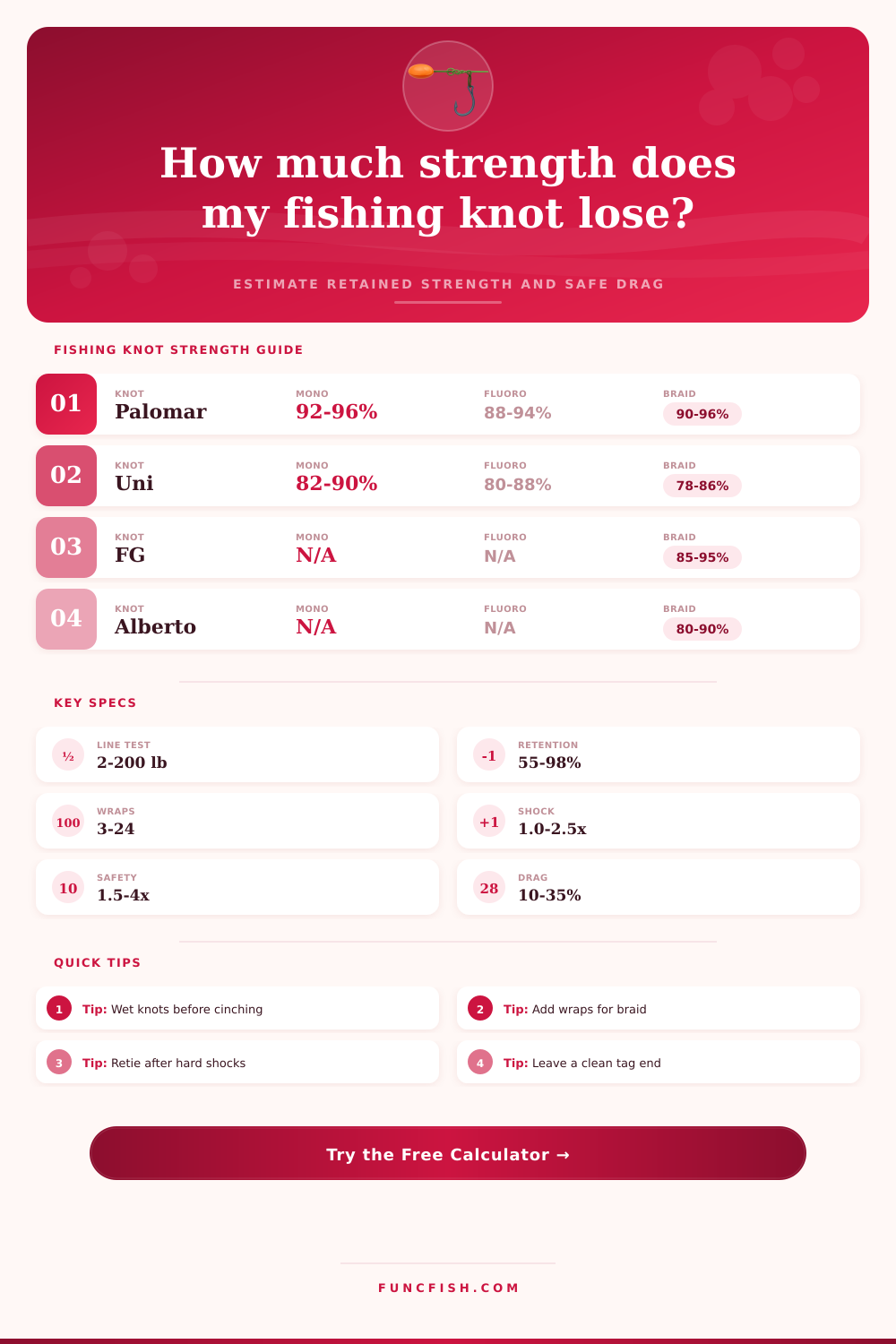
| Palomar | Terminal hook, lure, swivel | 88-96% | 2 doubled passes | Crossed loop can cut fluoro |
| Improved clinch | Light mono terminal knots | 76-88% | 5-7 turns | Slips on braid unless doubled |
| Uni knot | Terminal or small leader knots | 78-90% | 5-9 turns | Needs extra turns with braid |
| FG knot | Braid to fluoro or mono leader | 85-95% | 16-24 wraps | Half hitches must lock cleanly |
| Alberto | Braid to heavier leader | 80-90% | 10-14 wraps | Uneven wraps reduce bite |
| Bimini twist | Doubled line loop | 92-98% | 20-30 twists | Poor spreading damages loop |
| Line material | Knot behavior | Typical line test | Best knot family | Extra margin |
|---|---|---|---|---|
| Nylon monofilament | Stretchy and forgiving | 2-80 lb / 1-36 kg | Palomar, clinch, uni | Moderate |
| Fluorocarbon | Stiff, heat-sensitive | 4-100 lb / 2-45 kg | Palomar, uni, snell | Wet carefully |
| Braided PE | Slick, thin, low stretch | 6-200 lb / 3-91 kg | Palomar, FG, Alberto | More wraps |
| Copolymer | Balanced stretch and abrasion | 4-50 lb / 2-23 kg | Uni, Palomar, surgeon | Normal |
| Coated wire | Crimp-prone, kink-sensitive | 20-150 lb / 9-68 kg | Haywire-style, uni variants | High |
| Fly tippet | Fine diameter, small knots | 1-20 lb / 0.5-9 kg | Nail, surgeon, loop | Gentle seating |
| Scenario | Common line | Leader pairing | Drag target | Suggested safety factor |
|---|---|---|---|---|
| Bass casting | 10-50 lb braid or mono | Mono or fluoro leader | 20-30% of retained break | 2.0x |
| Trout stream | 2-8 lb mono or fluoro | Same or fine tippet | 15-25% of retained break | 2.5x |
| Inshore leader | 10-30 lb braid | 15-40 lb fluoro | 20-35% of retained break | 2.0-2.5x |
| Surf shock leader | 20-50 lb braid | 40-80 lb mono | Lower drag, high shock | 3.0-4.0x |
| Offshore trolling | 30-130 lb mono or braid | Heavy mono or fluoro | 25-33% of retained break | 2.0-3.0x |
| Fly fishing | Backing, fly line, tippet | Tippet or bite section | Soft drag, protect tippet | 2.5-3.0x |
| Condition | Adjustment | Why it matters | Typical penalty | Correction |
|---|---|---|---|---|
| Wet cinch | Best | Reduces heat and flattening | 0-2% | Lubricate before seating |
| Dry cinch | Risky | Heat damages mono and fluoro | 6-14% | Retie after friction burn |
| Too few wraps | Slippage | Knot cannot grip the standing line | 3-20% | Add turns, especially on braid |
| Flush tag | Unstable | Tag can pull into the knot under surge | 4-9% | Leave a small clean tag |
| Shock load | Drag derate | Short force spikes exceed steady drag | 1.2-2.5x | Use lower drag or stronger leader |
💡Rigging tips
Wet, dress, then test: pull the standing line and tag in stages so wraps stack evenly. A knot that looks pinched, white, or crossed should be retied before fishing hard drag.
Match wraps to material: braid usually needs more grip turns than mono, while hard fluorocarbon often needs slower seating and a slightly longer tag to avoid pull-through.
Fishing knot can fail in ways that are not immediate obvious to a person. For example, a fishing line can fail due to the fishing line breaking at the knot rather than at the hook or at a fishing spool. People often believe that the fish or the strength of the current caused the fishing line to break.
However, more often than not, the reason that the fishing line broke is because of the fishing knot that was used. Fishing knots can reduce the strength of the fishing line by as much as ten to twenty percent. The strength of the fishing knot will ultimately determine whether a person is successful in landing a fish or whether they lose the fish that they were attempting to land.
Fishing Knot Strength and Safe Drag
The calculator utilize several specific variables to allow anglers to understand the tradeoffs of different fishing knot. The variables that the calculator uses include the type of fishing knot that is to be used, the material of the fishing line, the number of wraps of the fishing line that are to be used in the fishing knot, and the condition of the fishing knot (whether it is to be wet or dry). Based on these variable, the calculator determine the strength of the fishing knot that will result from using these specific variables.
It also calculate the amount of strength that will be lost due to the fishing knot. Additionally, it determine the safe drag setting for the fishing line. This setting must include some margin for error in the drag setting.
Each of these variables is essential to understanding the effect that each of these variable will have on the strength of the fishing line. The material of the fishing line can impact the amount of strength that is retained by the fishing line. For instance, monofilament line will stretch and will forgive for error in the fishing knot being seated onto the fishing line.
Fluorocarbon line are stiffer than monofilament lines and will hold heat longer when the dry fishing knot is being cinched onto the fishing line. Braided lines are thin and slick, requiring anglers to use extra wraps to ensure that the braid does not slip along the fishing line. The calculator takes into account these different properties of the lines because a Palomar knot can retain ninety-four percent of the strength of the braid; however, the same type of knot can lose strength to wire to less than eighty-five percent of the strength of that wire.
The number of wraps that are used in the fishing knot and the quality of the cut of the end of the fishing line will impact the fishing knot. Using too few wraps can cause the knot to slide under the load of the fish. Using too many wraps can result in pressure point along the fishing line that may cut the fishing line.
Leaving a few millimeter of tag from the fishing line allows the fishing knot to have something to hold against the fish if the fish surge forward. If the fishing knot is cut too flush, it can creep due to the removal of the anchor of the fishing line. These variables can impact the percentage of strength that is retained by the fishing line and are important to consider when fishing in areas with heavy cover.
The shock and safety factor are employed in the calculation of the drag setting for the fishing line. The fish does not pull on the fishing line with a steady weight; the fish may surge forward or sideways in an attempt to catch the fish on the fishing line. Multiplying the strength of the fishing line by these factor and dividing by a safety margin will provide the drag setting for the fishing line.
This safety margin will allow the anglers to not fear that the fishing line will snap when the fish is being reeled in; it will provide a safety margin of twenty-five or thirty percent of the test of the fishing line. The condition in which the fishing knot is to be tied also have an effect on the fishing knot. If the angler ties the fishing line in a wet condition, it will easily slide into place.
However, if the fishing line is to be cinched while it is dry, the dry fishing knot could potentially cause micro burns to the fishing line. While these burn may only reduce the strength of the fishing line by a few percent, those few percent may be the difference between a strong fishing knot and a weak fishing knot that break during a fight between the fish and the angler. In addition to the fishing knot being created, there are a number of external variable that can impact the fishing line.
For instance, the sun, saltwater, and the number of times that it has been cast into the water will age the fishing line. A leader that has been sitting in a boat box for two season will age differently than a fresh fishing leader. A knot that appears to be secured when tied to a fishing rod may flatten or cross when tied to a rocking boat.
Due to these external variables, many angler use a scale to test the strength of their knot before using the knots to catch fish. Using this calculator will allow anglers to stop guessing about the strength of the knots that they create. Each of these parameter will provide anglers with an understanding of the actual strength of the fishing knot.
Anglers will recognize that braided line require extra wraps so that the line does not slip. They will also recognize that fluorocarbon lines require more time to cinch the fishing knot into place. Anglers will also recognize that adding a few millimeter of tag to the fishing line will allow for the recovery of a few percentage point of strength to the fishing line.
These type of small improvements will result in anglers losing fewer fish and gaining more confidence in the drag setting of their fishing line. The goal that anglers can use this particular calculator for is to learn about the interaction of these variables rather than to find the best fishing knot for all fishing trip. Using this fishing knot calculator allows anglers to see how each of these variable interact before they go into the water to fish for the day.