Fishing Leader Tippet Ratio Calculator
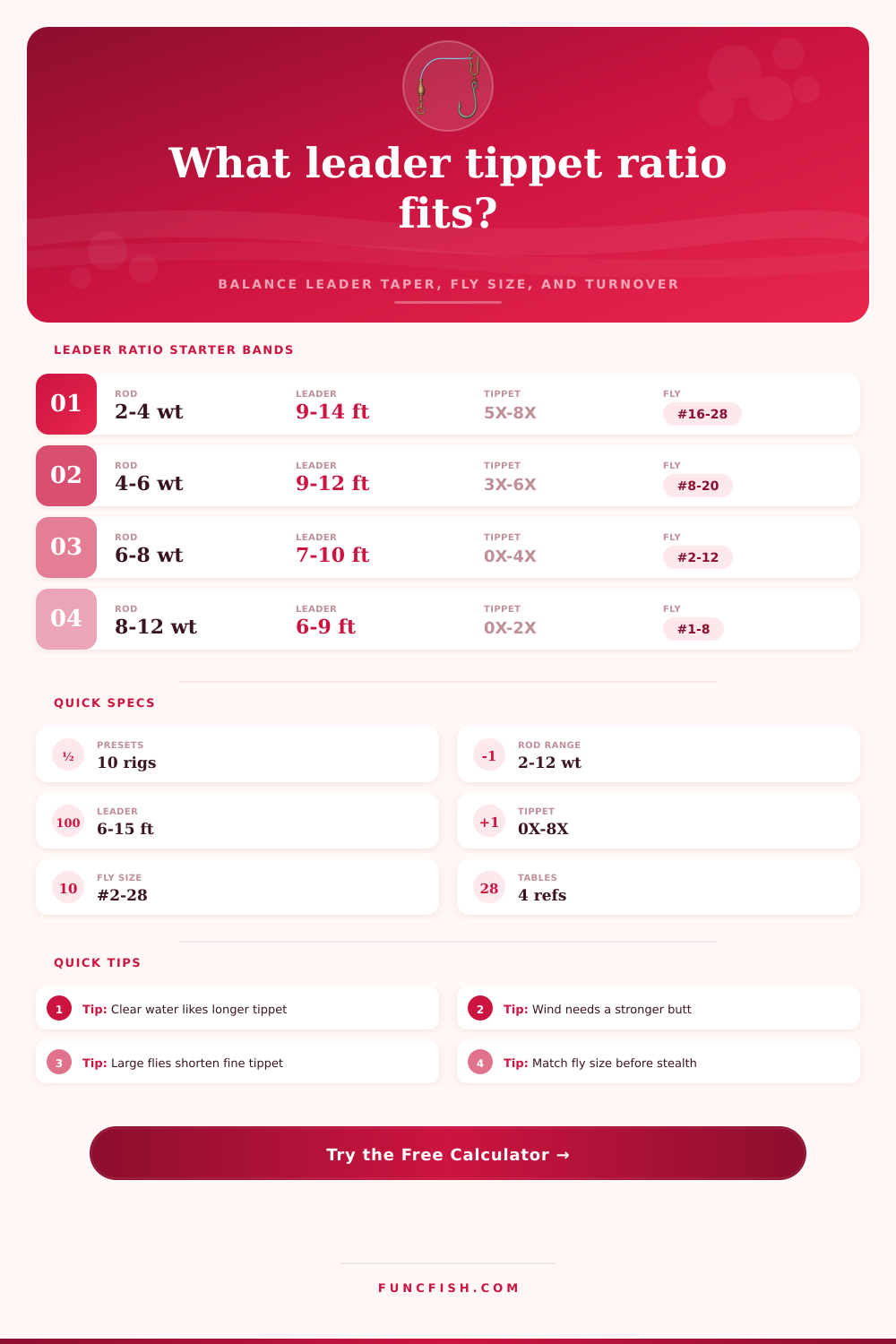
Build a fly leader taper from rod weight, total leader length, tippet X size and test, fly size, water clarity, presentation style, turnover demand, and wind.
📌Leader and tippet presets
⚙Ratio calculator inputs
Leader ratio results
Calculation breakdown
🎯Leader, tippet, and fly comparison grid
Technical Dry
11 to 14 ft leader, 5X to 7X tippet, #16 to #26 fly. Choose a longer tippet ratio when drag is the main problem.
All-Purpose Trout
8.5 to 10 ft leader, 3X to 5X tippet, #10 to #18 fly. Balanced turnover usually sits near a 22% to 28% tippet section.
Hopper or Indicator
7.5 to 9.5 ft leader, 2X to 4X tippet, #6 to #12 fly. Keep more butt section for turning over foam, split shot, or yarn.
Streamer and Salt
6 to 9 ft leader, 0X to 2X tippet, #1 to #8 fly. Shorter tippet and heavier butt material drive bulky flies into wind.
📊Tippet material data grid
0X Power
3X Utility
5X Trout
7X Stealth
📘Reference tables
| X size | Approx diameter | Typical test | Common role |
|---|---|---|---|
| 0X | 0.011 in / 0.28 mm | 15.0 lb / 6.8 kg | Bass bugs, steelhead, saltwater flies |
| 1X | 0.010 in / 0.25 mm | 13.5 lb / 6.1 kg | Streamers, windy hoppers, light salmon work |
| 2X | 0.009 in / 0.23 mm | 11.5 lb / 5.2 kg | Large trout dries, foam, weighted nymphs |
| 3X | 0.008 in / 0.20 mm | 8.5 lb / 3.9 kg | Hoppers, indicators, #8 to #12 flies |
| 4X | 0.007 in / 0.18 mm | 6.0 lb / 2.7 kg | General trout, #10 to #16 flies |
| 5X | 0.006 in / 0.15 mm | 4.5 lb / 2.0 kg | Clear-water trout, #14 to #18 flies |
| 6X | 0.005 in / 0.13 mm | 3.5 lb / 1.6 kg | Tailwater dries, small nymphs, #18 to #22 flies |
| 7X | 0.004 in / 0.10 mm | 2.5 lb / 1.1 kg | Technical midges and tiny dries |
| 8X | 0.003 in / 0.08 mm | 1.5 lb / 0.7 kg | Specialty micro flies and very soft presentations |
| Fly size | Starting tippet | Tippet ratio | Turnover note |
|---|---|---|---|
| #2 to #6 | 0X to 2X | 14% to 20% | Use a compact leader with a strong butt. |
| #8 to #10 | 2X to 3X | 18% to 24% | Good range for hoppers, stones, and small streamers. |
| #12 to #14 | 4X to 5X | 22% to 30% | Balanced dry-fly leaders often land here. |
| #16 to #18 | 5X to 6X | 26% to 36% | Longer tippet improves drift when the air is calm. |
| #20 to #24 | 6X to 7X | 30% to 42% | Keep casts open and reduce fly-line slap. |
| #26 to #28 | 7X to 8X | 34% to 44% | Specialty setups need soft rods and careful knots. |
| Rod weight | Typical leader | Tippet range | Best fit |
|---|---|---|---|
| 2 to 3 wt | 10 to 14 ft / 3.0 to 4.3 m | 5X to 8X | Small streams, tiny dries, soft hackles |
| 4 to 5 wt | 8.5 to 12 ft / 2.6 to 3.7 m | 3X to 7X | Most trout dry and nymph fishing |
| 6 to 7 wt | 7.5 to 10 ft / 2.3 to 3.0 m | 1X to 4X | Hoppers, streamers, heavy nymphs, light bass |
| 8 to 9 wt | 6 to 9 ft / 1.8 to 2.7 m | 0X to 3X | Bass, pike, redfish, bonefish, wind |
| 10 to 12 wt | 6 to 9 ft / 1.8 to 2.7 m | 0X to 2X | Tarpon, permit, large streamers, heavy wind |
| Condition | Tippet adjustment | Butt adjustment | Reason |
|---|---|---|---|
| Gin clear water | Add 4% to 6% | Reduce slightly | More separation from fly line and softer drift |
| Stained water | Subtract 2% to 4% | Add slightly | Stealth matters less than turnover |
| Wind over 10 mph | Subtract 4% to 7% | Add 3% to 6% | Energy must travel through the leader faster |
| Bulky foam fly | Subtract 4% to 8% | Add 4% to 8% | Wind resistance increases before the fly lands |
| Tiny dry fly | Add 4% to 8% | Reduce slightly | Drag reduction beats raw turnover power |
💡Ratio tuning tips
Turnover tip: If the leader piles up, shorten the tippet section first, then step one X size heavier if the fly still kicks sideways.
Stealth tip: If fish refuse in flat clear water, lengthen the final tippet section while keeping the butt and mid sections smooth enough to unroll.
Choosing the right leader and tippet will determine how well your cast’s fly lands on the water. The leader and the tippet must be balanced so that the fly lands on the water without spooking the fish. Most anglers guess at the taper for their leader when they tie in their flies.
However, guessing can only create mistakes. The balance of the leader and the tippet will require some adjustments depending on the weight of the rod, the size of the flies, and the condition of the water in which they are fishing. The leader that allow for a good presentation of a hopper fly in windy waters may not work well for presenting a small midge fly in clear water.
How to Pick the Right Leader and Tippet
Therefore, you must make adjustments to the leader and the tippet to accommodate for the different fishing conditions. The leader taper calculator requires several inputs from the angler to calculate the appropriate taper of the leader. These inputs include the weight of the fishing rod, the total length of the leader, the size and test strength of the tippet, the size of the flies being used, the clarity of the water, the presentation style for the flies, the turnover that the flies will demand during fishing, and the wind in which the angler will be fishing in.
The weight of the rod will determine the power that will be used to cast the line. The length of the leader will determine the power distribution along the leader. The size and test strength of the tippet will determine the connection between the flies and the fishing line.
The size of the flies will determine if the line will need to absorb some of the wind or if the flies do not need to be disturbed as they land on the water. The clarity of the water, the presentation of the flies, the turnover of the flies, and the wind will all affect the ratio of the leader to the tippet. Many people focus on the tippet to determine the balance of their leader.
The tippet will only work properly if the sections above the tippet can also balance well with the flies. Using a fine and long tippet with a short and rigid leader will cause the leader to fold back on itself when cast. Using a short tippet with a long leader will prevent the leader from straightening out enough to turn the flies over.
However, the leader taper calculator splits the length of the leader into percentages for the butt, the mid-section of the leader, and the tippet. By doing so, it ensures that the energy from the rod can remain connected to the flies. Furthermore, the leader taper calculator will also provide a turnover score for the leader and tippet that the user has designed.
Water clarity will have a significant effect on the flies and the tippet that is used to present them to the water. In muddy waters, the fish will not have good visibility of the leader. Therefore, a shorter tippet with a longer butt will work better.
In clear waters, the fish will have good visibility of the leader. Hence, a longer tippet will allow for better separation of the flies from the fishing line. However, increasing the length of the tippet will reduce the turning abilities of the leader.
This will have to be accounted for when selecting the clarity of the water in which the fish will be fishing. Wind also affects the leader and the tippet, but in the opposite way of water clarity. A leader that will allow the flies to land gently on the water when there is no wind will create a problem when exposed to the wind.
Therefore, the taper calculator will shorten the ratio of the tippet and strengthen the butt of the leader when windy conditions are selected so that more mass is moved forward with the cast to keep the flies from stalling in the wind. Presentation also has an effect on the leader and the tippet. For delicate dry fly presentations, a longer tippet is required so that the flies dont get disturbed in their travel to the waters.
For hopping rigs, there will be a need for a longer leader butt section so that the heavier flies will turn over properly. For euro nymphing, the tippet will need to be longer and finer to allow the flies to sink to the bottom without losing contact with the leader. Tables are provided on the page to provide the diameters of the tippets of each X size.
Additionally, the tables also feature the test strengths of each size of tippet. These tables will allow the angler to determine whether or not a tippet is strong enough for the type of fish that will be encountered. The tables also feature information regarding the size of the flies and the size of the tippet.
These tables are essential because the leader and tippet taper calculator only accounts for the ratios of the leader and tippet. However, the calculator will not provide information regarding whether a 5X tippet is enough strength to hold a large fish in fast moving waters. The angler will have to make this decision themselves.
Some of the most common mistakes with leaders and tippets include treating the leader as a single piece rather than three separate parts of the leader. For example, some anglers will lengthen the entire leader to provide more stealth for the flies. However, lengthening the leader will lengthen the butt and the mid-section of the leader, which will reduce the turnover of the leader.
Another common mistake is to decrease the X size of the tippet without lengthening the tippet. This will result in a tippet that is too fine for the size of the flies and it will land in a splash. The leader taper calculator will prevent these mistakes from being made by recalculating the ratios of each part of the leader every time an angler makes an adjustment to the leader.
This leader taper calculator will prove to be very useful for those who encounter changing fishing conditions throughout the day. For example, an angler may begin the day with a 9-foot leader with a 5-weight fishing rod for dry flies. However, as the day unfolds, the angler may encounter different conditions such as stronger wind conditions or the fish may move to areas of the water with faster moving currents.
By being able to adjust only the wind and the presentation styles in the leader and tippet calculator, the angler will be able to get a new set of measurements for the leader that will accommodate these changing conditions. This will allow the angler to retie the leader once throughout the day instead of having to return to the car to retrieve more tippet of the appropriate sizes. The turnover score that is calculated at the bottom of the results will indicate whether or not the leader and tippet that the angler designed will successfully deliver the flies to the desired location.
A high turnover score will indicate that the leader is balanced according to the rod, the flies, and the wind. A low turnover score will indicate that some part of the leader is fighting against the fly as it is being cast. Depending on the turnover score, the angler can either accept the leader that was designed or make adjustments to the parameters before beginning to fish.
A good leader will dissapears into the water as the flies drift and will turn over during the cast to the water. While it is very difficult to find the perfect balance between each of the leader components, it is much easier to find that perfect balance with the leader taper calculator than with guessing at the components of the leader.