Fishing Swivel Size to Line Calculator
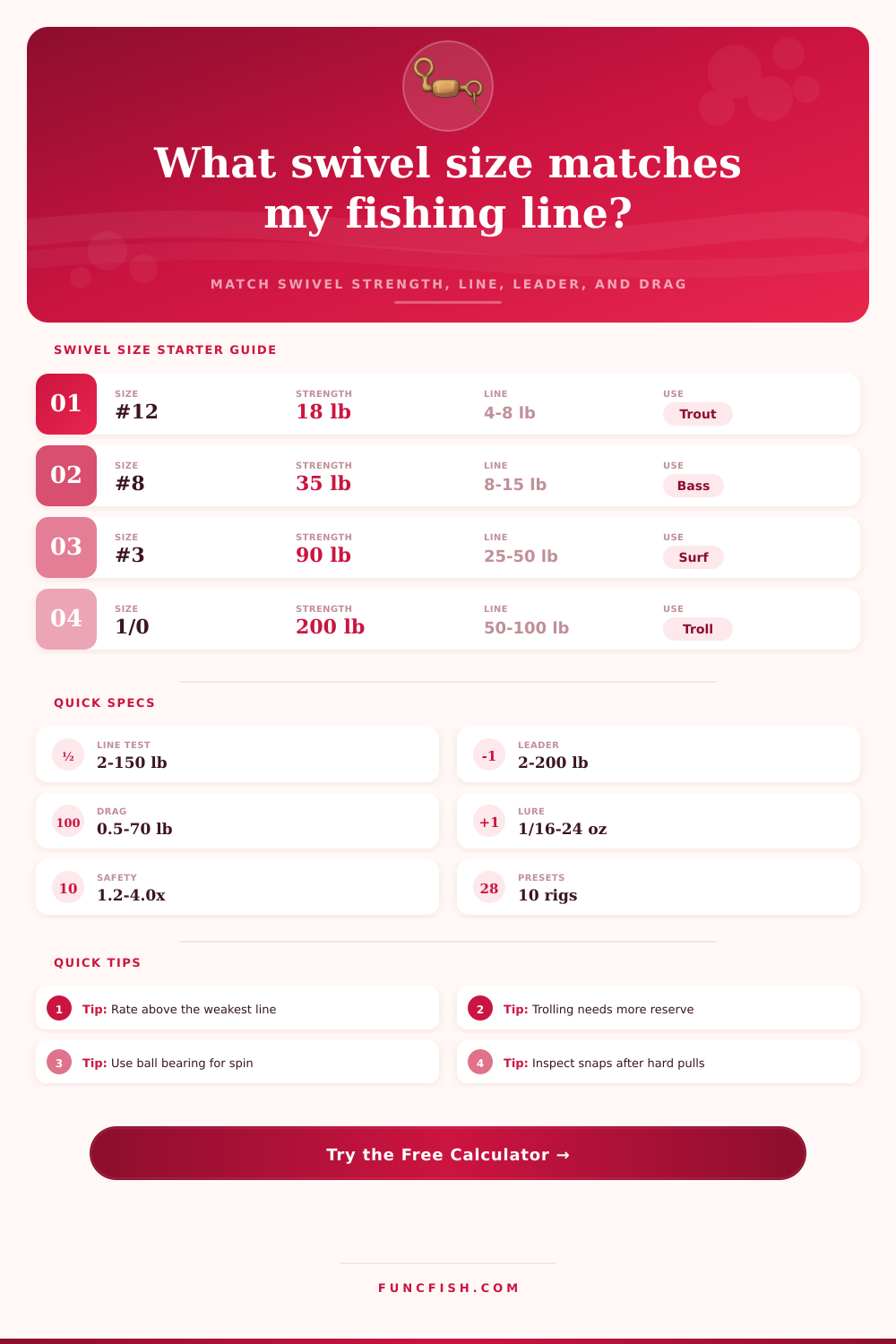
Match swivel size and breaking strength to main line, leader, drag setting, target species, scenario load, lure weight, current or trolling speed, and safety factor.
📌Swivel-line presets
⚙Swivel and line inputs
Swivel size recommendation
Enter your setup to compare swivel strength against line, leader, drag, lure shock, and scenario load.
Calculation breakdown
📊Swivel style grid
Barrel Swivel
Crane Swivel
Ball Bearing
Snap Swivel
Three-Way
Power Swivel
Rolling Swivel
Wire Snap
📋Reference tables
| Swivel size | Typical rating | Common line range | Typical use |
|---|---|---|---|
| #14 micro | 12 lb / 5.4 kg | 2 to 6 lb | Panfish, ice jigs, small trout |
| #12 finesse | 18 lb / 8.2 kg | 4 to 8 lb | Trout, crappie, finesse rigs |
| #10 light | 25 lb / 11.3 kg | 6 to 12 lb | Bass finesse, walleye live bait |
| #8 standard | 35 lb / 15.9 kg | 8 to 15 lb | Bass casting, small inshore |
| #7 inshore | 45 lb / 20.4 kg | 10 to 20 lb | Redfish, snook, light surf |
| #5 medium | 60 lb / 27.2 kg | 15 to 30 lb | Catfish, salmon, pike |
| #3 surf | 90 lb / 40.8 kg | 25 to 50 lb | Surf leaders, heavy current |
| #1 heavy | 150 lb / 68.0 kg | 40 to 80 lb | Musky, striper, heavy bottom |
| 1/0 offshore | 200 lb / 90.7 kg | 50 to 100 lb | Trolling, mahi, tuna school fish |
| 2/0 big game | 250 lb / 113 kg | 80 to 130 lb | Heavy trolling, shark leaders |
| 3/0 heavy troll | 300 lb / 136 kg | 100 to 150 lb | Planers, big lures, wire rigs |
| 4/0 extra heavy | 450 lb / 204 kg | 130 lb plus | Big shark, heavy offshore gear |
| Line and leader pairing | Weak link | Starting swivel rating | Best scenario |
|---|---|---|---|
| 4 lb main / 4 to 6 lb leader | Main line | 12 to 18 lb | Trout, panfish, finesse float |
| 10 lb braid / 8 to 12 lb leader | Leader knot | 25 to 35 lb | Bass spinning, walleye jigging |
| 20 lb braid / 20 lb leader | Leader or snap | 45 to 60 lb | Inshore lures, pike casting |
| 30 lb braid / 50 lb shock leader | Main line | 90 to 150 lb | Surf casting and pier rigs |
| 50 lb mono / 80 lb leader | Main line | 150 to 200 lb | Trolling, big plugs, live bait |
| 80 lb braid / 130 lb leader | Main line | 250 to 300 lb | Planer trolling, shark leaders |
| Species grid | Line test | Leader test | Swivel size range |
|---|---|---|---|
| Panfish or crappie | 2 to 6 lb | 2 to 8 lb | #14 to #12 |
| Trout | 4 to 8 lb | 4 to 10 lb | #12 to #10 |
| Bass | 8 to 20 lb | 8 to 25 lb | #10 to #7 |
| Walleye | 6 to 15 lb | 8 to 20 lb | #10 to #7 |
| Redfish or snook | 10 to 30 lb | 20 to 40 lb | #7 to #5 |
| Pike | 15 to 40 lb | 30 to 80 lb wire | #5 to #1 |
| Catfish | 15 to 50 lb | 20 to 80 lb | #5 to #1 |
| Striper or surf fish | 20 to 50 lb | 40 to 80 lb | #3 to #1 |
| Mahi or tuna school fish | 30 to 80 lb | 50 to 130 lb | #1 to 2/0 |
| Musky or shark | 65 to 150 lb | 100 to 200 lb | 1/0 to 4/0 |
| Scenario | Load factor | Why it matters | Swivel advice |
|---|---|---|---|
| Casting and retrieving | 1.00x | Short shock spikes from lure weight | Crane or power swivel if compact fit matters |
| Vertical jigging | 1.10x | Rod pumps and boat drift pulse the rig | Use a compact swivel above leader strength |
| Current bottom rig | 1.25x | Line belly and sinker drag add steady load | Size up one class for heavy current |
| Surf casting shock | 1.45x | Lure and sinker mass spike at release | Prioritize eye size and shock leader clearance |
| Trolling or planer pull | 1.55x | Speed and lure drag stay loaded all day | Ball bearing swivel with high reserve |
| Live bait drift | 1.15x | Bait and current twist the connection | Rolling swivel keeps bait tracking cleaner |
| Wire leader casting | 1.35x | Wire and toothy strikes stress snaps | Use heavier snaps than line rating alone suggests |
| Offshore trolling spread | 1.80x | Big lures, speed, and turns amplify pull | Use ball bearing or welded-ring hardware |
🚩Swivel sizing tips
Strength tip: size the swivel from the highest credible load, not just the line printed on the spool. Drag, current, lure weight, and trolling speed can push the hardware demand above the simple line-test number.
Fit tip: after strength is solved, check eye diameter, snap opening, and lure action. Tiny high-strength swivels are useful, but thick shock leaders and wire can need the next larger frame.
A swivel is fishing hardware that is used to connect a fishing line to an fishing lure. The swivel allow for the fishing line and lure to rotate independent of each other. The swivel is a critical component of most fishing rig because the swivel prevents the fishing line from continuously twisting when a fish pull on the lure.
If the swivel should break or fail, the fishing line will twist and likely break the line. If the fishing line breaks, the angler will lose the fish. While many anglers may choose a swivel based off habit or the fishing gear that others use, each angler should choose a swivel based on the type of loads that the swivel will experience when battling fish.
How to Choose the Right Fishing Swivel
The calculator included in this article will allow each angler to calculate the proper size for a fishing swivel. The angler will have to enter the strength of the main fishing line and the strength of the leader into the calculator to calculate the total tension that the fishing line will experience. The drag setting and the weight of the lure will also have to be accounted for in the calculation.
These two force will be added to calculate the total load that the fishing line will experience. A safety margin will also be added to the total load to account for the fact that fishing loads can change dramaticly. Fishing loads can change dramatic due to a variety of different factor.
For instance, if a fish swim into a strong current, the fishing line will experience a sudden increase in tension. The same can be said for if a fish suddenly begin to move within the water. Each species of fish may create a certain type of tension when being fished.
Anglers must consider the species of the fish that they are fishing for. For instance, bass may create tension in short burst while species like sharks or muskies may create a tension that remain continuous for long periods of time. The load factor for the swivel calculator will account for the species of the fish that is being fished for.
In addition to the strength of the swivel, the physical dimension of the swivel must also be considered. The diameter of the swivels eye must be large enough to allow for the leader to pass through the swivel. If the leader is of thick diameter or comprised of wire, it may not be able to pass through the eye of a swivel with a small diameter.
If the leader cannot pass through the eye of a swivel, the fishing rig will fail. The profile selector within the load calculator allow the angler to account for the size of the leader. The strength of the swivel will also degrade with the exposure to saltwater or with age.
The condition multiplier within the tool account for the strength of new hardware versus old, degraded hardware. The style of the swivel may also have an impact on how the swivel perform while on the fishing line. Ball bearing swivels are constructed in a way that they can continuously rotate, thus making them the best choice for trolling application as opposed to barrel swivels.
Snap swivels are often used to quickly change lure while fishing, but the snap on snap swivels is a potential point of failure for the swivel. Each style of swivel will receive a different allowance within this tool to reflect how each swivel design handle the stress that is placed upon it while fishing. While it may seem appealing to choose a swivel that is noticeably larger in size than the other components of the fishing rig, the oversized swivel will reduce the action of the lure and the swivel will add to the overall weight of the fishing rig.
Anglers should also avoid choosing a swivel that is too small in size because the swivel will fail when confronted with the tension of the fish. Yet once each angler determine the proper size of the swivel using the calculator, they should test that specific swivel on the water. If the swivel experience any signs of wear while on the water, the angler should of adjusted the settings in the calculator to account for this wear and choose a different swivel.