Tippet Diameter MM To Inches Converter
Convert fly tippet diameter from millimeters to inches, estimate X size, reverse-convert inches to millimeters, and match the result to material, fly size, fish class, knot, and presentation finesse.
📌Tippet diameter presets
⚙Diameter converter inputs
Tippet conversion result
Calculation breakdown
🧵Material diameter grid
Nylon mono
Fluorocarbon
Supple nylon
Salt mono
🎯Tippet, fly, and species grid
7X to 8X
0.10 to 0.08 mm tippet for #22 to #26 flies, tiny trout, grayling, and very calm presentations.
5X to 6X
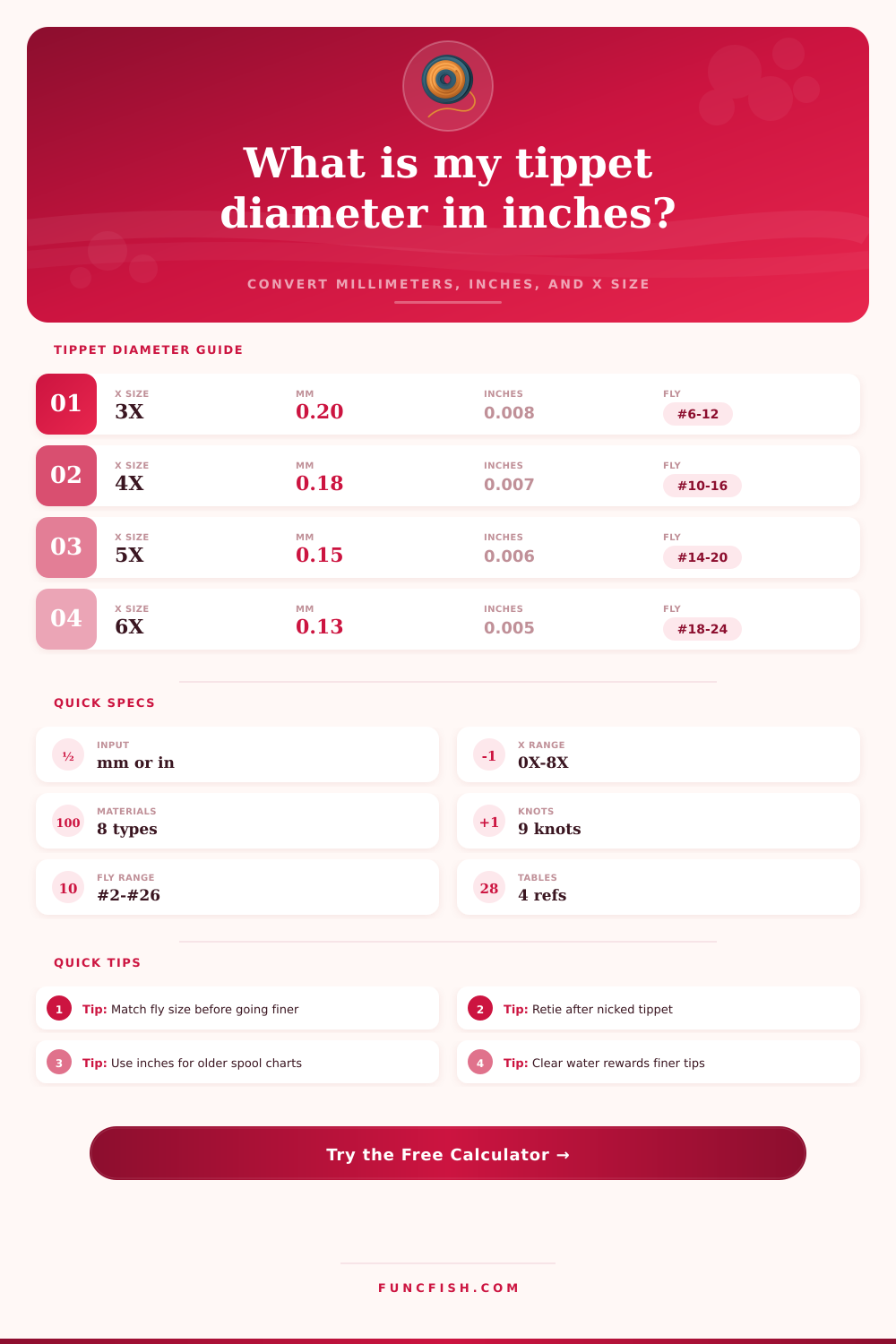
0.15 to 0.13 mm tippet for #14 to #22 flies, small trout, panfish, and clear water dry-fly rigs.
3X to 4X
0.20 to 0.18 mm tippet for #8 to #16 flies, nymphs, hopper rigs, and average trout in current.
0X to 2X
0.28 to 0.23 mm tippet for #2 to #10 flies, streamers, bass bugs, steelhead, and light saltwater work.
📊Reference tables
| X size | Common mm | Common inches | Typical pound test | Typical fly sizes |
|---|---|---|---|---|
| 0X | 0.28 mm | 0.011 in | 12 to 15 lb | #2 to #8 streamers, bass bugs |
| 1X | 0.25 mm | 0.010 in | 10 to 12 lb | #4 to #10 streamers, steelhead |
| 2X | 0.23 mm | 0.009 in | 8 to 10 lb | #6 to #12 hoppers, small streamers |
| 3X | 0.20 mm | 0.008 in | 6 to 8 lb | #8 to #14 nymphs, terrestrials |
| 4X | 0.18 mm | 0.007 in | 5 to 6 lb | #10 to #16 nymphs and dries |
| 5X | 0.15 mm | 0.006 in | 4 to 5 lb | #14 to #20 dries and droppers |
| 6X | 0.13 mm | 0.005 in | 3 to 4 lb | #18 to #24 small dries |
| 7X | 0.10 mm | 0.004 in | 2 to 2.8 lb | #22 to #26 midges |
| 8X | 0.08 mm | 0.003 in | 1.4 to 2 lb | #24 to #28 tiny midges |
| Material | Diameter feel | Strength index | Presentation note | Best use |
|---|---|---|---|---|
| Nylon monofilament | Round and elastic | 1.00x | Good turnover with cushion | Dry flies, general trout |
| Fluorocarbon | Dense and firm | 1.08x | Sinks slightly and resists scuffing | Nymphs, streamers, clear subsurface |
| Supple dry-fly nylon | Soft and limp | 0.94x | Excellent slack and drag-free drift | Small dries, wary trout |
| Copolymer tippet | Balanced stiffness | 1.03x | Blends mono stretch with crisp turnover | All-around fly rigs |
| Hard mono | Firm and glossy | 1.05x | Turns over larger bugs cleanly | Hoppers, bass, saltwater leaders |
| Fluoro shock section | Very abrasion resistant | 1.12x | Better near rocks, shell, and teeth | Streamers, carp, light saltwater |
| Tenkara level tippet | Fine and direct | 0.98x | Protects light fixed-line rigs | Small stream trout |
| Saltwater mono | Stiff and tough | 1.15x | Turns over wind-resistant flies | Bonefish, bass bugs, wind |
| Fish class | Useful X range | Useful mm range | Typical flies | Rig caution |
|---|---|---|---|---|
| Tiny trout / grayling | 6X to 8X | 0.13 to 0.08 mm | #18 to #28 | Protect on hookset |
| Small trout / panfish | 5X to 7X | 0.15 to 0.10 mm | #14 to #24 | Watch knots on small hooks |
| Average trout | 4X to 6X | 0.18 to 0.13 mm | #10 to #22 | Match clarity and current |
| Large trout / carp | 2X to 5X | 0.23 to 0.15 mm | #6 to #18 | Use fresh knots |
| Bass / warmwater | 0X to 3X | 0.28 to 0.20 mm | #2 to #10 | Turnover matters |
| Steelhead / sea-run trout | 0X to 2X | 0.28 to 0.23 mm | #2 to #8 | Current magnifies pressure |
| Bonefish / light saltwater | 0X to 2X | 0.28 to 0.23 mm | #2 to #8 | Check abrasion often |
| Heavy cover / big flies | 0X and heavier | 0.28 mm plus | #2 or larger | Diameter may exceed X charts |
| Knot type | Efficiency range | Fine tippet fit | Heavy tippet fit | Use note |
|---|---|---|---|---|
| Improved clinch | 82 to 88 percent | Good | Good | Common fly-to-tippet knot |
| Standard clinch | 76 to 82 percent | Fair | Good | Quick but less secure on slick line |
| Trilene knot | 88 to 92 percent | Good | Excellent | Strong choice for fluoro |
| Davy knot | 78 to 84 percent | Excellent | Fair | Fast for tiny flies |
| Double Davy | 84 to 90 percent | Excellent | Good | Small profile with extra security |
| Non-slip loop | 82 to 88 percent | Fair | Excellent | Adds movement to streamers |
| Double surgeon's | 80 to 88 percent | Good | Good | Fast tippet-to-tippet connection |
| Blood knot | 82 to 90 percent | Good | Good | Slim leader sections |
| Perfection loop | 74 to 82 percent | Fair | Good | Loop-to-loop connection point |
💡Conversion tips
Diameter first: X size is a handy shorthand, but the actual millimeter number is the cleaner input when comparing different tippet materials.
Fit before finesse: If a fine tippet will not turn over the chosen fly, move one X size heavier before changing knots or leader length.
Tippet diameter can be measured in millimeter or tippet diameter can be measured in X rating. The first provides an actual measurement of the tippet diameter, while the X ratings is a label given to the tippet for convenience. Many manufacturers will label their tippet with a measurement in millimeters.
This number can then be converted into the X rating to allow angler to use the older size chart. Fly size is another factor that must be consider when choosing the correct tippet diameter. Small fly, like #22 size midges, require a tippet diameter with very little mass.
How to Choose the Right Tippet Size
On the other hand, large flies, like #6 size hopper pattern, require a tippet with more mass. If the mass of the tippet is too small for a large fly, the large weight of the fly will cause the tippet to collapse. Thus, the size of the fly to be fish determines the tippet diameter.
Fish class is yet another factor to consider when choosing the tippet diameter. The class of fish to be targeted does not necessarily mean the specific species of fish. Instead, the fish class is an estimation of the amount of strength that the tippet should have.
For instance, a small fish species in flat water will not require the same amount of strength in the tippet as a large species of fish in a strong current. The strength of the tippet should provide a comfortable margin for the fish being target. If the tippet does not provide this margin of strength, then the angler should reconsider the tippet diameter prior to begin to fish.
Another factor that will affect the strength of the tippet is the type of knot that will be use. Because tying the tippet to the line will reduce the strength of the tippet, the angler must consider the type of knot when choosing the tippet diameter. Knot choice like Davy and improved clinch knots will reduce the strength of the tippet to vary degrees.
Thus, the choice of knot will determine the amount of strength that the tippet will have when it reach the hook. The type of material used to make the tippet will also impact the tippet. For instance, fluorocarbon will sink and resist abrasion but is stiff in water.
Nylon, in contrast, is more supple than fluorocarbon. Thus, the type of material will alter the way in which the fly will land on the water. The material type alter the strength curve of the tippet, which is factored into tippet strength calculator.
There are some real world variables that will impact the strength of the tippet. For instance, prolonged exposure to sunlight will degrade the tippet. Casting the line repeatedly will degrade the tippet.
Contact with rocks will also degrade the tippet. Additionally, if the tippet develop a nick, this will reduce the breaking point of the tippet. For these reason, anglers must retie the tippet frequent.
A micrometer tool allow the angler to measure the tippet to ensure that it has not stretch during the fishing process. The most effective habit for angler is to choose the type of fly to fish for first, and then determine the tippet size based on that information. By choosing the type of fly first, the tippet calculator will provide information as to whether or not the tippet size is large enough to allow the tippet to turn the fly over.
If the angler choose the tippet size first, however, it is possible the tippet is too finely for the type of fly chosen. Thus, the size of the fly should determine the tippet size. In conclusion, the measurement in millimeters will always provide the angler with the real dimension of the tippet.
The X rating are simply a label given for convenience. Tippet strength is affected by the diameter, material type, the knot choice, and the class of the fish to be targeted. The tippet strength converter remove the need for arithmetic for these different factor to be considered.