
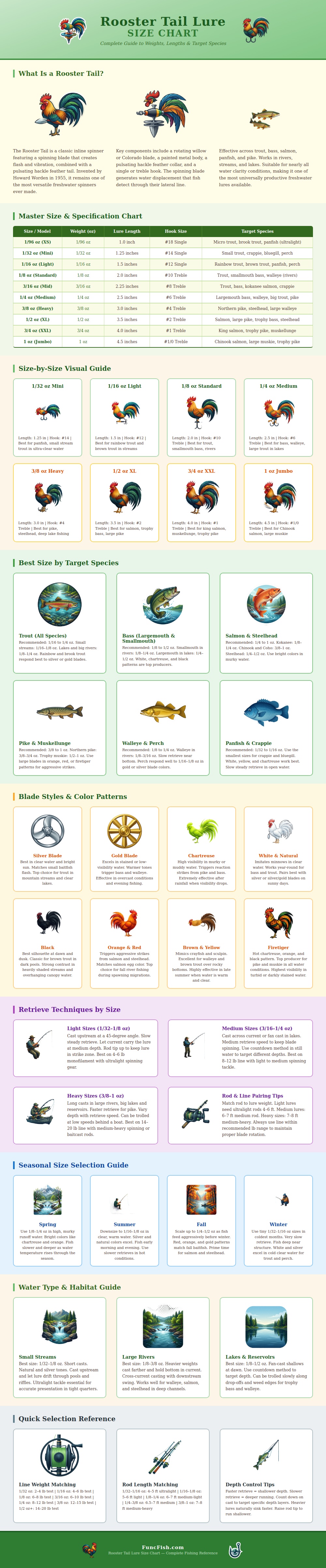
The size of a rooster tail lure is important when fishing because the size of the lure affect the way that the lure moves through an water and how deep the lure will sink. A person must select the apropiate size of rooster tail lure for the type of fish that they are targeting, the depth of the water, and the condition in which the water is found. The size of the lure will affect the amount of vibration and flash that the fish perceive from the lure, so the angler must choose the size of the lure carefully in order to ensure that the fish will notice the lure.
A rooster tail lure works because the blade of the lure spin while the hackle of the lure pulses. The movement of these two component of the lure creates the vibration and flash that the fish can detect through there lateral lines. Small rooster tail lures tend to have more intense movement to small areas of water, so those small size lures are effective in areas with smaller fish, like trout and panfish.
Pick the Right Size Rooster Tail Lure
Large rooster tail lures push more water as they move through the water, and the large sized lures tend to sink more quick, which makes them effective in deeper waters with larger fish species like bass and pike. A person should of choose a size of rooster tail lure according to the type of water in which they are fishing and the type of fish that they are targeting. Small rooster tail lures is effective in small mountain streams where the water moves quick and where pools of water are small.
Conversely, large rooster tail lures are effective in large rivers and lakes where there is more space for the lure to move, and where larger fish are more common. Additionally, the color of the lure and the blade of the lure should match with the size of the lure. For instance, fish in small streams with clear water may see a silver blade color better, while larger fish see bright colors in stained water.
Many anglers make the mistake of using the same size rooster tail lure in all types of environments. However, using the same size rooster tail lure in all situations may limit a person’s chance of catching fish. For instance, using a 1/8 ounce rooster tail lure may be effective in tempting trout in a stream of moderate depth and width.
However, the same size of rooster tail lure may not be effective in tempting walleye that live in deeper water. In this same example, using a 3/8 ounce rooster tail lure may be effective for enticing walleye, but could also spook the trout in shallow water. Thus, each angler must find a balance in the weight of the lure based off the depth and the type of fish that live in the area in which they are fishing.
The retrieve technique for a rooster tail lure must also change based upon the size of the lure. Light rooster tail lures will cycle at slow speed to ensure that the blade of the lure spins without to quickly bringing the lure to the surface. Large rooster tail lures can be retrieved faster due to the weight of the lure that keep the lure deep in the water.
Additionally, the angler must also match the strength of the fishing line to the weight of the lure. Using a line that is too strong for a small rooster tail lure will prevent that lure from moving through the water in the proper manner. Using a line that is too light for a large rooster tail lure will cause that line to break each time a large fish strike the lure.
Due to the different type of water in which fish live, the size of the rooster tail lure should also change with the season in which the fishing occurs. During the spring, lakes and rivers may be higher in water level due to spring rains, and the water may be stained with the growth of plants. During this time, using a larger rooster tail lure with bright colors will help the fish find the lure.
During the summer, the levels of water may be lower in the lakes and rivers due to evaporation, and the water may be clear. During this time, using a smaller rooster tail lure will not spook the fish. During the fall, the fish eat more food then during the spring and summer months.
During this time, using a larger rooster tail lure will mimic the size of the baitfish that the fish eat. Finally, depending upon the type of water that they fish, different sized rooster tail lures should be use. For instance, small streams will require compact rooster tail lures that have limited distance to cast, while reservoirs of larger sizes allow for the use of larger rooster tail lures.