
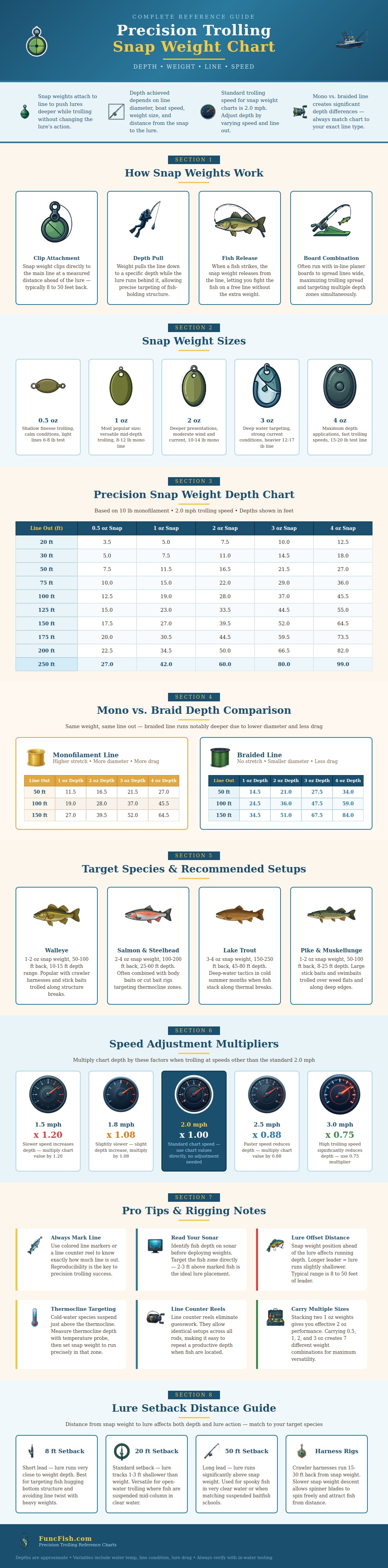
Snap weights is tools that help anglers to control a depth of the lure that they are trolling. When trolling for fish that are suspended in the water columns, anglers often want the lure to remain at a specific depth in the water. However, if heavy weights is attached to the lure, the fishing for those suspended fish can become difficult.
Instead, anglers attach snap weights to main line, ahead of the lure. The snap weight will allow the fishing line to be pulled down to the desired depth, while the lure remain behind the snap weight. When the fish strike the lure, the snap weight will pop off of the line, allowing the fish to be landed without the snap weight attach to the line.
How to Use Snap Weights to Control Lure Depth
To properly use snap weights for trolling fish, there is several factors that must be considered. For instance, the size of the snap weights, the length of the line that is cast out beyond the snap weights, and the speed at which the boat is raced can alter the depth that the lure will travel through the water. A chart can help to display these different parameter, including the size of the snap weights and the depths that the lures will travel at each of the indicated snap weights.
Each of the parameters are an approximation, but can remove the guesswork of where to position the snap weights. The size of the snap weights can also change with the conditions of the water. For instance, anglers typically use half-ounce snap weights for trolling in shallow waters, and for anglers who use light fishing lines.
One ounce snap weights is often used for most trolling activities. Two and three ounce snap weights is used for trolling deeper into the water when there are conditions like the wind that may try to lift the fishing lines. Four ounce snap weights are typically used for trolling for maximum depth, or for those who troll at high speeds with their boat.
The type of fishing line that anglers use can also change the depths at which the lures travel. For instance, braided fishing lines have smaller diameters than lines made of monofilament material, and will allow the weighted lures to travel to more greater depths in the water. Thus, if an angler change the type of fishing line that they use, the depth of the lures can change as well.
The speed at which the boat is raced will also alter the depth at which the lures travel. For instance, if the boat is traveling at speeds that are slower than the speeds indicated in the chart that displays the depths at which the lures will travel, the lures will drop to deeper depths in the water. Conversely, if the boat is traveling at speeds that is faster than those indicated in the chart, the depths of the lures will rise within the water column.
The use of multipliers can help anglers to calculate the depths of the lures at speeds other than the speeds indicated on the chart. Additionally, not all the fish require the same type of snap weights for fishing lines. For instance, anglers will typically catch walleye with one ounce or two ounce snap weights, and will typically be targeted at depths in the water ranging from fifty to one hundred foot.
Salmon and steelhead fish is found in depths ranging from twenty-five to sixty feet, hence the requirement for snap weights that are heavier than other fish species and for lines that are of a long length. Lake trout live at depths of hundreds of feet in the summer months, so they require the heaviest snap weights and the longest lengths for the fishing lines to reach these depths. Pike and muskies, however, live at shallower depths in the water, so they require lighter snap weights and shorter lengths for the fishing line.
In trolling for fish species, the various factor must be combined into one system. If the angler use a sonar device to determine the depth of the fish in the water, the angler should position the snap weights and the fishing line so that the lure move only a few feet above the fish. Additionally, the length of the line between the fish and the snap weight is referred to as the leader length.
Leader lengths can be short to ensure that the depth of the lure is the same as the depth of the snap weights, or the leader length can be long to allow for the lure to move to greater depths in the water. It is also helpful for the anglers to mark the fishing line to ensure that it is cast out to the proper length. For instance, anglers can attach line counters to the fishing line, or colored marker can be used to make markings on the line.
By making these markings on the fishing line, the anglers can ensure that they are able to always troll the line to the same depth. Thus, if the fish are located at seventeen feet in depth, the anglers will always ensure that the line is dropped to the same depth. Finally, it is also helpful for the anglers to have multiple size of snap weights.
For instance, anglers can carry half ounce, one ounce, two ounce, and three ounce snap weights. Additionally, two of the lighter weights can be stacked together to simulate the weight of one heavier weight. Thus, precision trolling for fish can be accomplished with each of these factor working together to ensure that the anglers do not guess at the depth of the lures, they can calculate the depths with certainty.