
Fly fishing require you to select the correct type of fly because the type of fly you use will determine whether or not the fish will eat the fly. If the trout are eating small insects that are near the surface of the water, a large streamer will not work for the fish because the streamer is too bigly for the fish to eat. If the fish is hunting for baitfish in deeper portions of the water, then dry flies will not work because dry flies remain on the surface of the water and dont sink to the deeper waters.
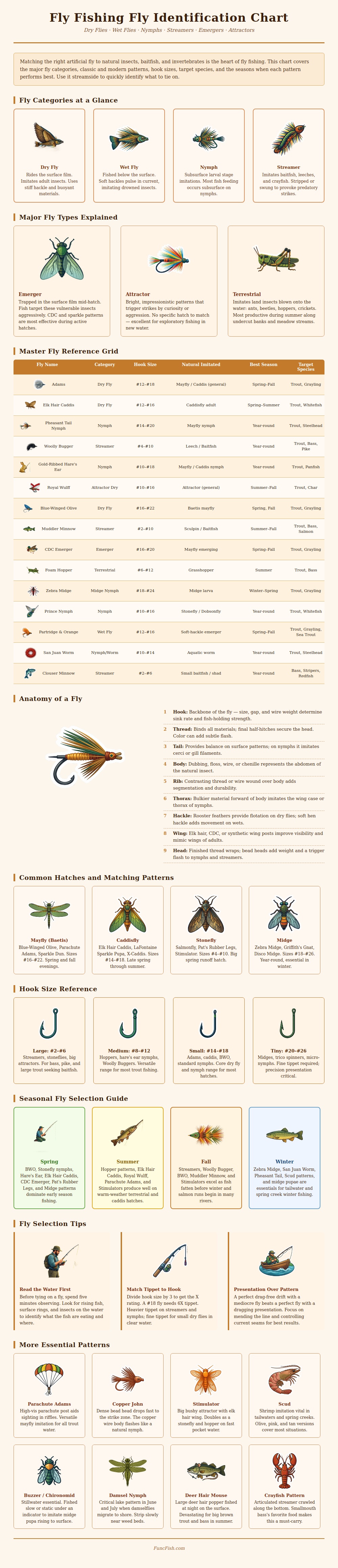
An identification chart is useful for understanding which type of fly you should use because the chart explain how each type of fly can be used to imitate the insects that live in the water. The chart can be used to organize the different types of flies and to understand the purpose of each type of fly. Dry flies are flies that remains on the surface of the water to imitate the insects that live on the water’s surface.
How to Choose the Right Fly
Wet flies and nymphs are types of flies that work in the portion of the water beneath the surface of the water to imitate the insects that live beneath the water. Streamers are flies that imitate larger prey fish like baitfish or leeches, and work best when anglers move them through the water. Emerger and terrestrial flies are types of flies that often fill gaps within the other categories.
Emerger flies mimic insects that become stuck on the surface film of the water, while terrestrial flies mimic insects that falls from the land into the water. Each of these categories has an important role in the fly-fishing process for these different types of fish. The reference grid on the chart display which type of fly or baitfish each type of fly imitates.
The Adams fly imitates mayfly and caddisflies, and can be used in both the spring and fall seasons. The Woolly Bugger is a fly that is used in the streamer category because it can mimic the appearance of a leech or small fish. These types of pairings between flies and the fish is essential to understanding how trout perceive these artificial flies.
Trout can see the movement, size, and profile of the fly, so knowing how each type of fly works in each category is essential. Finally, the seasonal column on the chart indicates during which time of year each type of fly is most active. The hook sizes for each type of fly are also categorized within the identification chart.
Flies with larger hooks has larger profiles and will sink faster in the water; these types of flies are used when targeting fish like bass or pike. Smaller hooks are used to keep the flies light and delicate and to avoid spooking the trout. Each of these hook sizes are categorized on the identification chart to allow anglers to understand which types of flies to use in what type of river.
For example, the hook size that works for one river may not be successful with another river due to the difference in size of the insects that live in those rivers. Beyond the type of flies that are categorized on the chart, the anatomy of each type of fly is also important. For example, the hackle on a dry fly can allow the dry fly to remain on the water’s surface.
The bead on a nymph will add weight and flash to the nymph. The rib on the body of a fly will help the fly to have a segmented look that the fish mimics. Each part of a fly has a specific function, and understanding each of these functions will help anglers understand that the flies are actualy a collection of different type of triggers.
Each type of fly has a different type of season when the fish are actively using those types of flies. For instance, mayflies, caddisflies, stoneflies, and midges are all types of flies and insects that live in specific seasons. Each of these types of insects can be emulated by specific types of flies, which allow anglers to match the fly that is emulated by the insect.
Thus, recognizing what type of insects the fish are using will allow anglers to select the correct type of flies. Beyond the specific types of flies, each type of fly may be used during specific times of the year. For instance, the spring season may feature nymphs and emergers because there is more runoff into the water that features these types of prey fish.
During the summer, terrestrial insects begins to populate the rivers. During the fall, fish may use streamer flies to gain additional weight before the winter months. During the winter, small midges and worms are targeted because these are the only types of prey fish that live during the winter months in the majority of rivers.
Each of these fly patterns can be recognized by the chart to allow anglers to understand the connection between the calendar and the fish. Beyond the information that is displayed directly on the chart, there is also a tips section for each category of fly. For instance, anglers should read the water before they tie on a fly; understanding what the fish are doing in the water will allow anglers to better mimic the prey fish.
Anglers can read the water by watching for the fish rises out of the water or by watching for the insects on the surface of the water. Additionally, anglers should match their tippet line to the size of their hook; a too-light tippet line will break when a large fish consume the flies, while a too-heavy tippet line will prevent the flies from performing naturaly in the water. These aspects of fishing for trout will improve the success of the anglers.
Finally, there are additional patterns to the identification chart, such as parachute posts or foam bodies to the flies. These additional flies are categorized on the chart for specific purposes, which is to solve the problems regarding the visibility of the flies or how long the flies will remain on the surface of the water. These additional types of flies are picked for these specific purposes to allow the flies to perform their necessary functions.
Thus, the identification chart for fish flies becomes a tool that anglers can use to enhance their skills. While the chart will not replace the time that anglers spend fishing, the identification chart will allow them to fish with less guess work.