Fishing Leader Knot Length Calculator
Estimate finished knot length, leader cut length, trimmed tag allowance, and rod guide clearance for real braid-to-leader and mono-to-leader knots.
📌Named leader knot presets
⚙Knot and leader settings
Leader knot length results
Full breakdown
📋Line material diameter grid
Braided PE
Fluorocarbon
Nylon Mono
Hard Mono
📐Reference tables
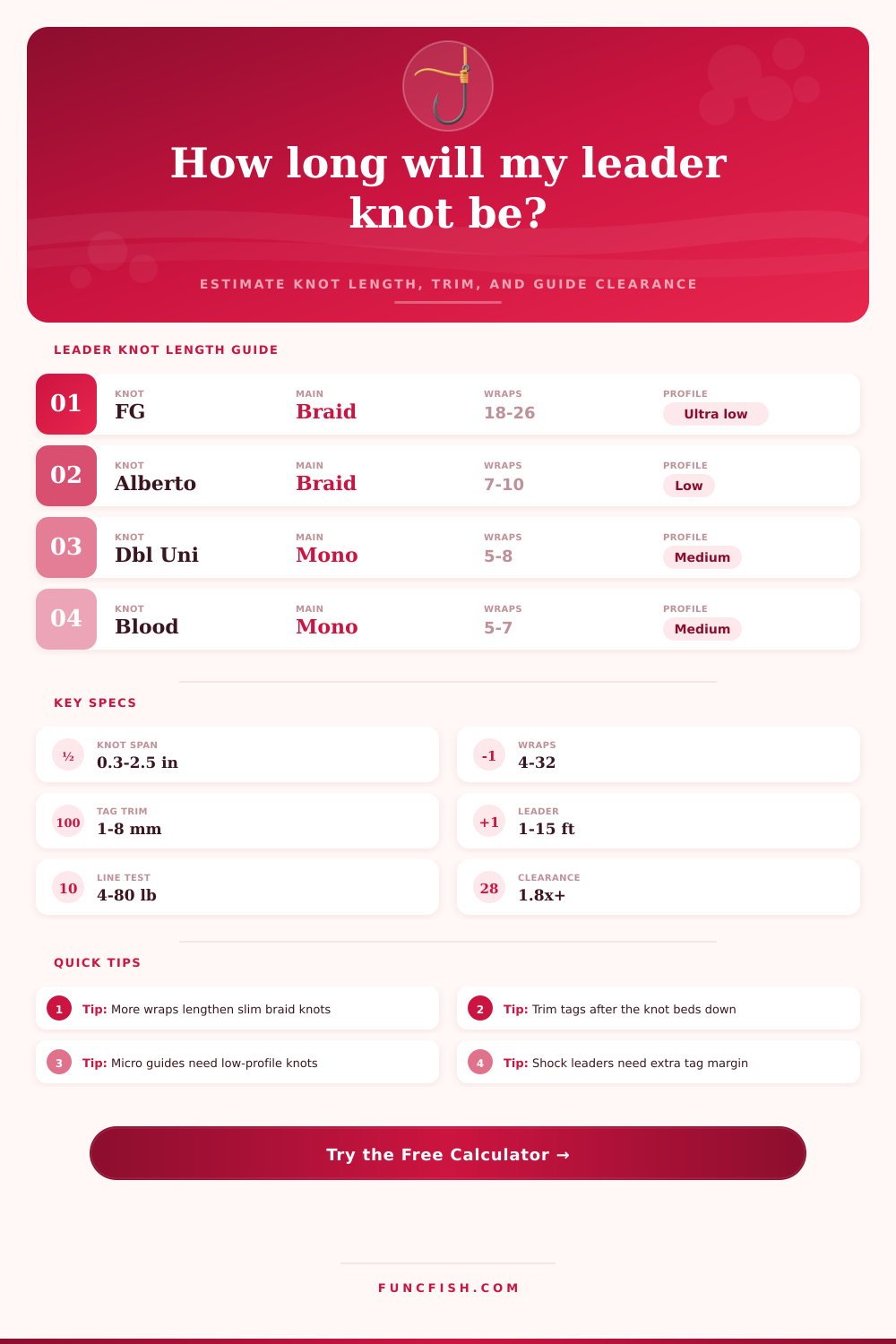
| Knot | Best mainline | Typical wraps | Guide profile | Leader use |
|---|---|---|---|---|
| FG Knot | Braid to fluoro or mono | 16-28 braid wraps | Ultra low | Long casting leader |
| Alberto Knot | Braid to fluoro or mono | 7-10 up and back | Low | Inshore and bass |
| Albright Special | Braid or mono to heavier leader | 8-12 wraps | Medium low | Shock and bite leaders |
| Double Uni Knot | Mono, fluoro, or braid mix | 4-8 per side | Medium | General leader joins |
| Blood Knot | Mono to mono or fluoro | 5-7 per side | Medium | Tapered leaders and tippet |
| Surgeon's Knot | Mono or fluoro tippet | 2-4 passes | Medium high | Fast tippet changes |
| PR Bobbin Knot | Braid to heavy leader | 28-50 bobbin wraps | Ultra low | Offshore casting |
| Leader role | Target length | Knot priority | Tag margin | Guide note |
|---|---|---|---|---|
| Finesse leader | 3-8 ft / 0.9-2.4 m | Small and straight | Short | Often through guides |
| General casting | 5-10 ft / 1.5-3.0 m | Balanced strength | Medium | Check tip and runners |
| Inshore abrasion | 2-6 ft / 0.6-1.8 m | Abrasion and bite | Medium | May stay outside tip |
| Surf shock leader | 20-30 ft / 6-9 m | Cast load safety | Long | Low profile matters |
| Offshore wind-on | 12-25 ft / 3.7-7.6 m | Heavy leader grip | Long | Rollers need clearance |
| Fly tippet | 1-4 ft / 0.3-1.2 m | Straight turnover | Short | Usually outside guides |
| Guide clearance | Ratio target | Best knot profile | Casting feel | Adjustment |
|---|---|---|---|---|
| Micro guides | 2.7x knot diameter | FG or PR | Very sensitive to tags | Trim close but not flush |
| Standard guides | 2.2x knot diameter | FG, Alberto, Albright | Usually clean | Keep wraps compact |
| Generous guides | 1.8x knot diameter | Most leader knots | Forgiving | Use strength priority |
| Outside guides | No pass needed | Any strong knot | Knot does not cast through | Prioritize reliability |
| Knot / leader grid | Fluoro leader | Mono leader | Shock leader | Clearance result |
|---|---|---|---|---|
| FG Knot | Excellent | Excellent | Good with care | Best through guides |
| Alberto Knot | Very good | Very good | Good | Low, compact barrel |
| Albright Special | Good | Very good | Very good | Moderate tag bump |
| Double Uni Knot | Good | Good | Fair when heavy | Noticeable twin barrels |
| Blood Knot | Good if diameters match | Excellent | Fair | Clean but not tiny |
| Surgeon's Knot | Fast and reliable | Fast and reliable | Bulky when heavy | Best outside guides |
💡Practical knot checks
Tip: If the finished knot clicks hard through the tip guide, shorten the leader so the knot sits outside the rod before casting or switch to a lower-profile knot.
Tip: Heavy fluorocarbon and hard mono need a slightly longer tag after tightening because stiff material can creep while the knot beds down.
When a leader knot is too long, there are several factors that contribute to an extra length of the knot. These factors include the number of wrap that are used in the knot, the length of the tag ends of the knot, the way in which the knot bed down when under tension, and the safety margin for casting. Most people only notices the length of the knot after the fishing rig is complete, especially if the leader is too short to reach the fish or too long to pass through a guides on the fishing rod.
These problems can be prevented by determining the correct length of the knot before begin to tie the knot. There are several different variables that can be entered into the leader knot calculator. The type of main line that you will use and the type of leader material are two of the most important variable to enter into the calculator.
Why Leader Knots Get Too Long and How to Prevent It
Braid will compress more than fluorocarbon and monofilament lines, thus requiring more wraps for the same amount of tensile strength of the line. The purpose of the leader will also impact the amount of length that is required for the knot to hold true. For instance, if the purpose of the leader is to be a finesse leader, then the knot will be shorter than a surf shock knot, which must be able to handle the extra force of being cast from the surf.
The number of wraps is one of the setting for the knot that will impact the length of the completed knot. By increasing the number of wraps, the strength of the knot will increase. However, the length of the knot will also increase with the number of wraps that is added to the knot.
The size of the guides on the fishing rod is another of the variables that must be consider. The diameter of the knot must be smaller than the opening of the guides on the fishing rod; otherwise, the knot will become stuck on the fishing rod. The leader knot calculator considers this measurement so that the angler can determine if the knot will pass through the guides.
Some of the environment variables in the water can also impact the behavior of the fishing line and the strength of the knot. For instance, the temperature in the water will impact the stiffness of fluorocarbon lines. The salt crystals in the water will also impact how braid grip onto the other materials within the knot.
Additionally, the constant tension upon the line when trolling will cause the knot to bed down and reduce the length of the leader. These variables are accounted for in the casting style setting on the leader knot calculator. Knots that must stand up to hard casts and loads, like surf casts, will require more margin for safety in the length of the cut leader than those that is pitched or trolled.
Some of the most common mistakes that anglers can make is to treat every knot as if it is the same as every other knot. For instance, an FG knot will have a slim profile when tied correctly, whereas a blood knot will have a thicker profile due to the way that the wraps of the knot sit beside one another rather than in a spiral shape along the leader. The reference tables on this page list the type of knots that will work best for certain types of main lines and leaders.
Additionally, the amount of tag ends that are left on the knots will impact the strength of the knot as well as how it will move through the guides. One of the best ways to prevent length-related problems with leader knots is to incorporate a few simple steps into the knot-tying process. After the knot is complete, load the knot onto the fishing rod.
Measure the length of the completed knot and compare the size of the knot to the smallest guide on the fishing rod. If the size of the knot is too large for the guide, then the angler should shorten the next piece of leader or use a different knot with a lower profile. By using the leader knot calculator prior to using the fishing rig with the fish, the angler can avoid these types of problems altogether.
By planning the length of each of the knots prior to going into the water, the angler can ensure that the rig will perform exactly as they have intend from the moment that it is first cast.