Fishing Dropper Loop Length Calculator
Size dropper loop arms, branch spacing, branch load, and rig balance from the rig type, species, current, leader strength, mainline material, and snag risk.
📌Dropper rig presets
⚙Rig inputs
Dropper loop length forecast
Balanced branch geometry for your selected rig.
Full breakdown
📊Rig and species comparison grid
Surf Double
Pier High-Low
Reef Chicken
River Dropper
Panfish
Flounder
Snapper
Cod
📋Reference tables
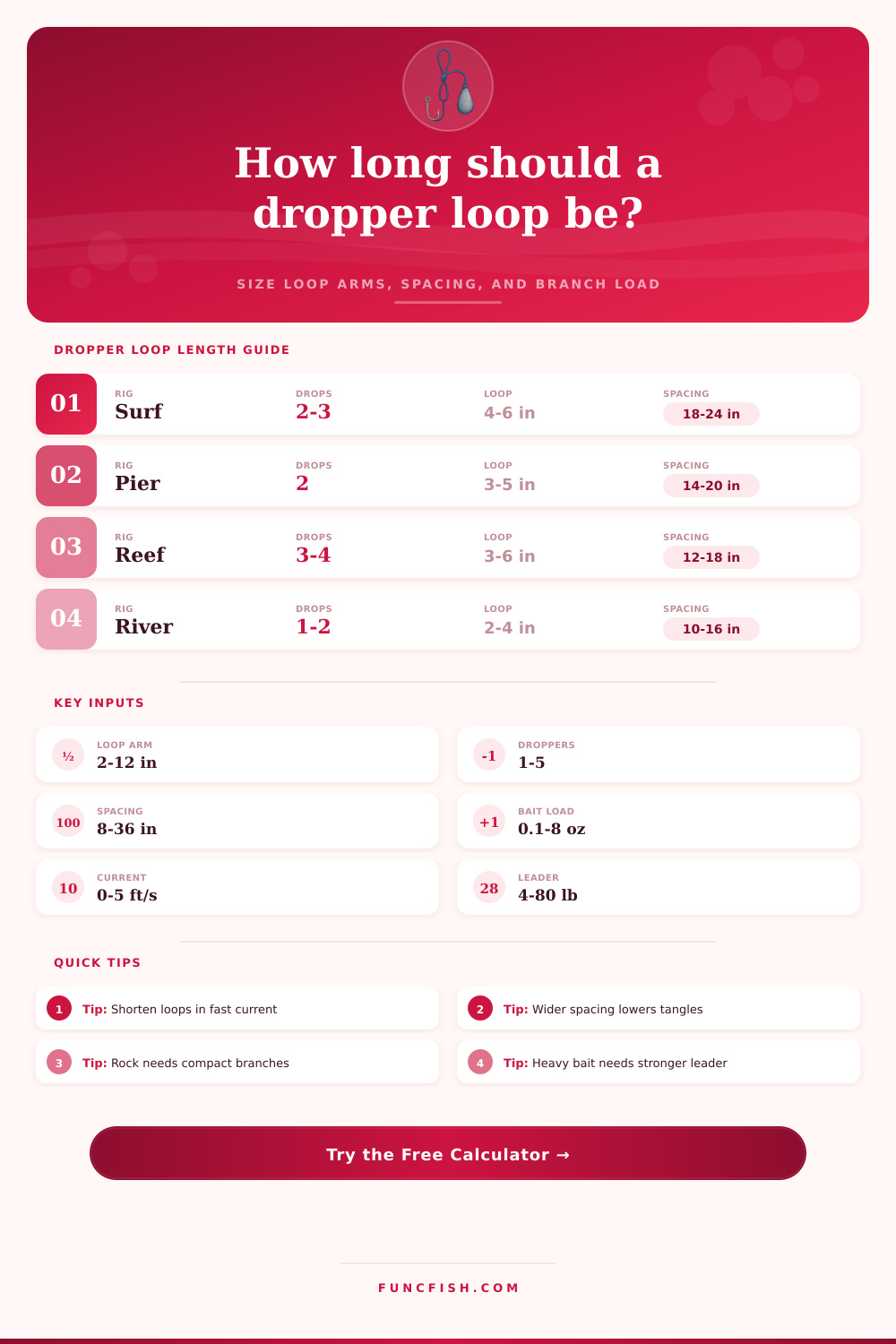
| Rig type | Typical droppers | Loop length | Spacing target |
|---|---|---|---|
| High-low rig | 2 | 3-5 in / 7.6-12.7 cm | 14-22 in / 35.6-55.9 cm |
| Paternoster | 1-2 | 3-6 in / 7.6-15.2 cm | 12-24 in / 30.5-61 cm |
| Chicken rig | 3-4 | 3-6 in / 7.6-15.2 cm | 12-20 in / 30.5-50.8 cm |
| Surf double drop | 2-3 | 4-6 in / 10.2-15.2 cm | 18-28 in / 45.7-71.1 cm |
| River drift dropper | 1-2 | 2-4 in / 5.1-10.2 cm | 10-18 in / 25.4-45.7 cm |
| Target species | Loop tendency | Spacing tendency | Leader window |
|---|---|---|---|
| Panfish / perch | Short and tidy | Close spacing | 4-8 lb / 1.8-3.6 kg |
| Trout / walleye | Moderate | Medium spacing | 6-12 lb / 2.7-5.4 kg |
| Flounder / redfish | Longer sweep | Open spacing | 12-25 lb / 5.4-11.3 kg |
| Snapper / sea bass | Compact power | Medium spacing | 15-40 lb / 6.8-18.1 kg |
| Cod / striped bass | Longer load arm | Wide spacing | 25-60 lb / 11.3-27.2 kg |
| Mainline material | Stretch feel | Loop behavior | Calculator adjustment |
|---|---|---|---|
| Monofilament | High cushion | Forgiving, slightly springy | Adds small load buffer |
| Fluorocarbon | Moderate | Stiffer branch, fewer wraps | Shortens loop slightly |
| Braid mainline | Low stretch | Direct pull, more wrap risk | Adds spacing buffer |
| Wire bite leader | Very stiff | Needs compact geometry | Shortens loop strongly |
| Shock leader | High buffer | Handles surf loading | Adds load allowance |
| Snag risk | Bottom example | Loop adjustment | Spacing adjustment |
|---|---|---|---|
| Low | Sand or mud | Baseline or longer | Open spacing allowed |
| Medium | Shell or grass | Slightly shorter | Keep branches separated |
| High | Rock or dock legs | Short and compact | Moderate spacing |
| Extreme | Reef or timber | Shortest practical loop | Enough room to clear knots |
💡Rig checks
Tip: If two baits touch when the rig swings, increase branch spacing before lengthening every loop.
Tip: In rock, reef, or timber, a shorter loop often fishes cleaner than a longer branch with the same bait.
The distance between the hook and the mainline on a fishing rig is criticaly to understand and is also the distance that determines whether the fishing rig will tangle with the bottom. If the dropper loop is too close to a knot, it will become entangled during the retrieve. However, if it is too far from the knot, then it will snag on rocks or grass and the fishing rig will be lost.
The angler must set the length of the dropper loop to the correct length to allow for the movements of the bait in the current, even distribution of the weights of the branches of the fishing rig, and to provide enough room for the fish to take the bait without the fishing rig catch on itself. The dropper loop calculator will provide an angler with a recommendation based on the specific inputs that the angler enter into the calculator. The various inputs requires the rig style, the species of fish to be caught, the speed of the current, and the strength of the fishing leader.
How to Choose the Right Dropper Loop Length
Each of these inputs will impact the recommendation that the dropper loop calculator makes. For instance, the high-low rig that is used for light surf will have different recommendations than a high-low rig that is being used for a reef environment since shorter loops will reduce the chance of the fishing rig getting wedged between stones on the sea floor. Additionally, live bait will be required to be swept in wider arc when targeting striped bass when the same leader is being used to target snapper species that are also attracted to these same structures in the water.
The current speed will change the requirements of the fishing rig. The faster the water movement in the fishing spot, the shorter the dropper loop will be required for the bait to remain in the strike zone of the target species. Additionally, there must be enough space between the branches of the fishing rig so that the two hooks will not fold together due to the drag of the water.
The dropper loop calculator will account for the current speed by shortening the recommended length of the dropper loop if the current is set to a faster speed. While the dropper loop calculator can offer numbers to anglers to avoid having to estimate the drag coefficient of the fishing rig, the angler will have to make a decision as to whether the recommended length is appropriate for the fishing location. Anglers must take into consideration the type of leader that will be used in the fishing rig because the leader material will impact the performance of the fishing rig.
For instance, monofilament will stretch so that it will offer forgiveness to an angler should a fish surge into the bait. Fluorocarbon will be stiffer than monofilament so the loops made of fluorocarbon will be more rigid and the knot will be tighter. Finally, a braid main line with a wire bite will be the stiffest type of fishing rig so it will require the shortest dropper loops.
These materials will impact the performance of the fishing rig but not in dramatic way individually. However, these differences will become more important when fishing in areas with snag risks. The behavior of the fish species that will be targeted will impact the length of the dropper loop.
Each species will dictate the ideal length of the dropper loop. For instance, panfish and perch species will require the fishing rig to be more compact since the bait will only take short pecks at the bait. In contrast, flounder and redfish will require the dropper loop to be longer to allow the species to sweep the sandy sea floor.
Cod and striped bass will require the longest dropper loops due to the size of the bait that these species use and the strong currents that the species require to travel through. Snag risk is another variable that many anglers dont think about but which will ultimately determine how much space there is between the fish hooks on the fishing rig. If the location of fishing is on clean sand, there will be more space between the hooks.
However, if the area to be fished has rocks or dock pilings in it, there will have to be shorter loops. The dropper loop calculator will take into account the snag risk of the location. However, the angler may have to shorten the dropper loop by hand to account for any specific issues that may be present in the targeted fishing spot.
The reference tables will help anglers understand the recommendations of the dropper loop calculator. They are especially helpful in that they allow the angler to adjust the weight of the bait to make sure that the spacing recommendation is appropriate for that species of fish. The dropper loop calculator will provide the angler with a recommendation for the length of dropper loops but the angler will have to make small adjustments to the fishing rig based on the movements of water in the targeted fishing spot.