
Panfish are a type of fish that almost every person who begins to fish as a pastime will encounter. Panfish are often the first type of fish that a person will catch when beginning to fish. Panfish will bite even when other types of fish will not bite, and panfish will fight with a surprising amount of strength for there small size.
Because of the strength of the panfish when being caught, panfish has the potential to transform an average fishing afternoon into an afternoon that a person will always remember. Whether a person is a six-year-old child who is learning how to fish with a simple cane pole, or an adult who is near retirement and who fishes with a custom ultralight fishing rig, panfish provide activity and entertainment for people of all age. The term panfish applies to a variety of different species of fish, each of which have a tendency to grow to a size that is good for being cooked in a frying pan after a person has completed there journey to the water.
Many newcomers to fishing are unaware of the different behaviors that each type of panfish exhibits. Many newcomers are unaware of the locations where each type of panfish like to live, and the actions that must be taken to catch each of these types of panfish. If a person learns of the specific behaviors of each of the main species of panfish, that person will be able to select the type of fishing tackle that they will use when fishing for panfish, as well as which locations in which to fish.
This will allow a person to avoid frustration at fishing locations where the panfish will not bite. The following list includes the most common panfish species that live in North America, as well as the specific methods for catching each of these species. Bluegill is considered to be the most important species of panfish due to the various reasons for which bluegill fish are among the most desirable of panfish species.
Common North American Panfish Species to Catch
1. Bluegill
Bluegills have saucer-shaped bodies, they have bright orange bellies, and the flap of bluegills ears are black in color, all characteristics which make them easy for a person to recognize when lifted out of the water. During the spring season, bluegills begin to establish nests in shallow water. Consequently, these nesting areas become a location where large groups of bluegills can be found.
If a person places a worm into a bobber, or if a person casts a tiny jig into these nest locations, a person will be rewarded with bites from bluegill fish. Furthermore, because bluegills are an excellent species of fish for children to catch and hold, bluegills also provide entertainment for adults. However, bluegills rarely grow to sizes over ten inches in most water bodies.
2. Pumpkinseed Sunfish
Pumpkinseed sunfish have bodies adorned with bright turquoise spots, as well as wavy, worm-like markings along the laterals of their bodies. Pumpkinseed sunfish prefer to live in lakes that contain numerous weeds and gravel bottoms, where they hunt for snails and small crayfish species. Because the mouths of pumpkinseed sunfish are small in comparison to other species of sunfish, someone must use smaller bait items in an attempt to catch these panfish.
For example, a size 10 hook adorned with a piece of red worm will be appropriate for catching pumpkinseed sunfish. Pumpkinseed sunfish dont live in tight groups like bluegill fish, so more area must be covered in search of these species. However, their bright colors and strong fishing behavior make them desirable to anglers.
Consequently, pumpkinseed sunfish are a desirable species for anglers that seek to catch a type of panfish that is different than the typical bluegill.
3. Redear Sunfish
Redear sunfish, also called shellcrackers, use the teeth located in their throats to crack the shells of snails and mussels. Redear sunfish have deeper bodies than bluegill fish, and the ear flaps of redear sunfish contains a red or orange edge.
Redear sunfish live in water depths that are deeper than other types of sunfish, and often live in areas outside of the nesting beds of those species. Furthermore, redear sunfish will bite on weighted crickets or mussel pieces when fished along the bottom of the water body in which they live. Because redear sunfish can grow to sizes of twelve or fourteen inches in length, which is more than other species of sunfish, they are desirable for anglers that wish to land a large panfish.
However, redear sunfish tend to become more difficult to catch as the water temperatures rises above seventy-five degrees.
4. Crappie
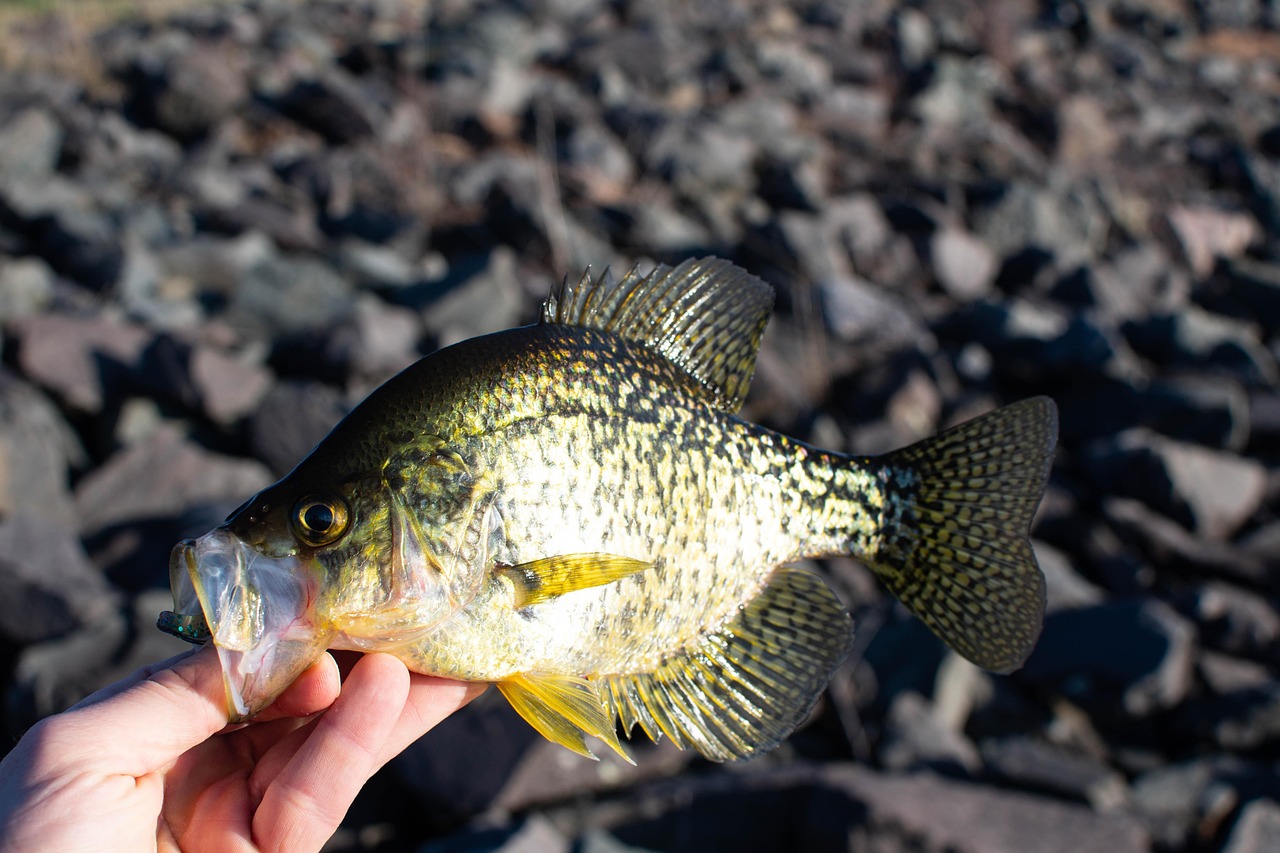
Black crappie and white crappie may appear to be similar species, but exhibit different behaviors. Black crappie species have spots of black on their bodies that contrast against the silvery green of their bodies, and are found in clear waters with alot of submerged trees and branches.
White crappie species have vertical bars on their bodies, and can be found in water that is murkier than clear water. Both species of crappie live in groups around areas with similar features, such as brush piles, docks, or submerged trees. Furthermore, both species will take a small curly-tail jig or a live minnow that is moved through the submerged areas.
Crappie species can grow to sizes of fifteen inches or more in length. Consequently, when a crappie species hits a light fishing rod, it feels like a large fish. However, the precise depth at which crappie live must be located; if a person misses the depth at which crappie live by as little as two feet, the fish will be missed.
5. Rock Bass
Rock bass may appear to be small bass fish, but have a surprised look to their faces. Rock bass have red eyes and dark stripes on their bodies, color characteristic that allow for their recognition. Rock bass live near rocky shoreline, rocky banks, or near dams.
Unlike most panfish species, rock bass will bite on larger pieces of bait. Additionally, rock bass will also bite upon the presence of small crankbaits or spinners. Consequently, anglers who prefer to use lures rather than bait prefer rock bass.
However, rock bass rarely grow to sizes over ten inches in length. Furthermore, rock bass have a preference for warm water, which allows them to be caught during the summer fishing season alone.
6. Warmouth
Warmouth species are the “tough” fish among the panfish family.
Warmouth species have large mouths, heavy bodies, and mottled coloring that allows them to hunt for prey in the same manners as bass fish. Warmouth species live in areas like lily pads or sunken logs. Because warmouth species have such large mouths, the size of the hook and bait may be increased beyond the size necessary for species like bluegill.
For instance, a person may cast a small popper lure onto the water’s surface during the dawn hours to catch warmouth species. Warmouth species do not live in tight groups of other warmouth species. However, the catching of each individual warmouth species is an accomplishment to the angler that successfully lands the fish.
The only disadvantage to warmouth species are the sharp gill plates of the fish, which may cut a persons thumb if they are not careful.
7. Yellow Perch
Yellow perch is often the most underrated of the panfish species. Yellow perch species have bright golden colored sides to their bodies, as well as black vertical bars that cross their bodies.
These panfish species live in groups in deeper waters during the summer season, and live in large numbers in the northern lakes of North America. A small jig adorned with a perch eye or a piece of worm will be effective when bounced along the lake bottom where schools of yellow perch live. Because yellow perch species grow to lengths of six to ten inches, and because they tend to bite upon the presence of anglers, people are able to fill a cooler with yellow perch fish in a short amount of time.
Furthermore, because yellow perch live in schools, only one location must be fished in order to experience the enjoyment of catching fish. This type of fishing is helpful for anglers on cold autumn days when other fish species will not be biting.
8. Green Sunfish
Green sunfish have bodies that are stockier than bluegill species, have larger mouths than bluegill species, and have an overall more aggressive attitude towards anglers.
Green sunfish live in streams, farm ponds, or any water with low amounts of dissolved oxygen to the water. Green sunfish will bite on almost any type of bait or lure that is small enough to fit into their mouths. For instance, tiny topwater plugs will work to catch green sunfish.
Because green sunfish are able to accommodate for different types of bait and lures, green sunfish species are an excellent species to teach another person how to fish. Green sunfish grow to a maximum size of around eight inches in length. Each of the panfish species that live in North America provide an individual fishing experience for the angler.
On some fishing trips, an angler may find themselves chasing crappie fish around submerged trees. On other fishing trips, a person and their child may fish near a bluegill nest. The benefit of panfish species is that the same type of fishing rod and tackle can be used to catch each of these panfish species.
All that a person needs to know is the type of panfish species that is most likely to live in the same area as where the angler will fish. Therefore, a person should collect a group of size eight fishing hooks, a few tiny jigs to use when fishing for panfish, and ensure that there neck is protected from the sun with a hat or sunglasses. Panfish species are waiting for the angler, and they do not care for the age or experience of the angler that shows up at the water’s edge.
All the angler must do is show up at the water and pay attention to what is happening in the water. By showing up at the water’s edge and paying attention to the panfish species, a person of any age can expect to encounter new knowledge of panfish species each trip.