
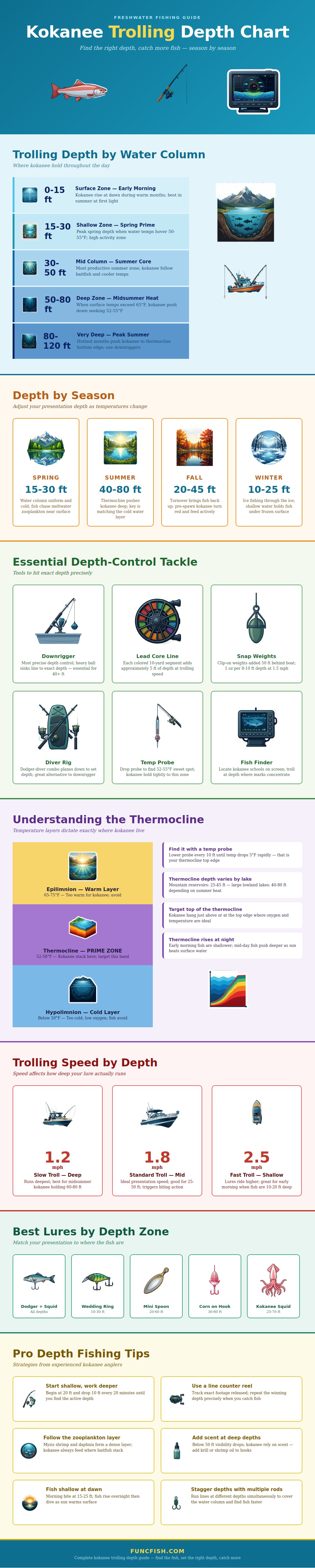
Kokanee are a specific type of trout, but they dont behave in the same ways as other types of trout. Kokanee trout require a narrow range of water temperatures to survive. Therefore, Kokanee move to different depth in the water column in response to changes in the water temperature.
Because Kokanee change depths according to the temperature of the lakes waters, anglers must place there bait into a correct slice of the water column to succeed in catching these fish. Without placing the lure into the correct slice of the water column, Kokanee will not be caught. A chart that maps the depth of the lakes different temperature slices throughout the year allow anglers to create a plan for their fishing efforts rather than guess where to find the fish.
Where Kokanee Trout Live and How to Catch Them
The top slice of the lakes water column is only home to Kokanee during the early hours of summer mornings. The fish is seen rising to the surface to eat during these early hours. However, the Kokanee fish drop to the deeper portions of the lake once the sun heat the surface of the water.
Spring is one of the easiest season to catch Kokanee fish because the temperature of the lake is cold and uniform throughout the spring season. During this time, the Kokanee trout are forced to remain in shallow waters. Once the spring season begins to transition into summer, however, the surface water begin to warm.
The Kokanee follow the cooler temperatures into the depths of the lake. The fish move based off the presence of a thermocline in the lake. A thermocline is a layer of water where the temperature drop rapidly with increasing depth in the water.
The Kokanee stay near the top of this thermocline because this portion of the water contains the amount of oxygen and water temperatures that the fish need to survive. Additionally, zooplankton is found in abundance near the thermocline, forcing the Kokanee to remain in this depth range to eat. The depth of the thermocline within the lake can vary depending upon the type of lake.
For instance, the thermocline is deeper within lowland lakes than it is within mountain reservoirs. To find the thermocline, anglers can drop a temperature probe into the water every ten feet. When the temperature drop is found, the thermocline has been located.
Therefore, anglers should set the fishing lines just above the thermocline to allow the lures to enter the same area as the Kokanee. A variety of tackle can be used when fishing for Kokanee fish. Downriggers are one tackle option that allow anglers to have exact control over the depth at which their bait will travel, which is helpful when the Kokanee are at depths of sixty or seventy feet.
However, downriggers are not necessary in the spring season when the Kokanee are found near the surface of the lake. Anglers can use lead core lines and snap weights to adjust the depth of the fish finders line. Additionally, fish finders display a visual map of the lake and where the fish are located.
Anglers should monitor the fish finder to find dense marks on the screen. The depth of the lures should be adjusted to match the depth of the marks on the screen. Additionally, the speed at which the anglers troll their lines will impact the depth at which the lures will fall.
Slow trolling speeds will cause the lures to travel to greater depths in the lake. Therefore, slow trolling speeds are beneficial during midsummer when the Kokanee are deep in the waters. Faster trolling speeds will cause the lures to stay higher in the water column.
Thus, trolling at faster rates is helpful when fishing at dawn or during the fall when the Kokanee travel to the shallower portions of the lake. The type of lure that is used when fishing for Kokanee fish depend upon the depth at which the Kokanee are located. A dodger and a squid bait combination is effective at all depths because the flash of the dodger and the scent of the squid bait remain effective even in areas of low visibility.
Wedding ring and small spoon baits are effective only in shallow waters where the Kokanee are very aggressive in their attacks on the bait. However, corn and squid bait is best used in depths of fifty feet or less. Using corn and squid bait in these depths works because Kokanee fish rely upon their sense of smell instead of sight when locating baits at depths of fifty feet or less.
The size and type of lure should be matched to the depth of the Kokanee fish. Therefore, the depth will indicate which lure the angler should use to catch the Kokanee. One of the mistake that many anglers make is staying at one depth in the water for extended periods of time.
At the beginning of the day, anglers should begin fishing in areas of shallow water. Then, the angler should drop the depth every twenty minutes by ten feet until the Kokanee are caught. Once the correct depth is found, the angler should remain at that depth.
A line counter reel will help the angler to stay on the same depth with every pass of the fishing lines. However, if not using a line counter reel, anglers may have to guess the depth at which the Kokanee fish is located. Anglers that guess at the depth of the Kokanee may fish either ten feet above or ten feet below the location of the fish.
Winter can create changes in fishing techniques for Kokanee. During the winter months, ice covers the lake, and fishing is performed on the ice. During this portion of the year, the fishing should be performed in shallow waters because the entire lake drops to cold temperatures during the winter.
In the winter, the Kokanee fish hold in the bottom of the lake near the ice. Therefore, the surface of the ice is the top layer of the water. The depth at which the Kokanee fish live is a moving target that changes based upon the amount of light and temperature in the lake.
However, if anglers use a chart to determine where the Kokanee are during different times of the year, their behavior will be easy to predict. Youll find that the depth changes alot.