Fishing Sinker Egg Weight Calculator
Size an egg sinker for sliding rigs using current speed, depth, bait weight, line diameter, line test, bottom type, target species, cast distance, and leader length.
🎯 Egg Sinker Presets
⚙ Sliding Rig Inputs
Egg Sinker Recommendation
Results appear after the calculator reads your rig and water inputs.
Calculation Breakdown
🧰 Egg Sinker / Rig / Species Grid
Finesse Egg
Creek Slider
All-Around Egg
River Contact
Channel Egg
Surf Slider
Heavy Current
Deep Hole Egg
📊 Egg Sinker Holding Range
| Egg sinker size | Metric equivalent | Best water | Typical sliding rig use |
|---|---|---|---|
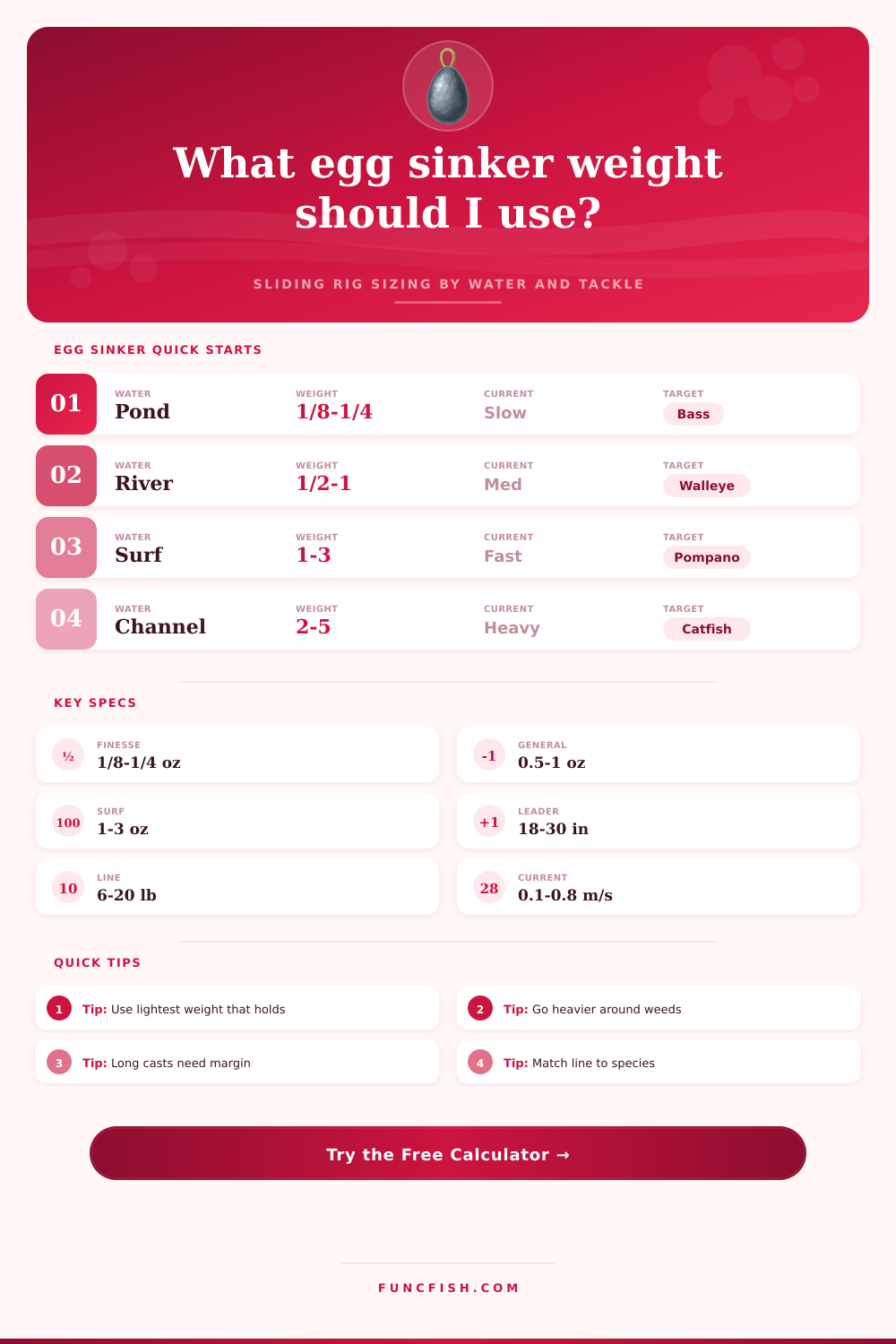
| 1/16 to 1/8 oz | 1.8 to 3.5 g | Ponds, creeks, very slow current | Trout drift eggs, small live bait, finesse bass |
| 3/16 to 3/8 oz | 5.3 to 10.6 g | Light flow, shallow flats, short casts | Carolina rigs, flounder creeks, light slip rigs |
| 1/2 to 1 oz | 14 to 28 g | Moderate rivers, lake points, deeper edges | Walleye slip rigs, bass Carolina rigs, carp ledger rigs |
| 1 1/2 to 3 oz | 43 to 85 g | Channels, inlets, long casts, moving tide | Fish finder rigs, redfish, pompano, catfish |
| 4 to 8 oz | 113 to 227 g | Heavy surf, deep holes, strong river flow | Large bait sliding rigs where current control matters |
🔗 Sliding Rig Matching Table
| Rig type | Weight behavior | Leader range | Good match |
|---|---|---|---|
| Carolina rig | Moderate contact with clean sliding | 18 to 36 in / 46 to 91 cm | Bass, walleye, flounder on sand or gravel |
| Slip sinker rig | Balanced bottom feel with low resistance | 12 to 30 in / 30 to 76 cm | Live bait, carp, catfish in mild current |
| Fish finder rig | Heavier casting and tidal hold | 20 to 48 in / 51 to 122 cm | Surf species, redfish, pompano, striper |
| Running ledger rig | Stable bottom hold with a sliding main line | 10 to 24 in / 25 to 61 cm | Catfish, carp, drum in channels |
| Drift egg rig | Light touch that ticks along bottom | 8 to 20 in / 20 to 51 cm | Trout, smallmouth, creek presentations |
🐟 Species Starting Points
| Species | Starting egg sinker | Line test range | Common leader length |
|---|---|---|---|
| Trout | 1/16 to 1/4 oz / 1.8 to 7 g | 4 to 8 lb / 1.8 to 3.6 kg | 8 to 20 in / 20 to 51 cm |
| Bass | 1/8 to 3/4 oz / 3.5 to 21 g | 8 to 17 lb / 3.6 to 7.7 kg | 18 to 36 in / 46 to 91 cm |
| Walleye | 1/4 to 1 oz / 7 to 28 g | 6 to 12 lb / 2.7 to 5.4 kg | 18 to 48 in / 46 to 122 cm |
| Catfish | 1 to 5 oz / 28 to 142 g | 12 to 40 lb / 5.4 to 18 kg | 10 to 30 in / 25 to 76 cm |
| Surf species | 1 to 4 oz / 28 to 113 g | 10 to 30 lb / 4.5 to 14 kg | 20 to 48 in / 51 to 122 cm |
🧵 Line And Bottom Adjustment Table
| Factor | Lower weight tendency | Higher weight tendency | Calculator adjustment |
|---|---|---|---|
| Line diameter | Thin braid below 0.20 mm | Heavy mono or wire above 0.45 mm | Diameter adds drag as current and depth rise |
| Bottom type | Soft mud or clean sand | Rock, weed edges, or shell bars | Rough bottoms need more hold but slide less cleanly |
| Bait profile | Small worms, eggs, small minnows | Cut bait, crab, large live bait | Bait weight and drag lift the required egg size |
| Cast distance | Short pitches under 20 yd / 18 m | Long casts over 60 yd / 55 m | Longer casts get a margin so the rig lands cleanly |
💡 Egg Sinker Tips
Sliding feel: If fish drop the bait, reduce the egg sinker one size or shorten the leader so the rig transmits less resistance during the pickup.
Bottom contact: If the rig sweeps too fast, increase one standard size before changing the whole rig. Egg sinkers work best with steady, not excessive, contact.
An egg sinker must be of a correct weight to ensure that the bait stay within the strike zone. If the egg sinker are too light, the currents will move the bait away from the fishes. If the egg sinker is too heavy, the egg sinker will pin the bait to the bottom and prevent it from move naturaly in the water column.
To determine the correct egg sinker weight, a fisherman must consider the current, the depth of water, the type of fishing line being use, and the type of bottom that is being fished. Using an egg sinker calculator will allow a fisherman to determine the correct weight for the egg sinker. The speed of the current is one of the most important factor to consider when determining egg sinker weight.
How to Choose the Right Egg Sinker Weight
There may be a light breeze on the water surface, but there may be a strong current near the bottom of the water column. Such a current will create drag on the fishing line and the egg sinker. Egg sinker calculators accounts for the current by factoring in the current and water depth in the calculator.
The deeper the water, the more exposed the fishing line will be to the current. More exposed fishing line to the current indicates that a heavier egg sinker are required. The depth of the water will impact the movement of the bait in the strike zone.
In shallow waters, such as four feet deep, a lighter egg sinker will allow the bait to naturally roll in the water column. However, in deep water, such as twenty feet deep, a light egg sinker may cause the bait to lift off from the bottom of the water column. To avoid this occurrence, egg sinker calculators must weigh the depth of the water against the strength of the current in the water.
The weight of the bait and the profile of the bait will impact the drag of the fishing rig. For example, a small bait, such as a worm, will add very little drag to the fishing rig. A large bait, such as a crab, will add significant drag to the fishing rig.
The egg sinker calculator takes into account the type of bait being use. The fisherman must account for the type of bait because it will change the drag of the fishing rig. The diameter of the fishing line and the material of the fishing line will also create some drag for the fishing rig.
For instance, braided fishing lines are known to cut through the water more easy than monofilament lines. However, braided lines will transmit more vibrations to the fishing rod. Fluorocarbon lines will sink more quickly than other lines, but they may also create more resistance in deep water.
The egg sinker calculator takes into account these variable in the final recommendation for egg sinker weight. The type of bottom that is being fished will also impact the weight of the egg sinker. For instance, soft mud bottoms will allow a fisherman to use a light egg sinker to allow the egg sinker to dig into the bottom.
Rock or shell bottoms may cause the egg sinker to bounce off from the bottom. Weeds may also cause the egg sinker to get stuck on the bottom. Egg sinker calculators must take into account the type of bottom being fished.
Some species of fish will require different egg sinker weights than other species. For instance, some fish species will prefer that the bait move slow through the water column, while other species will prefer the bait to make short hops in its path. A long leader will hide the weight of a heavy egg sinker, but it may also cause the fishing line to tangle with the current.
Egg sinker calculators consider these variable to arrive at a suggested egg sinker weight. Another factor to consider is the distance that the fishing line will have to be cast. Using too light of an egg sinker for a long cast may cause the fishing line to bow out of the water and the bait to leave the bottom where the fish are residing.
To account for this, egg sinker calculators may include a small amount of weight to account for long casts of the fishing line. The reference tables will indicate common sizes for egg sinkers, the type of fishing rig to be use with each size of egg sinker, and the species of fish that have been found to have a preference for each size of egg sinker. These tables are provided as a helpful tool to the fisherman and should not be relied upon as the sole means of determining egg sinker weight.
Using an egg sinker calculator will allow a fisherman to stop using trial and error to determine the correct egg sinker weight. The fisherman will understand how each of the variables will impact the egg sinker weight. This knowledge will be of great help to the fisherman should the fishing condition change.
The egg sinker calculator will suggest a size for the egg sinker. This size will be the minimum weight that the egg sinker must have to maintain contact with the ocean floor. The egg sinker calculator will also include a margin for holding the egg sinker to the ocean floor.
This margin is the amount of extra weight that the egg sinker can take before it will begin to move in an unnatural way to the fish. A modest margin for holding the egg sinker is used so that there is some extra weight to account for sudden changes in the current. A large margin for holding the egg sinkers will cause the bait to begin to move in an unnatural way in the water.
The goal of the egg sinker is not to use the heaviest egg sinker, but the lightest egg sinker that is capable of performing the task. Therefore, the lightest egg sinker should be used that works in the current, the depth of the water, with the fishing line, and with the type of ocean floor being fished. By understanding each of the factor that influence egg sinker weight, a fisherman can make a calculated choice about the weight of the egg sinker that will be used during a fishing trip.
Its going to be a lot of help when your out on the water.