
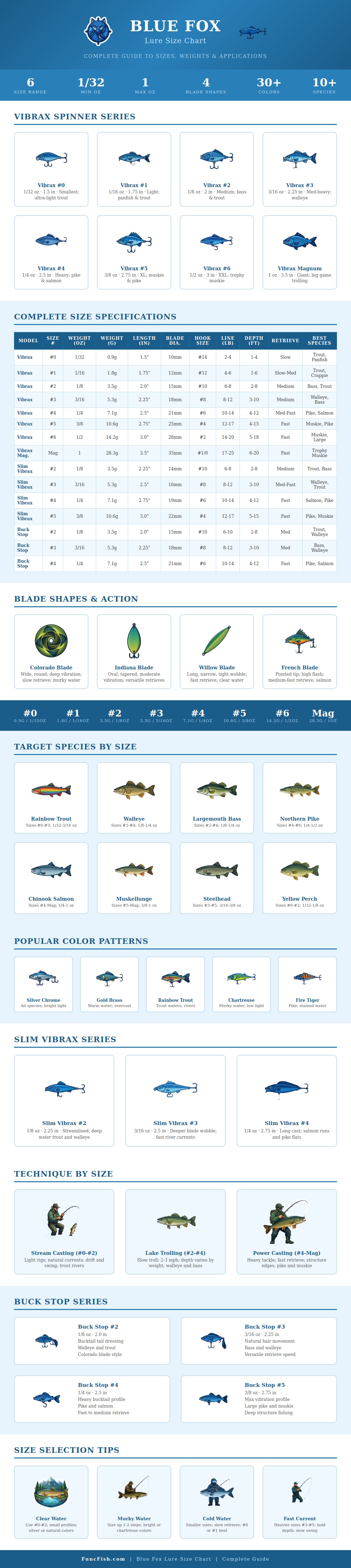
When you go fishing, the size of the lure you use is a critical factor in your fishing effort. The size of the lure will determine how the fish will react to the lure. At Blue Fox, we offer lures of many different sizes.
To be successful with the Blue Fox lures, you must choose the correct size of lure for your water conditions and the species of fish that lives in those waters. Many people tend to ignore this factor when choosing a lure, but the size of the lure you choose will have to match your water conditions, the light in the water, and the species of fish you want to attract to your bait. The Vibrax series of lures come in many different sizes.
How to Pick the Right Lure Size, Shape and Color
The smaller Vibrax lures will create a small amount of flash and vibration. This small amount of flash and vibration will attract trout or panfish since these species of fish eats tiny insects and minnows. As the size of the Vibrax lure increases, the blade of the lure and the weight of the lure will also increase.
Larger Vibrax lures are created for larger predator fish species or for those waters that are deeper in relation to the size of the lure. Using a size of Vibrax lure that is correct for smallmouth bass in a creek might not be correct for catching pike in a bay with many plants that cover parts of the bay floor. In this case, the size chart will help ensure that the lure size you choose matches your fishing environment.
In addition to the size of the lure, the shape of the blade of the lure is another important factor. The size chart includes four different blade shapes. The Colorado blade will create a wide vibration of the lure that can be felt in the murky water.
Using this blade type will help when fishing in water where the fish are sluggish in there movements. The Willow blade will spin faster and create more flash than the Colorado blade. The faster spin and more flash will allow the fish to spot the lure if the water is clear.
The Indiana blade is an intermediate blade between the Colorado and the Willow blades. The French blade will create a different flash pattern to the fish and anglers who are trying to catch salmon use it. Each of these blade shapes has a different function in the water, so understanding each function will allow anglers to target specific fish species.
The color of the lure is another factor that must be chosen. The size chart displays the popular colors for each lure for solving specific fishing problems. The silver chrome lure will reflect a lot of light when the days are bright with sunlight.
For the gold lure, the color shows up more clearly when the sky is overcast with clouds or when the water has a warm tint to it. The chartreuse and Fire Tiger lure colors is helpful when fishing in stained water. The fish will see these colors when the natural colors of the water cannot be seen.
While the color of the lure will not cause the fish to bite if they do not want to, choosing the correct color of lure will not prevent the fish from being attracted to the lure. Not all species of fish will respond to the same sizes of lures. For instance, the lighter end of the weight of the lure will attract trout and perch fish.
For muskie and large pike fish, the heavier end of the lure models will work best since they can travel farther with the heavier lure. For species like walleye and bass fish, the middle sizes of the lure will work best for catching these species of fish. The size chart also displays the Slim Vibrax and the Buck Stop models of lures.
Each of these has a different profile to the Vibrax lures for specific situations where a standard Vibrax lure will not work as well. The technique for reeling in the lure will also change with the size of the lure. Smaller Vibrax lures will work best with a light rod and a slow retrieve speed for the lure since the current will move the lure.
For the larger Vibrax lures, faster retrieves will work best. Additionally, larger lures can be trolled behind a boat since they will not sink too deep or spin the fishing line when the boat moves them. If an angler is using a size four lure when a size one lure is required for the fishing spot, the angler is making an error in fishing technique.
Using the wrong size of lure will result in the angler catching no fish at all. The condition of the water also affects the size of lure that the angler should select. For clear waters, using lures with smaller profiles and using subtle colors for the lures will keep the fish from getting spooked by the bright colors.
For stained water or fast-moving water, using a larger size of lure will allow the lure to stay in the strike zone for the fish and will allow the lure to commote enough to get the attention of the fish. In cold water, the fish will be moving more slowly, so using smaller sizes of lures and using a slow retrieve rate will work best for catching the fish. The size chart for the Vibrax lures allows anglers to reference the appropriate size of lure for their specific fishing situation.
The main purpose of the size chart is to help anglers reduce the guesswork in selecting the proper size of lure for their catch. If anglers know the species of fish that they are targeting and the conditions of the water where they will be fishing, the size chart will reduce the number of lure sizes to the best options for the angler. Instead of hoping that the lure will work when fishing, the size chart will allow anglers to ensure they are using the best size of lure available for their specific situation.