Gila Trout Weight Calculator
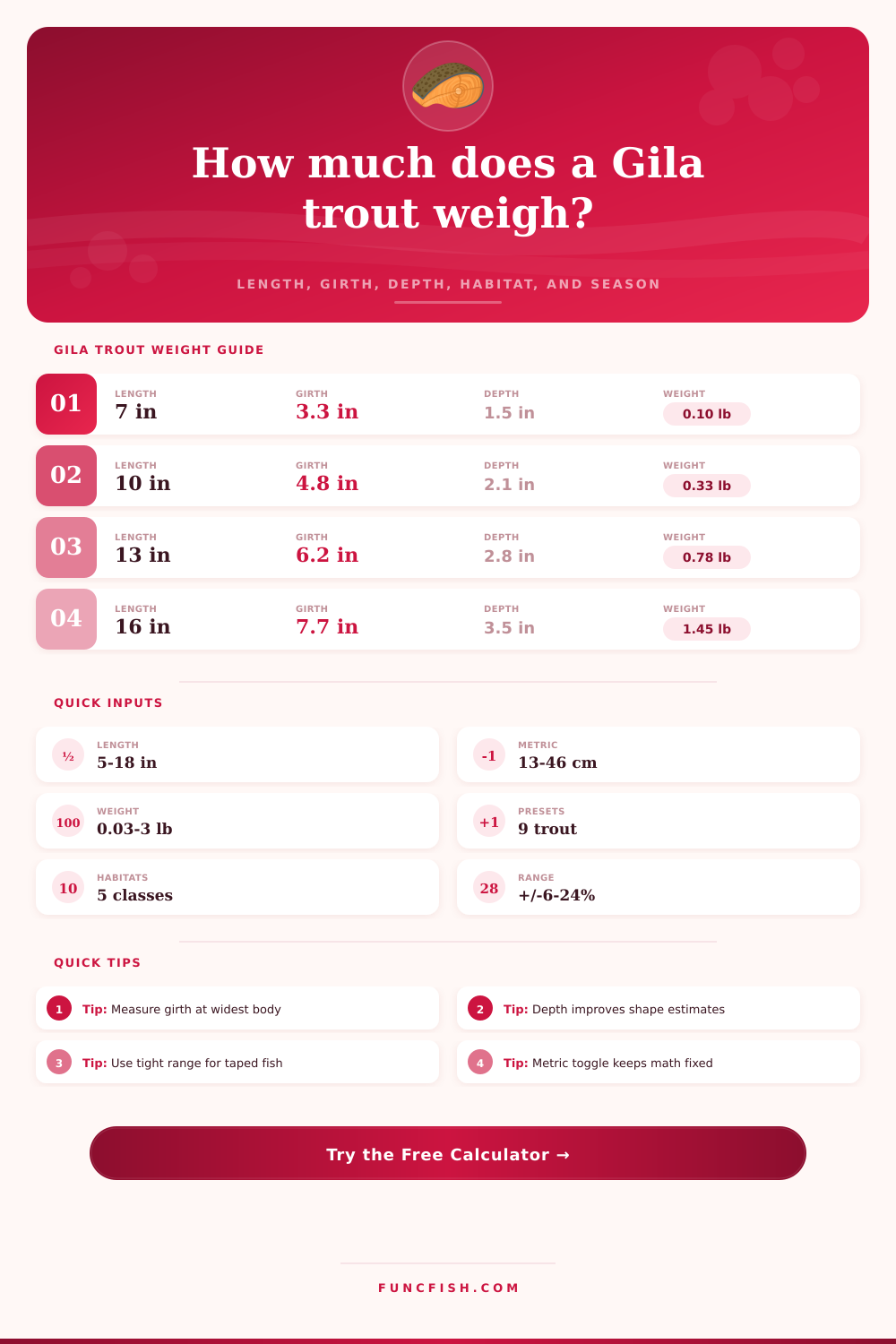
Estimate Gila trout weight from total length, maximum girth, body depth, condition factor, habitat class, stream gradient, seasonal forage, and measurement confidence.
📌Gila trout measurement presets
⚙Habitat, length, girth, depth, and condition inputs
Model: the calculator blends a trout length-girth estimate, a depth cross-check, and a Fulton-style condition factor, then adjusts for habitat class, stream gradient, forage season, and measurement confidence.
Gila trout weight estimate
Calculator output appears here after entering measurements.
Calculation breakdown
📊Gila trout habitat class data grid
Cold Headwater
Canyon Riffle
Meadow Pool
Spring Run
📐Gila trout comparison grid
Headwater Slender
Cool, narrow stream profile with longer frame and modest girth.
Canyon Runner
Balanced riffle fish with firm shoulders and average depth.
Meadow Pool Fish
Lower gradient pool profile with more girth per inch.
Spring Creek Fish
Steady forage profile that can carry a compact deep body.
Sparse Forage Fish
Thin body profile where length can overstate expected weight.
📋Gila trout reference tables
| Length class | Total length | Typical girth | Estimated weight |
|---|---|---|---|
| Fingerling-size sample | 5-7 in / 13-18 cm | 2.2-3.3 in / 5.6-8.4 cm | 0.03-0.12 lb / 14-54 g |
| Small stream trout | 8-10 in / 20-25 cm | 3.7-4.8 in / 9.4-12.2 cm | 0.16-0.34 lb / 73-154 g |
| Quality Gila trout | 11-13 in / 28-33 cm | 5.2-6.3 in / 13.2-16.0 cm | 0.45-0.82 lb / 0.20-0.37 kg |
| Large Gila trout | 14-16 in / 36-41 cm | 6.7-7.8 in / 17.0-19.8 cm | 0.95-1.55 lb / 0.43-0.70 kg |
| Very large sample | 17-18 in / 43-46 cm | 8.1-8.8 in / 20.6-22.4 cm | 1.7-2.5 lb / 0.77-1.13 kg |
| Habitat class | Weight factor | Neutral K | Shape note |
|---|---|---|---|
| Cold shaded headwater | 0.96 | 1.00 | Long, leaner, lower depth ratio |
| Canyon riffle-run reach | 1.00 | 1.04 | Balanced frame with steady current |
| Meadow pool complex | 1.06 | 1.10 | Deeper body and stronger girth clue |
| Spring-fed clear run | 1.08 | 1.12 | Compact frame with consistent forage |
| Warm-edge mixed reach | 0.94 | 0.98 | More variable body condition |
| Gradient and growth zone | Growth factor | Girth ratio clue | Use in calculator |
|---|---|---|---|
| Steep cold gradient | 0.94 | 0.42-0.46 | Trims weight for narrow, fast water fish |
| Moderate riffle growth | 1.00 | 0.45-0.49 | Baseline Gila trout length-girth profile |
| Low-gradient pool growth | 1.05 | 0.48-0.53 | Adds mass for fuller pool fish |
| Fertile spring-influenced | 1.08 | 0.49-0.54 | Adds mass when depth and K agree |
| Warm limited-growth edge | 0.93 | 0.41-0.48 | Widens range and lowers base mass |
| Season and forage | Adjustment | Condition clue | Confidence effect |
|---|---|---|---|
| Winter lean forage | 0.94 | Lower girth for length | Range widens slightly |
| Spring aquatic insect pulse | 1.02 | Improving body condition | Normal range |
| Summer terrestrial drift | 1.04 | Steady shoulder fill | Normal range |
| Monsoon drift pulse | 1.06 | Short-term fullness possible | Range widens slightly |
| Fall full-bodied condition | 1.08 | Highest seasonal body mass | Normal range |
| Sparse forage stretch | 0.90 | Low K and shallow depth | Range widens |
💡Measurement tips
Girth and depth tip: If girth is estimated from a photo, keep the confidence setting wider and use body depth as a supporting part of the model.
Condition factor tip: Use the custom K field when you already have a measured weight from a similar fish in the same habitat class.
This calculator is for weight estimation and measurement comparison only, using the measurements and habitat classes entered above.
Gila trout live in fragmented and demanding waters in the Southwest. Because Gila trout live in these demanding waters, it is necessary to be able to estimate the weight of a Gila trout. Gila trout typically grows slowly in their cold headwaters, but can be found in meadow pools where they has more room to grow.
Because Gila trout may be found in different types of water in the Southwest, a Gila trout of a specific length may weigh more in one type of water than it would in another type of water. Thus, specific measurements of a Gila trout (along with notes regarding the habitat of the fish) must be use to find the accurate weight of the fish. To estimate the weight of a Gila trout, three different measurements will be used: its length, girth, and depth.
How to Estimate the Weight of a Gila Trout
These three measurements are the shapes of the fish that will determine its mass. Length alone will not provide enough information to determine the weight of the fish, girth alone will not provide enough information to determine the weight of the fish, and depth alone will not provide enough information to determine the weight of the fish. However, if those three measurements are obtained, the calculator can accurately determine the weight of the fish.
Other factors that influence the weight of the Gila trout include its habitat class, gradient, forage season, and the condition factor of the fish. Its habitat class will account for the different growth rates of the Gila trout that live in different types of water. Its gradient and forage season will account for the fact that the weight of the Gila trout during a forage season will differ from its weight during a season without available forage.
Finally, the condition factor will provide a number that indicates whether the Gila trout is lean, average, or has good forage in its habitat. The most common measurements of a Gila trout are its length, girth, and depth. Length is the easiest of the three measurements to take on a measuring board or tape.
Next would be girth, but it is necessary to only measure the girth at the widest point behind the dorsal fin; measuring the girth near the tail of a Gila trout will provide an incorrect measurement of that dimension. Depth is the last of the three measurements that should be taken. Once length, girth, and depth have been measured, the calculator will use a length-girth formula and a depth cross-check to calculate the weight of the Gila trout.
Additionally, the calculator will use a Fulton-style calculation of the condition of the Gila trout to arrive at the estimated weight of the fish. The result of this calculation will be an estimate of the weight of the Gila trout along with a confidence band. The confidence band will be wide if any of the measurements were estimated rather than taken with a tape measure.
The confidence band provides an estimation of how confident the calculated weight is. With such a confidence band, if only length, girth, and depth are measured with a measuring board and tape, the confidence will be high and the confidence band will be narrow. However, if any of those measurements are estimated, the confidence in the weight will be lower, resulting in a wider confidence band.
Additionally, the calculator will include a calculation of the condition factor of the Gila trout. The condition index will show whether the weight of the Gila trout is similar to the neutral value for that species of trout. A score of one hundred indicates that the Gila trout has a typical weight for that species.
A score below one hundred shows that the Gila trout is lean, while a score above one hundred shows that the Gila trout has encountered good forage. The reference tables included in the calculator will show the weight factors for each habitat class of the Gila trout and how the girth of the fish may change with the gradient of the river reach in which it is found. These reference tables will allow an individual to understand why a twelve-inch Gila trout in a meadow pool may weigh more than a twelve-inch Gila trout in a headwater.
Additionally, the reference tables will allow individuals to understand how the Gila trout in the fall may weigh more than a Gila trout that is measured during a period of low forage. These factors are included in the calculator to account for seasonal differences in the weight of Gila trout. Common mistakes that many individuals makes when attempting to calculate the weight of a Gila trout is treating each fish as though it is the same.
For example, a Gila trout of any length in a stretch of water that does not contain much forage may weigh less than a Gila trout of the same length in a stretch of water that is home to abundant food for the fish. In this instance, the body profile selector can help individuals account for the body type of the fish. If an individual incorrectly selects a profile as “slender” yet the depth of the fish indicates that it has a deep body, the condition index will show the discrepancy and the confidence in the measurement will decrease.
Another common mistake is to not account for the confidence in the measurements that are used to calculate the weight of the Gila trout. For example, if the girth of the fish is estimated from a photo of the fish, the confidence in the weight of the fish will decrease; the same is true of if an individual guesses the depth of the Gila trout rather than measuring it. One of the most helpful results of these calculations is the weight of the Gila trout in relation to the habitat in which it was caught and during what season of the year it was weighed.
A twelve-inch Gila trout that lives in a canyon in the summer will have a different weight than a twelve-inch Gila trout that lives in a meadow pool in the fall. Additionally, the condition index will allow an individual to determine if any of the Gila trout in question has a typical body mass for its habitat. Thus, by measuring many Gila trout from various locations, individuals will be able to compare the body masses of those fish and determine what the average body mass is from each habitat class of Gila trout.
Patterns may emerge from the weight of each fish; however, they can only be found through measuring the weights of many Gila trout. For example, individuals may discover that Gila trout from headwater streams have lower girth measurements than Gila trout from pools. Additionally, it is possible to find that during the monsoon rains when there is an abundance of forage for the trout, the condition score of the Gila trout increases for a few weeks during the year.
These discoveries may be difficult for individuals to find without the use of this calculator. Another of the most important aspects of this calculation is its potential for consistency in the data that is recorded of Gila trout. Both individuals that wish to keep records of the fish and those that perform conservation work on Gila trout require consistent calculations of the weight of these species.
While the weight of a single Gila trout will not impact any conservation efforts, the trend of the weights of Gila trout in a specific area can inform those that perform conservation work on the species of any adjustments that may need to be made to the habitat for the survival of those fish. In addition to these conservation efforts, the calculations of Gila trout also have the potential to provide information regarding the health of the species, overall. Thus, while the weight of a single Gila trout may seem like an insignificant number, especially in the scope of the species’ existence, the ability to calculate the weight of each of these fish will allow individuals to better understand the “signature” of the Gila trout species.
Thus, not only will the calculations of Gila trout allow individuals to determine its weight, but they will also allow individuals to understand the meaning of those numbers and measurements.