Sockeye Salmon Weight Calculator
Estimate sockeye or kokanee weight from fork length, maximum girth, body depth, ocean or river phase, run stage, lake or ocean productivity, condition, and measurement confidence.
📌Sockeye and kokanee presets
⚙Form, phase, length, girth, depth, and confidence
Model: the calculator blends a salmon length-girth estimate, a body-depth cross-check, and a condition-factor estimate, then adjusts for sockeye versus kokanee form, ocean or river phase, run stage, productivity, and measurement confidence.
Sockeye weight estimate
Calculation breakdown
📊Sockeye measurement signals
Ocean Bright
River Fresh
Late Red Fish
Kokanee
🧬Salmon comparison grid
Sockeye
Deep red flesh, compact adult body, strong run-phase weight changes.
Kokanee
Resident sockeye form; lake productivity controls adult size.
Coho
Usually longer and less compact than sockeye at the same weight.
Chinook
Largest Pacific salmon; the same formula needs a heavier coefficient.
Pink
Smaller two-year salmon with stronger spawning-shape distortion.
Chum
Large head and leaner river body can reduce girth-based estimates.
📘Sockeye reference tables
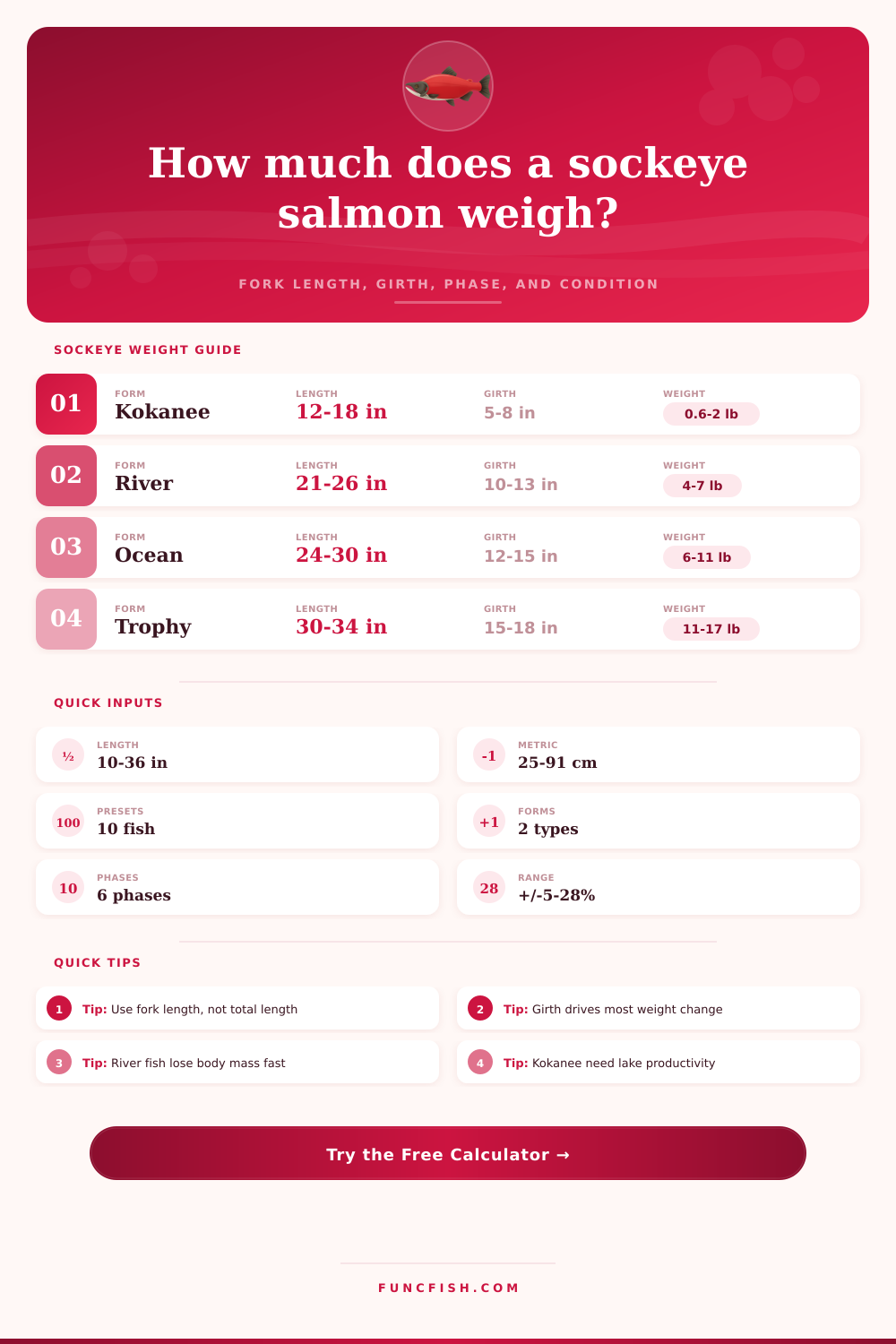
| Form and size class | Fork length | Typical girth | Approximate weight |
|---|---|---|---|
| Small kokanee | 10-13 in / 25-33 cm | 4.5-5.8 in / 11-15 cm | 0.3-0.8 lb / 0.14-0.36 kg |
| Good kokanee | 14-18 in / 36-46 cm | 6-8 in / 15-20 cm | 0.9-2.2 lb / 0.41-1.00 kg |
| Average adult sockeye | 22-27 in / 56-69 cm | 10.5-13.5 in / 27-34 cm | 4-8 lb / 1.8-3.6 kg |
| Large ocean sockeye | 28-32 in / 71-81 cm | 14-17 in / 36-43 cm | 9-15 lb / 4.1-6.8 kg |
| Exceptional sockeye | 32-36 in / 81-91 cm | 16-19 in / 41-48 cm | 14-20 lb / 6.4-9.1 kg |
| Ocean, river, or lake phase | Multiplier | Body cue | Best use |
|---|---|---|---|
| Ocean feeding or nearshore bright | 1.06 x | Full belly and shoulders | Chrome fish still carrying ocean reserve |
| Tidewater bright fish | 1.02 x | Firm deep body | Fresh run fish near salt water |
| Lower river fresh fish | 0.99 x | Slight travel loss | Early river estimate |
| Mid-river traveling fish | 0.94 x | Reduced belly mass | Several days into migration |
| Upper river holding fish | 0.88 x | Lean body behind shoulders | Long river travel |
| Spawning color or kype phase | 0.82 x | Shape distortion and weight loss | Late red fish or kyped male |
| Resident lake kokanee phase | 0.74 x | Smaller resident form | Kokanee with no ocean years |
| Productivity profile | Multiplier | Expected build | Use when |
|---|---|---|---|
| High-productivity ocean stock | 1.08 x | Thick shoulders and belly | Bristol Bay style ocean growth |
| Average coastal ocean growth | 1.00 x | Typical adult sockeye | Default for anadromous sockeye |
| Low-productivity ocean year | 0.93 x | Longer and slimmer | Poor feeding year or smaller stock |
| Large productive lake kokanee | 0.86 x | Large resident sockeye | Big lake kokanee populations |
| Clear low-nutrient lake kokanee | 0.70 x | Lean resident body | Oligotrophic lakes |
| Fertile reservoir kokanee | 0.92 x | Stocky resident fish | Reservoir forage is strong |
| Confidence setting | Base band | Measurement input | Calculator behavior |
|---|---|---|---|
| Excellent: board, tape, and girth | 5% | Direct fork length, girth, and depth | Tightest range |
| Good: careful field measurement | 9% | Reliable tape with normal fish movement | Standard field range |
| Fair: quick tape measurement | 14% | Fast tape or uneven fish posture | Wider range |
| Estimated girth or depth | 20% | One shape value estimated | Shape mismatch widens band |
| Photo or memory estimate | 28% | Indirect length or girth | Widest practical range |
All values are field estimates from measurements entered in the calculator; exact weight requires a calibrated scale.
💡Measurement tips
Fork length tip: Sockeye weight references usually use fork length. If you measured total length, expect the estimate to run high unless the tail fork is excluded.
Girth and phase tip: River sockeye can lose belly mass during migration. Recheck girth and run phase when comparing an ocean-bright fish with a red spawning fish.
Sockeye salmon carry weight that they build while living in salt waters. Yet, the weight of sockeye salmon change once those fish enter freshwater rivers. For instance, sockeye salmon may look quite large when they are in an ocean.
Yet, after those fish have traveled for one week, they may look leanly. The weight of sockeye salmon changes due to distance that they have traveled, the energy that they have spent traveling, and the quality of the water in which the fish lived. Thus, length is not the only measurement that indicate the weight of sockeye salmon; there are other measurements, as well, which must be provide in order to provide an accurate estimation of the weight of a sockeye salmon.
How to Estimate Sockeye Salmon Weight
One of the measurements that should be taken is the fork length of the sockeye salmon. The fork length is the measurement of the fish that is least affected by the tail fin. Additionally, it is also important to take the girth of the sockeye salmon.
The girth measurement will indicate the amount of body masses of the sockeye salmon that is located behind its fork length. For instance, a sockeye salmon with deep bellies will weigh more than a sockeye salmon with a slenderly body and the same fork length. Additionally, measuring the body depth of the sockeye salmon can help to determine if the salmon have traveled long distances; body depth can reveal if the fish is thin or hollow behind its shoulders.
Using these three measurements, the calculator will be able to provide an adjusted weight of the sockeye salmon. Beyond length, one of the variables to consider is the phase of the sockeye salmon. Sockeye salmon burns the body mass reserves of their own bodies in order to travel up rivers to spawn.
Thus, sockeye salmon in early phases will weigh more than those in late phases of their journeys. Because the sockeye salmon has traveled a long distance, it will weigh less due to the loss of belly mass. The reader must choose this phase in the calculator to reflect the body mass loss by the sockeye salmon.
If not choose correctly, the weight will be higher than the actual weight of the sockeye salmon. The productivity of the water in which the sockeye salmon grew will impact the weight. For instance, sockeye salmon from Bristol Bay will be thicker than those from smaller coastal systems due to the more productively oceans in Bristol Bay.
Additionally, kokanee, which are landlocked sockeye salmon, dont live in salt water. Instead, the weight of kokanee fish is dependent upon the fertility of the lakes in which they lives. Thus, the user must choose the productivity factor to prevent the weight from being incorrect calculated.
Additional factors that impact the weight of sockeye salmon are the condition and the sex of the fish. For instance, a male sockeye salmon will not have the same body mass as a female sockeye salmon of the same length. Additionally, a sockeye salmon that has traveled long distances may weigh less than an average sockeye salmon despite having the same length.
The calculator accounts for these factors to ensure the accuracy of the number provided to the reader. The tables located on the reference table portion of the calculator provide the same information as the calculator itself. Yet, they provide the information in a static format.
These tables allow for people to review how each of the factors impact the weight of the sockeye salmon. Many individuals often assume that length and girth are the measurements necessary to calculate the weight of a sockeye salmon. Yet, this is often not the case.
For instance, the shoulders of the salmon may be very thick, yet its belly thin. Thus, a single girth measurement may be misleading. Measuring the body depth of the sockeye salmon will allow for the weight of the fish to be calculated in a more accuratley manner.
The weight of the sockeye salmon can also be impacted by the confidence in the measurements. Using a board and tape to measure a sockeye salmon when it is calm will result in more accurate measurements than taking the same measurements of a sockeye salmon while it is move. Thus, the calculator provides a range of possible weights for the sockeye salmon to account for these inaccuracies in the measurements.
There are various ways to utilize this calculator. For instance, fishing guides may use the calculation to determine which sockeye salmon to keep and which to release. Biologists may use the measurement to calculate changes in the productivity of the oceans over time.
Additionally, anglers can use this information to determine whether the sockeye salmon that they caught is an average sockeye salmon, or one with unusual characteristics for that system of water. The calculator asks each of the variables of the reader due to the fact that length is only a guess as to the weight of the sockeye salmon. An estimate of the weight of the fish requires the use of fork length, girth, body depth, phase, productivity, and condition.
Each of these factors allow for the reader to compare the sockeye salmon that they are measuring to the average sockeye salmon.