Lingcod Weight Calculator
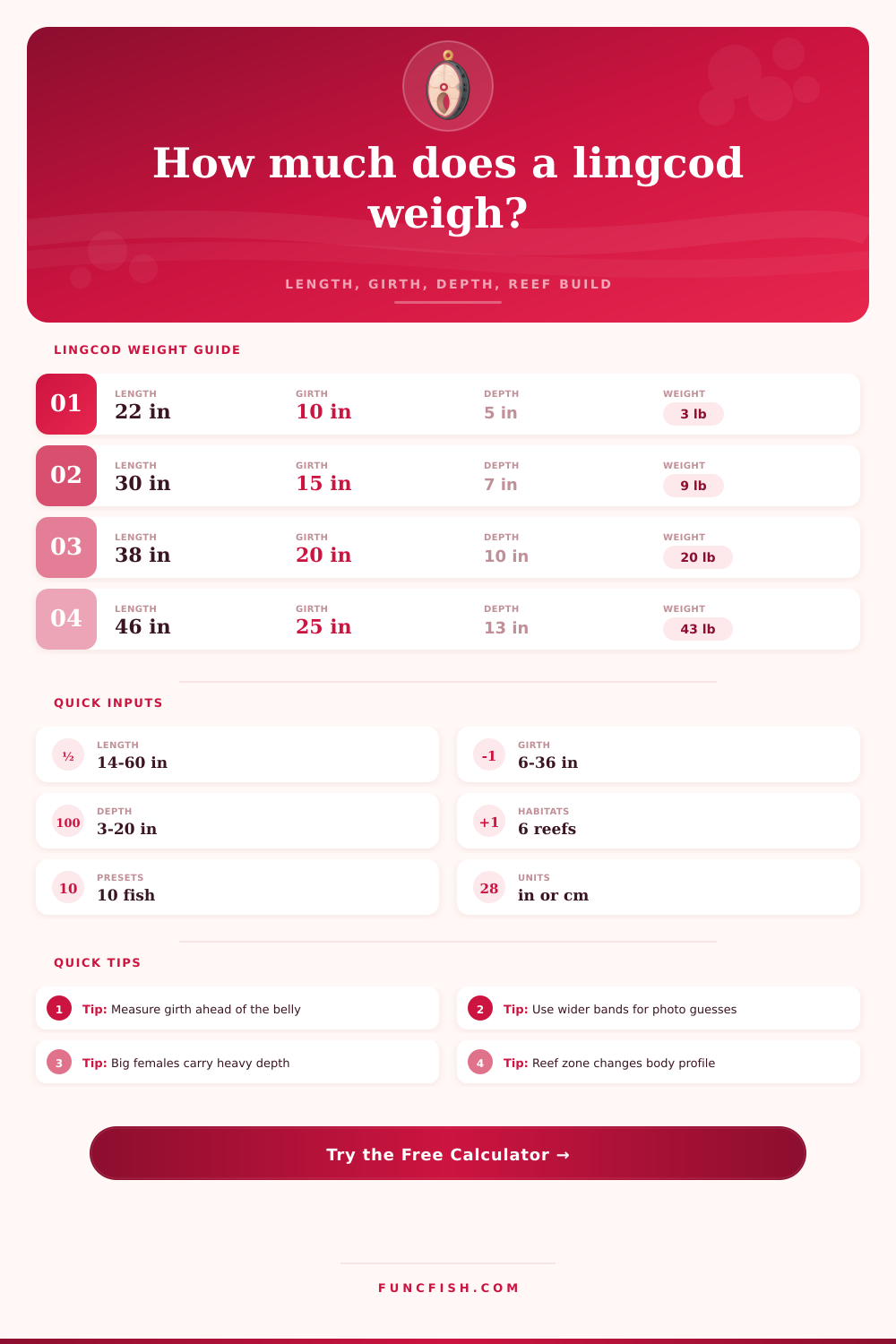
Estimate lingcod weight from total length, widest girth, body depth, nearshore or offshore reef habitat, sex and maturity, forage condition, water depth band, confidence, and units.
📌Named lingcod presets
⚙Lingcod measurements and reef profile
Model note: lingcod weight is estimated from a length x girth squared baseline, then cross-checked with body depth and adjusted for reef setting, maturity, forage, water-depth band, and measurement confidence.
Estimated lingcod weight
Results combine measured shape with lingcod reef biology and confidence range.
Full calculation breakdown
📊Lingcod calculator data grid
Length Window
Girth Weight
Depth Check
Range Width
🐟Lingcod, greenling, and rockfish comparison
Lingcod
Long-bodied reef predator with heavy head, strong shoulders, and girth-sensitive weight gain.
Greenling
Smaller nearshore fish with lower maximum depth and less abrupt girth-driven weight changes.
Rockfish
Deeper compact body where height and belly mass often change weight faster than length alone.
📘Reference tables
| Lingcod length | Typical girth | Typical body depth | Estimated weight band |
|---|---|---|---|
| 18 in / 46 cm | 7.0-8.5 in / 18-22 cm | 3.8-4.8 in / 10-12 cm | 1.2-2.0 lb / 0.5-0.9 kg |
| 24 in / 61 cm | 10.0-12.0 in / 25-30 cm | 5.2-6.4 in / 13-16 cm | 3.2-5.0 lb / 1.5-2.3 kg |
| 30 in / 76 cm | 13.5-16.5 in / 34-42 cm | 6.8-8.4 in / 17-21 cm | 7.0-11.0 lb / 3.2-5.0 kg |
| 36 in / 91 cm | 17.5-20.5 in / 44-52 cm | 8.8-10.6 in / 22-27 cm | 15-24 lb / 6.8-11 kg |
| 42 in / 107 cm | 21.0-25.0 in / 53-64 cm | 10.8-13.2 in / 27-34 cm | 28-44 lb / 13-20 kg |
| 50 in / 127 cm | 26.0-31.0 in / 66-79 cm | 13.5-16.5 in / 34-42 cm | 55-85 lb / 25-39 kg |
| Reef habitat | Weight factor | Expected shape | Calculator cue |
|---|---|---|---|
| Nearshore kelp reef | 0.98 x | Long frame, moderate belly | Good default for shallow reef fish |
| Jetty or boulder line | 1.00 x | Chunky shoulders, variable girth | Use tape girth if possible |
| Rocky nearshore slope | 1.02 x | Balanced reef profile | Stable blend of length, girth, depth |
| Offshore outer reef | 1.06 x | Fuller adult body | Often deeper than kelp fish |
| Offshore pinnacle reef | 1.09 x | Heavy ambush predator build | Girth and depth both matter |
| Deep shelf-edge reef | 1.08 x | Large-frame deep reef fish | Range widens with depth |
| Sex or maturity class | Multiplier | Depth cue | Use when |
|---|---|---|---|
| Juvenile lingcod | 0.90 x | Lower body depth | Short, slim nearshore fish |
| Immature reef fish | 0.96 x | Developing shoulders | Mid-size fish with modest girth |
| Adult male | 1.00 x | Strong head and leaner belly | Default adult estimate |
| Adult female | 1.06 x | Rounder belly line | Full adult with better depth |
| Large mature female | 1.13 x | Heavy depth and girth | Large fish with full body mass |
| Postspawn adult | 0.88 x | Reduced belly reserve | Lean fish after spawning condition |
| Forage or depth input | Effect | Range impact | Body signal |
|---|---|---|---|
| Winter lean reef forage | 0.93 x | Normal | Lower belly and narrower girth |
| Mixed baitfish and crab | 1.00 x | Normal | Balanced reef condition |
| Herring or anchovy full | 1.08 x | Slightly wider | Full belly and shoulders |
| Octopus and crab heavy | 1.06 x | Normal | Deep body and firm girth |
| 240-450 ft reef | 1.05 x | Wider | Large adults and depth variation |
| Photo or deck estimate | No weight boost | Wide | Use only as a field range |
This tool estimates field weight only. A calibrated scale is the only exact weight reference.
💡Measurement tips
Lingcod weight changes quickly when girth changes because girth is squared in the baseline formula. Measure around the fullest shoulder and belly area without compressing the fish.
A long lingcod with modest body depth should not be treated like a heavy offshore female. The depth input tempers estimates when the fish is long but flat.
To accurate estimate teh weight of a lingcod, additional factor beyond length have to be considered. The weight of a lingcod of a specific length can vary due to the habitat where the lingcod live, the food that it eat, and if it is carrying egg. The calculator use the length, girth, and depth of the lingcod to determine the weight of that lingcod.
Each of these measurement has an effect on the weight of the lingcod, which you must understand to properly use the calculator. The girth of the lingcod has a large effect on the weight. The girth is measured at the widest point ahead of the belly of the lingcod.
How to estimate a lingcod’s weight from measurements
If the girth is measured too far back on the body, the estimated weight will be too low. If the girth is measured too tight, the estimated weight will be too high. Furthermore, you can compare the girth to the girth of lingcod from various reef habitats.
Lingcod from a kelp edge can be leaner than lingcod from an offshore pinnacle reef habitat. This can influence the final estimate weight of the lingcod. Body depth can be used to ensure the accuracy of the weight of the lingcod.
A lingcod’s body depth measurement will help ensure that the weight estimate account for the fact that a long and thin lingcod will not have the same weight as a heavy female lingcod with a round belly. If the lingcod’s body depth measurement is lower than the value use in calculating the weight estimate, the weight will be lowered as well to ensure the accuracy of the estimated weight of the lingcod. Furthermore, the confidence in the weight estimation also change according to the measurement of the lingcod.
If the depth is measured using a tape measure, there will be a tighter range of possible weight. If the depth is guessed or estimated from a photograph of the lingcod, there will be a wider range of possible weights. The maturity and forage of the lingcod will impact the weight of the lingcod.
Large females will have more mass within their body than males of the same length. Furthermore, if the lingcod has eaten many small fish, it will have a fuller body than a lingcod that has eaten less. These biological factor will change the weight of a lingcod, and often change it enough to be important when the lingcod is near a size limit for that particular reef.
The location of the reef where the lingcod lives will impact the lingcod’s body shape. Lingcod from shallow kelp area will often be longer and have a moderate belly while lingcod that live on deep shelf will have more girth to their bodies. Lingcod on deep shelves are usually of an older age and eat larger prey fish.
This factor is included in the depth-band selector for the lingcod weight calculator. Due to the fact that different fish species require different measurement for estimating their weights, the lingcod must have its girth measure. Rockfish will require the body depth to be measured.
If the incorrect type of measurement is use for the species of fish that is being measured, an error will be made in the weight of that fish. The reference table will provide information on the weight of lingcod and rockfish of each length and maturity and forage condition. These tables will help to show why two lingcod of the same length and measurement could have different weight.
These tables will not replace a scale, but will allow for the estimation of the weight of the fish if a scale is not available. The weight of the head of the lingcod is also accounted for in the weight estimation. While the head of the lingcod is known to be heavy, the ratio of the head to the body change with the depth at which the lingcod live and the sex of the lingcod.
These parameter are included in the habitat and maturity settings so that the weight estimation does not have to calculate the weight of the lingcod’s head separately. This allow the weight of the lingcod to be estimated without having to measure the head of the lingcod. These number will help to make decisions regarding the lingcod.
If the lingcod is within the weight estimate with high confidence, it can be decided whether to keep or release the lingcod. Furthermore, if the weight of the lingcod is near the top of the estimated weight, it may be beneficial to measure the lingcod one more time before making a decision regarding the lingcod. These measurement will provide the decision maker with a specific number for the weight of the lingcod.
Thus, the weight measurement will translate into the weight of the lingcod as it live in its natural habitat on the reef.